Uma inornata
Coachella Valley fringe-toed lizard
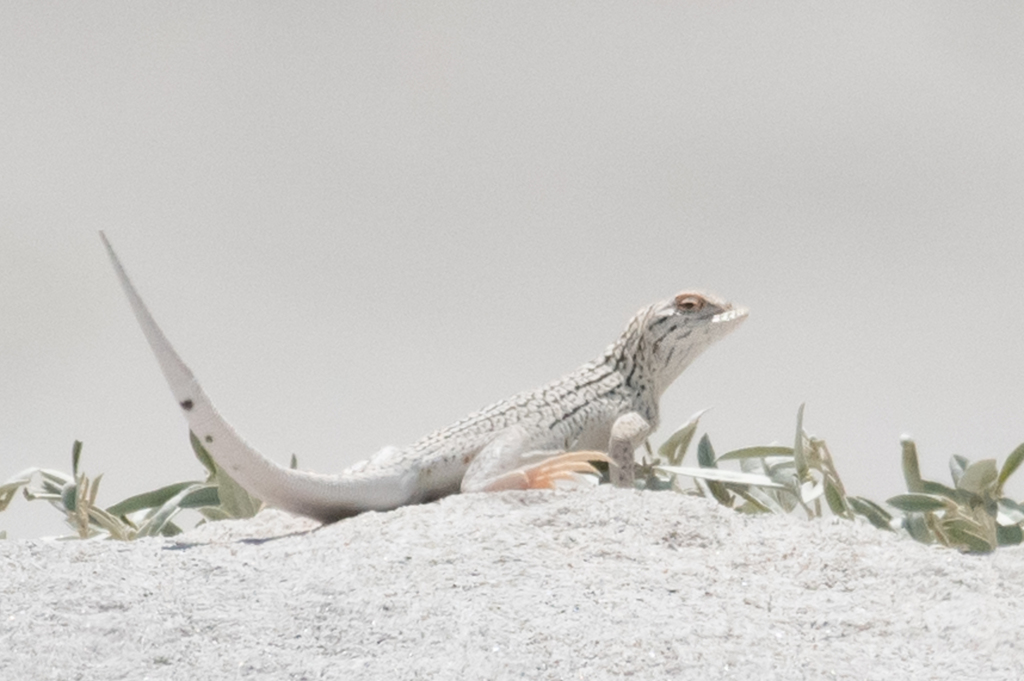
no rights reserved · CC0
Family: Phrynosomatidae · Class: Reptilia · Order: Squamata
Conservation status: SE · Threatened · G1Q S1
Uma inornata (Coachella Valley fringe-toed lizard) is a California animal in the Phrynosomatidae family.
The Coachella Valley fringe-toed lizard is a medium-sized lizard measuring 89 to 152 mm (3.5 to 6.0 inches) in total length, with adults typically weighing 8 to 14 grams. The species displays a pale sandy coloration with darker crossbands and spots that provide camouflage against desert sand. The most distinctive feature is the series of elongated, comb-like scales (fringes) along the toes of the hind feet, which provide traction for movement through loose sand. The body is laterally compressed with a wedge-shaped head, countersunk lower jaw, and overlapping eyelids that protect against sand penetration during burrowing. Historically, Uma inornata inhabited approximately 270 square miles of sand dune habitat throughout the Coachella Valley in Riverside County, California. The species' range has contracted significantly, with suitable habitat reduced to about 50 square miles, of which only 19 square miles continues to receive the natural sand deposition necessary for long-term viability. Current populations are restricted to scattered locations within the Coachella Valley, including areas protected within the 3,709-acre Coachella Valley National Wildlife Refuge and the 16,405-acre Coachella Valley Preserve system. The species requires active sand dune ecosystems characterized by fine, windblown sand deposits known locally as "blowsand." These habitats typically occur at elevations between 46 and 762 meters (150 to 2,500 feet) in desert washes and areas where prevailing winds accumulate loose sand. The lizards depend on areas with sparse vegetation, particularly creosote bush scrub communities, where sand movement is not impeded by dense plant growth. Substrate temperature and sand grain size are critical habitat parameters, with the species preferring fine sand that allows efficient burrowing. Coachella Valley fringe-toed lizards are insectivorous, feeding primarily on beetles, ants, flies, and other arthropods found in sand dune environments. They are active during daylight hours but avoid extreme midday temperatures by retreating beneath the sand surface. The species exhibits sand-swimming behavior, using lateral undulation to move through loose substrate. Reproduction occurs from May through July, with females depositing 2 to 6 eggs in sandy burrows approximately 10 to 20 cm deep. Eggs incubate for 45 to 60 days, with hatchlings emerging in late summer. The U.S. Fish and Wildlife Service listed the Coachella Valley fringe-toed lizard as threatened under the Endangered Species Act in 1980, with California designating it as endangered. Approximately 12,000 acres of critical habitat were designated at the time of federal listing. Primary threats include habitat loss and fragmentation from urban development, agricultural expansion, and off-highway vehicle activity. Invasive plant species alter sand movement patterns and degrade habitat quality. The Coachella Valley Multiple Species Habitat Conservation Plan, implemented in the 1990s, provides coordinated conservation efforts across the region, establishing preserves and managing sand transport corridors essential for maintaining viable lizard populations.
Classification
Class: Reptilia · Order: Squamata · Family: Phrynosomatidae
Conservation status
SE · Threatened · G1Q S1
Frequently asked questions
How is Uma inornata classified?
Uma inornata belongs to class Reptilia, order Squamata, family Phrynosomatidae.
What family does Uma inornata belong to?
Uma inornata is in the Phrynosomatidae family.
Is Uma inornata protected or of conservation concern?
Uma inornata carries the following status: SE · Threatened · G1Q S1.
What is Uma inornata?
The Coachella Valley fringe-toed lizard is a medium-sized lizard measuring 89 to 152 mm (3.5 to 6.0 inches) in total length, with adults typically weighing 8 to 14 grams.
Is Uma inornata found in California?
Yes. Uma inornata is recorded in California in The California Species Project's catalogue.
Related species
Other California species in the same genus, family, or bioregion.
Data from The California Species Project — 14,000+ California species with verified data from CNPS, CDFW, USFWS, and more.