Uma notata
Colorado Desert Fringe-toed Lizard
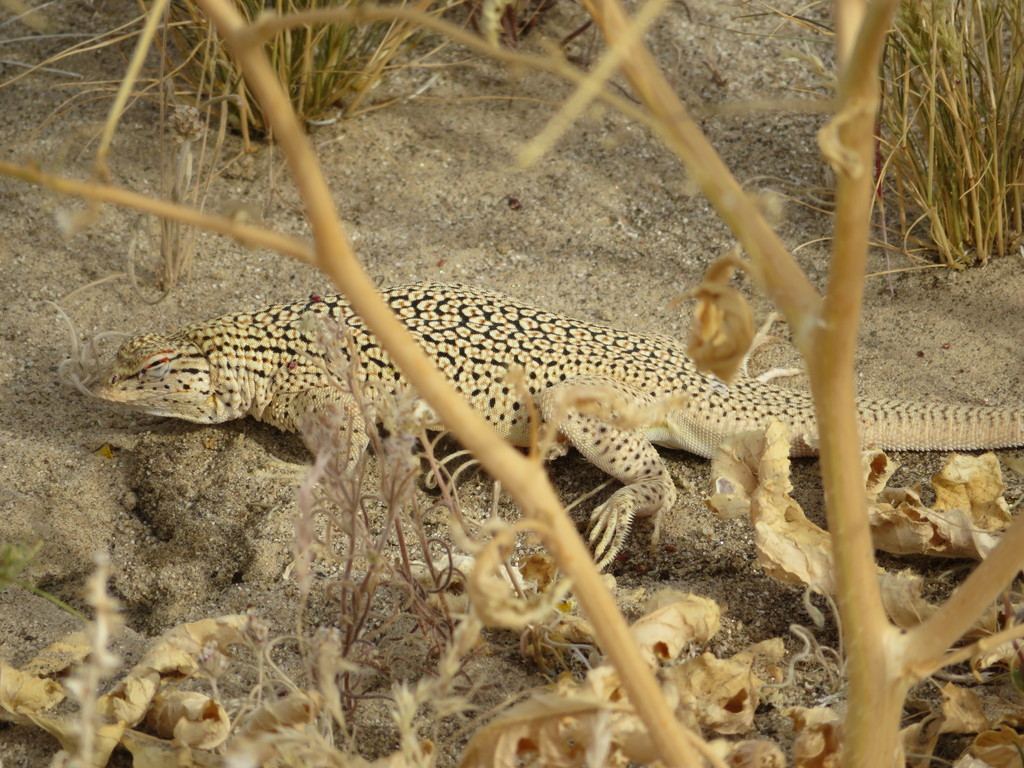
(c) kclarksdnhmorg, some rights reserved (CC BY) · licence
Family: Phrynosomatidae · Class: Reptilia · Order: Squamata
Conservation status: G3 S2
Uma notata (Colorado Desert Fringe-toed Lizard) is a California animal in the Phrynosomatidae family.
The Colorado Desert fringe-toed lizard (Uma notata) is a medium-sized lizard specialized for life in sandy desert environments. Adults typically measure 100 to 180 mm (3.9 to 7.1 inches) in total length, with females generally larger than males. The body is flattened dorsoventrally with a streamlined profile adapted for sand swimming. Coloration consists of pale gray to tan dorsal surfaces with darker crossbands or spots that provide camouflage against sand substrates. The belly is white or cream-colored. The species' most distinctive features are the elongated scales or "fringes" along the edges of the toes, which function as sand shoes to increase surface area for rapid movement across loose sand. Additional sand-dwelling adaptations include overlapping eyelids, valvular nostrils, and countersunk lower jaw. Uma notata occurs in extreme southeastern California within the Colorado Desert region of the Sonoran Desert. The species ranges from the Salton Sea and Imperial sand hills east to the Colorado River, and south to the Colorado River delta. This distribution includes portions of Imperial and eastern Riverside counties. The range extends into Arizona and northwestern Mexico, making it distinct from the more restricted Coachella Valley fringe-toed lizard (Uma inornata). The species inhabits areas of fine, windblown sand including sand dunes, sandy washes, and flats with sparse vegetation. These "blowsand" habitats are characterized by loose, fine-grained sand that accumulates in low-lying areas through wind action. The lizards require open areas with minimal vegetation cover, typically avoiding areas with dense shrub growth or hardpan surfaces. They are most commonly found at elevations below 150 meters (492 feet). Colorado Desert fringe-toed lizards are diurnal and heliothermic, becoming active when sand temperatures reach optimal levels. They are exceptional sand swimmers, diving into sand when threatened and moving through it with undulating body motions. The diet consists primarily of insects including beetles, ants, flies, and moth larvae, as well as occasional plant material such as buds and leaves. Breeding occurs from April through July, with females laying clutches of 2 to 5 eggs in sandy burrows. Eggs incubate for 50 to 60 days, with hatchlings emerging from late June through September. The species has a NatureServe global conservation rank of G3 (vulnerable) and a state rank of S2 (imperiled) in California. Unlike the federally threatened Coachella Valley fringe-toed lizard, Uma notata does not have federal protection status. Primary threats include habitat loss from urban development, agriculture, off-road vehicle use, and sand and gravel mining operations. Climate change may affect the wind patterns that maintain the dynamic sand systems essential for the species' survival. The Colorado River's flow regulation has altered natural sand deposition patterns in some areas.
Classification
Class: Reptilia · Order: Squamata · Family: Phrynosomatidae
Conservation status
G3 S2
Frequently asked questions
How is Uma notata classified?
Uma notata belongs to class Reptilia, order Squamata, family Phrynosomatidae.
What family does Uma notata belong to?
Uma notata is in the Phrynosomatidae family.
Is Uma notata protected or of conservation concern?
Uma notata carries the following status: G3 S2.
What is Uma notata?
The Colorado Desert fringe-toed lizard (Uma notata) is a medium-sized lizard specialized for life in sandy desert environments.
Is Uma notata found in California?
Yes. Uma notata is recorded in California in The California Species Project's catalogue.
Related species
Other California species in the same genus, family, or bioregion.
Data from The California Species Project — 14,000+ California species with verified data from CNPS, CDFW, USFWS, and more.