Uma scoparia
Mohave Fringe-toed Lizard
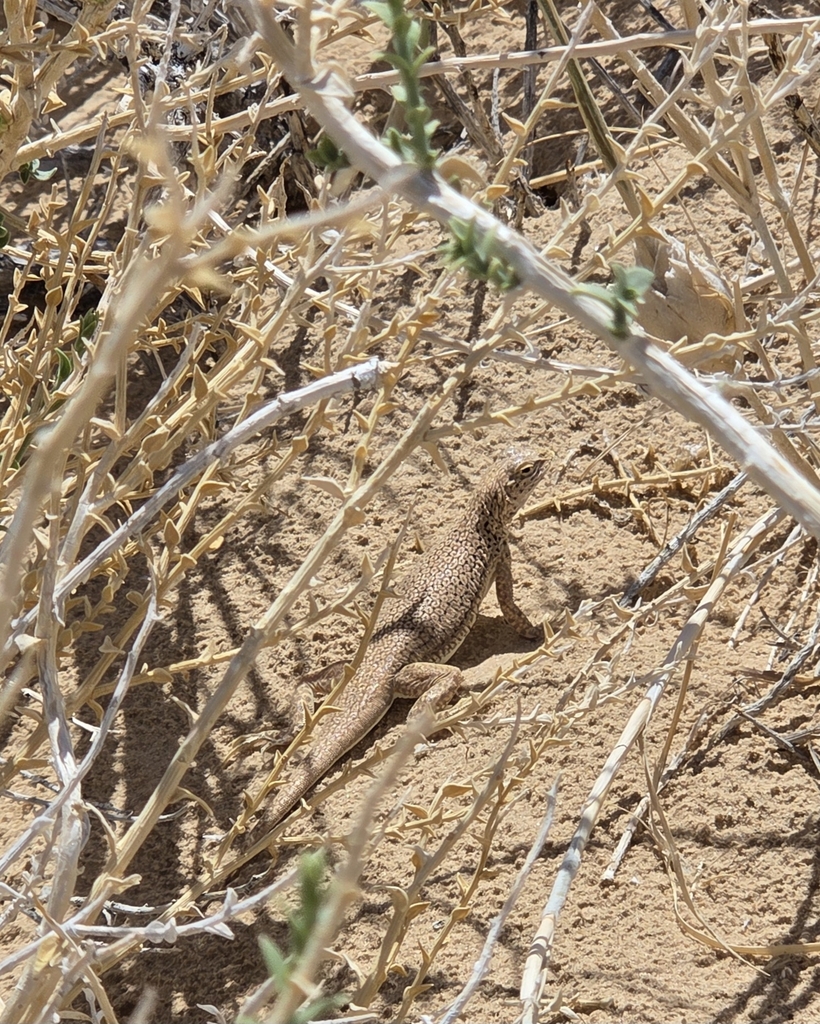
(c) Chris Frost, some rights reserved (CC BY) · licence
Family: Phrynosomatidae · Class: Reptilia · Order: Squamata
Conservation status: G3G4 S3S4
Uma scoparia (Mohave Fringe-toed Lizard) is a California animal in the Phrynosomatidae family.
The Mojave fringe-toed lizard is a medium-sized lizard endemic to sandy desert habitats of the southwestern United States. Adults typically measure 76 to 127 mm (3.0 to 5.0 inches) in snout-to-vent length, with total length including the tail reaching up to 254 mm (10 inches). The species exhibits cryptic coloration that closely matches its sandy environment, with a pale yellowish or grayish base color marked by darker bands and spots. Adults display a distinctive yellow-green wash on the belly and pink coloration on the sides during breeding season. The species is characterized by prominent fringed scales on the hind toes that aid in locomotion across loose sand. Historically, the Mojave fringe-toed lizard occurred in suitable sandy habitats across portions of the Mojave Desert in California, Nevada, Arizona, and Utah. In California, the species is found in the eastern Mojave Desert, primarily in San Bernardino County and portions of Inyo County. The distribution includes areas near the Colorado River and extends into isolated populations in Arizona and Utah. Current populations are highly fragmented, with only nine known populations persisting across approximately 59.5 acres (24.1 hectares) of suitable habitat. The species is restricted to fine-grained, windblown sand deposits including active sand dunes, sandy washes, and flat sandy areas with sparse vegetation. Mojave fringe-toed lizards require loose sand substrates for burrowing and thermoregulation, typically inhabiting areas with sand particles of specific grain size that allow for rapid burial. The lizards are found from near sea level to elevations of approximately 1,000 feet (305 meters), in areas receiving less than 5 inches (127 mm) of annual precipitation. Mojave fringe-toed lizards are primarily diurnal and exhibit pronounced seasonal activity patterns, being most active during spring and fall when temperatures are moderate. The species is omnivorous throughout its life cycle, feeding primarily on insects including beetles, ants, and flies, but also consuming seeds, flowers, and plant material. Reproduction occurs in spring, with females laying clutches of 1 to 5 eggs in sandy burrows. The species possesses specialized adaptations for sand-dwelling existence, including interlocking eyelid scales, protective ear flaps, and the ability to close nostrils to prevent sand infiltration during burrowing. The Mojave fringe-toed lizard has a NatureServe global rank of G3G4 and California state rank of S3S4, indicating moderate conservation concern. The U.S. Fish and Wildlife Service received a petition in 2008 to list the Amargosa River population as threatened or endangered, though the species currently lacks federal protection. Primary threats include habitat loss and fragmentation from urban development, off-road vehicle use, renewable energy projects, and sand and gravel mining operations. Climate change poses additional challenges through altered precipitation patterns and increased temperatures that may affect suitable habitat availability.
Classification
Class: Reptilia · Order: Squamata · Family: Phrynosomatidae
Conservation status
G3G4 S3S4
Frequently asked questions
How is Uma scoparia classified?
Uma scoparia belongs to class Reptilia, order Squamata, family Phrynosomatidae.
What family does Uma scoparia belong to?
Uma scoparia is in the Phrynosomatidae family.
Is Uma scoparia protected or of conservation concern?
Uma scoparia carries the following status: G3G4 S3S4.
What is Uma scoparia?
The Mojave fringe-toed lizard is a medium-sized lizard endemic to sandy desert habitats of the southwestern United States.
Is Uma scoparia found in California?
Yes. Uma scoparia is recorded in California in The California Species Project's catalogue.
Related species
Other California species in the same genus, family, or bioregion.
Data from The California Species Project — 14,000+ California species with verified data from CNPS, CDFW, USFWS, and more.