Urbanus dorantes
Dorantes Longtail
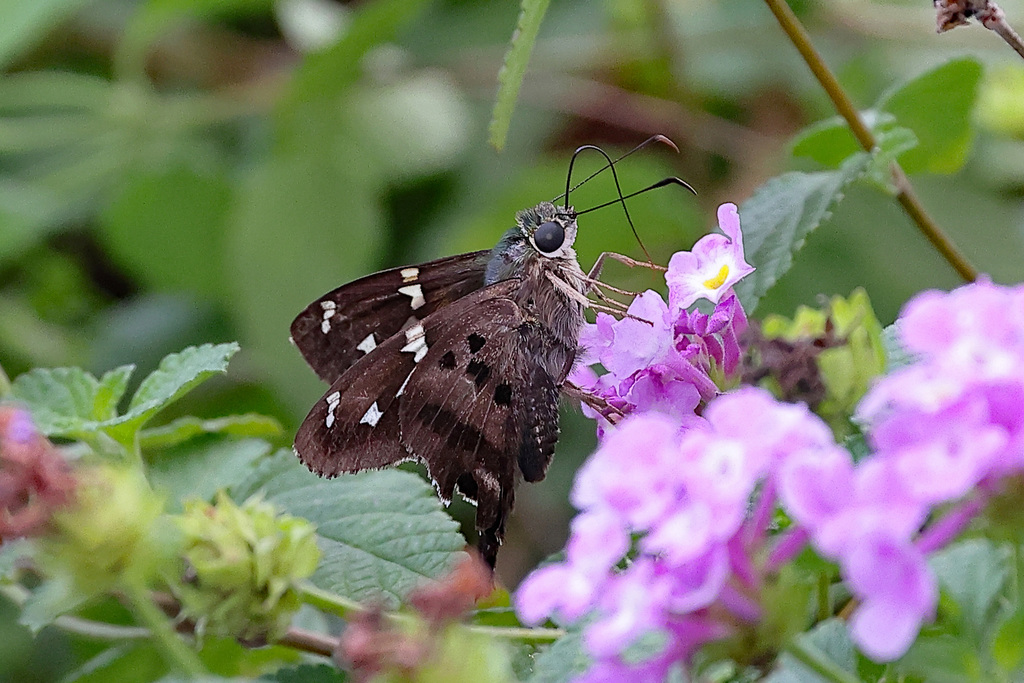
no rights reserved · CC0
Family: Hesperiidae · Class: Insecta · Order: Lepidoptera
Urbanus dorantes (Dorantes Longtail) is a California animal in the Hesperiidae family.
The Dorantes Longtail is a medium-sized skipper butterfly with distinctive elongated hindwing tails that extend 8 to 12 mm beyond the wing margin. Adults measure 35 to 45 mm in wingspan, with males slightly smaller than females. The dorsal wing surfaces are dark brown to black with distinctive white spots on the forewings, including a prominent triangular white patch near the wing apex. The hindwings feature a series of small white spots along the outer margin. The ventral surfaces are lighter brown with more pronounced white markings and a distinctive pattern of pale spots on the hindwings. Males possess a prominent dark stigma or scent patch on the forewings, used in courtship displays. The Dorantes Longtail ranges from Argentina north through Central America, Mexico, and the West Indies to South Texas and peninsular Florida. The species regularly strays north to northern California, southern Arizona, southern Missouri, and southern Georgia. In California, records exist primarily from the southern counties, with occasional sightings extending northward along the coast and in interior valleys. The species is considered a regular immigrant rather than a permanent resident in most areas north of Mexico. This species inhabits open areas including gardens, parks, fields, forest edges, and disturbed habitats from sea level to approximately 1,500 meters elevation. Adults are frequently observed in areas with abundant flowering plants and leguminous host vegetation. The species shows strong attraction to urban and suburban environments where cultivated legumes provide breeding sites. Dorantes Longtails are strong fliers with rapid, darting flight patterns typical of the skipper family. Adults feed on nectar from various flowering plants, showing particular preference for lantana, pentas, and other garden flowers. Males establish territories near host plants and engage in aerial pursuit of females. The species produces multiple broods per year in tropical regions, with continuous reproduction possible where temperatures permit. Females deposit eggs singly on host plant leaves, typically on the upper leaf surface. Larvae feed on various legumes including wild and cultivated beans (Phaseolus), beggar's ticks (Desmodium), and blue peas (Clitoria). Caterpillars construct leaf shelters by folding and securing leaves with silk, feeding primarily at night. The larval stage lasts approximately 3 to 4 weeks under optimal conditions. Pupation occurs within the final larval shelter or in leaf litter near the host plant. The Dorantes Longtail holds no special conservation status and is considered secure throughout most of its range. Populations appear stable, with the species demonstrating adaptability to human-modified landscapes. In fact, cultivation of leguminous crops and ornamental plants may have expanded available habitat in some regions. The species' strong dispersal ability and broad host plant range contribute to its ecological resilience. Climate change may potentially expand the species' permanent range northward as temperatures increase, though this remains speculative without long-term monitoring data.
Classification
Class: Insecta · Order: Lepidoptera · Family: Hesperiidae
Frequently asked questions
How is Urbanus dorantes classified?
Urbanus dorantes belongs to class Insecta, order Lepidoptera, family Hesperiidae.
What family does Urbanus dorantes belong to?
Urbanus dorantes is in the Hesperiidae family.
What is Urbanus dorantes?
The Dorantes Longtail is a medium-sized skipper butterfly with distinctive elongated hindwing tails that extend 8 to 12 mm beyond the wing margin.
Is Urbanus dorantes found in California?
Yes. Urbanus dorantes is recorded in California in The California Species Project's catalogue.
Related species
Other California species in the same genus, family, or bioregion.
Data from The California Species Project — 14,000+ California species with verified data from CNPS, CDFW, USFWS, and more.