Urbanus procne
Brown Longtail
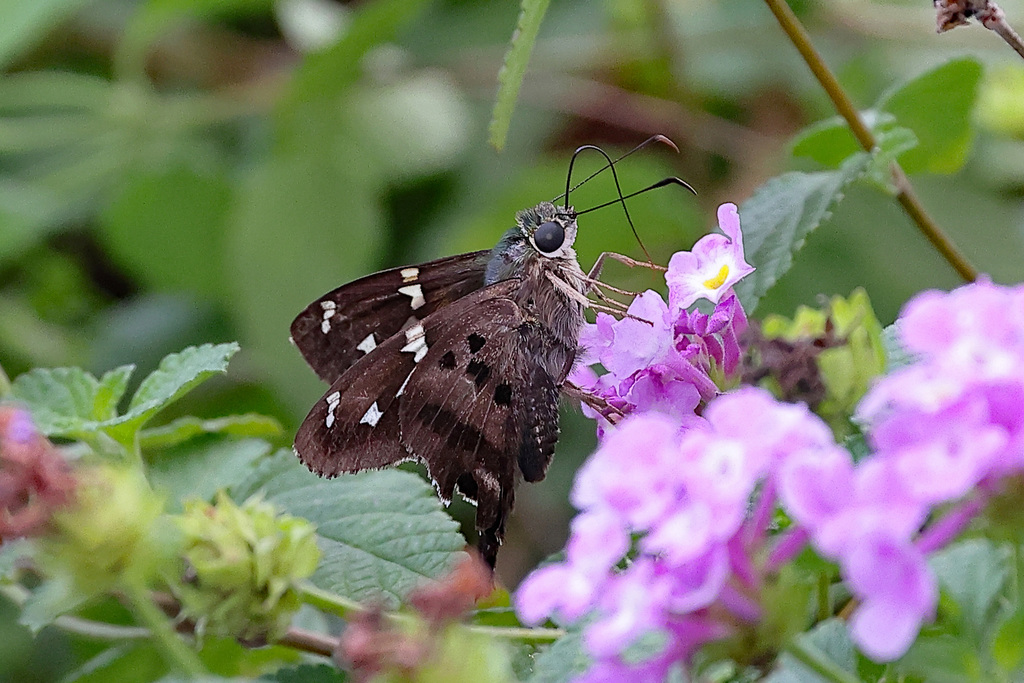
no rights reserved · CC0
Family: Hesperiidae · Class: Insecta · Order: Lepidoptera
Urbanus procne (Brown Longtail) is a California animal in the Hesperiidae family.
The Brown Longtail (Urbanus procne) is a medium-sized skipper butterfly in the family Hesperiidae, characterized by its distinctive elongated hindwing tails and robust build. Adults have a wingspan of approximately 38-50 mm (1.5-2.0 inches). The dorsal wing surfaces are dark brown to blackish-brown with translucent spots on the forewings, while the hindwings feature prominent tail-like projections extending 8-12 mm beyond the wing margin. The ventral surfaces display mottled brown and gray patterns with lighter scaling that provides effective camouflage when at rest. Males possess a distinctive dark stigma patch on the forewings used in courtship displays. The Brown Longtail ranges from Argentina north through Central America and Mexico to South Texas, representing one of the most widely distributed Urbanus species in the Americas. In the United States, it occurs as a rare stray in southern New Mexico, southern Arizona, and southern California. California records are sporadic and typically associated with vagrant individuals that have dispersed northward from established populations in Mexico during favorable weather conditions. Most documented California occurrences are in Imperial, Riverside, and San Diego counties. This species inhabits open areas with abundant grasses, including agricultural fields, pastures, roadsides, and disturbed habitats from sea level to approximately 1,500 meters elevation. In California, Brown Longtails are most commonly encountered in desert washes and agricultural areas where host plants are present. The species shows tolerance for both natural and modified environments, often utilizing irrigation ditches and field margins. Larval development occurs exclusively on grasses, with documented host plants including Bermuda grass (Cynodon dactylon) and Johnsongrass (Sorghum halepense). Caterpillars construct silk shelters by folding grass blades and feeding within these protective chambers. The larval stage lasts approximately 3-4 weeks, with pupation occurring in a silk girdle attached to the host plant or nearby vegetation. Adults are strong fliers and active during daylight hours, typically from mid-morning through late afternoon. Males establish territories and engage in aerial courtship flights. Females deposit single eggs on young grass shoots, and multiple broods occur annually in warmer climates. The Brown Longtail holds no special conservation status in California or federally, as it is not considered a resident breeding species within the state. Population trends are difficult to assess due to the sporadic nature of California records and the species' status as a non-resident vagrant. Climate change may potentially increase the frequency of northward dispersal events, but establishment of permanent populations in California remains unlikely due to seasonal temperature constraints and limited suitable habitat. The species faces no significant conservation threats within its core range, where it remains locally common in appropriate grassland habitats.
Classification
Class: Insecta · Order: Lepidoptera · Family: Hesperiidae
Frequently asked questions
How is Urbanus procne classified?
Urbanus procne belongs to class Insecta, order Lepidoptera, family Hesperiidae.
What family does Urbanus procne belong to?
Urbanus procne is in the Hesperiidae family.
What is Urbanus procne?
The Brown Longtail (Urbanus procne) is a medium-sized skipper butterfly in the family Hesperiidae, characterized by its distinctive elongated hindwing tails and robust build.
Is Urbanus procne found in California?
Yes. Urbanus procne is recorded in California in The California Species Project's catalogue.
Related species
Other California species in the same genus, family, or bioregion.
Data from The California Species Project — 14,000+ California species with verified data from CNPS, CDFW, USFWS, and more.