Urbanus proteus
Long-tailed Skipper
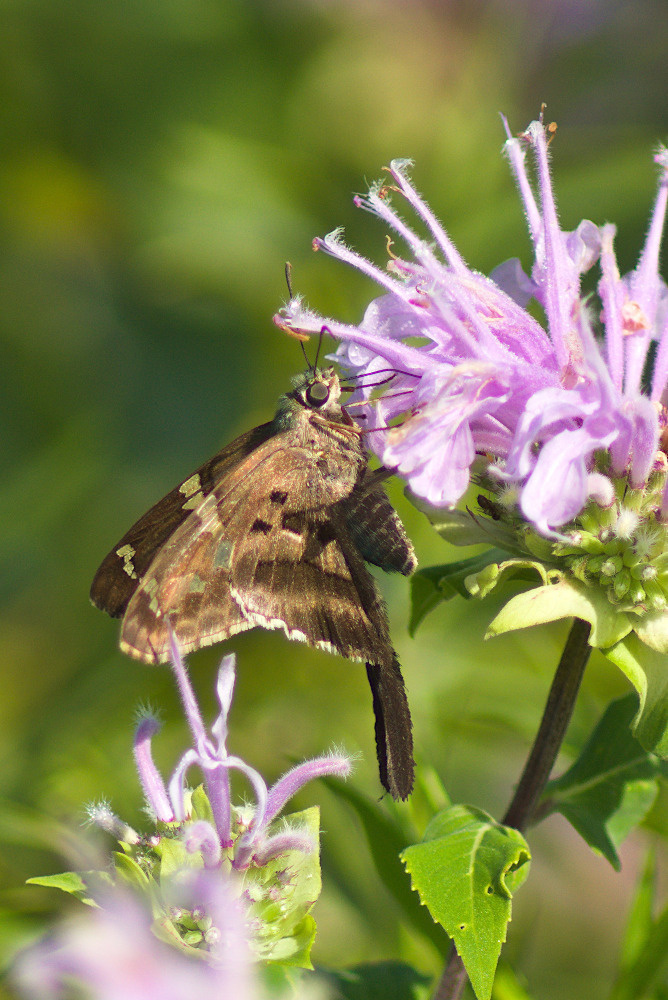
(c) psweet, some rights reserved (CC BY-SA) · licence
Family: Hesperiidae · Class: Insecta · Order: Lepidoptera
Urbanus proteus (Long-tailed Skipper) is a California animal in the Hesperiidae family.
The Long-tailed Skipper (Urbanus proteus) is a medium-sized butterfly in the family Hesperiidae, distinguished by its prominent hindwing tails and distinctive flight pattern. Adults have a wingspan of 44-54 mm (1.7-2.1 inches), with brown forewings marked by conspicuous white or translucent spots arranged in a distinctive pattern. The hindwings are brown with iridescent blue-green scaling and terminate in prominent tails approximately 6-8 mm long. The underside of the hindwings displays a characteristic pattern of white bands and spots. Males possess a dark stigma or scent patch on the forewings, while females lack this feature. The species ranges from Argentina north through Central America, the West Indies, and Mexico to peninsular Florida and South Texas. As a strong disperser, it occasionally strays and establishes temporary colonies north to Connecticut, southern Illinois, eastern Kansas, southern Arizona, and southern California. In California, the species appears primarily as a vagrant or temporary colonist, with records concentrated in southern counties including San Diego, Imperial, and Riverside. The butterfly cannot survive freezing temperatures and does not maintain permanent breeding populations in most northern areas of its expanded range. Long-tailed Skippers inhabit a variety of open and semi-open environments where their host plants occur. These include gardens, parks, agricultural areas, forest edges, and disturbed habitats from sea level to approximately 1,500 meters elevation. The species shows particular affinity for areas with abundant flowering plants that provide nectar sources for adults, combined with suitable leguminous host plants for larvae. The species is multivoltine, producing multiple generations per year in warmer climates, with continuous breeding possible in tropical and subtropical regions. Females deposit single eggs on the upper surfaces of host plant leaves. Larvae are green caterpillars with dark heads that construct leaf shelters by folding or rolling leaves and securing them with silk. The species utilizes vine legumes including various beans (Phaseolus), hog peanuts (Amphicarpa bracteata), beggar's ticks (Desmodium), blue peas (Clitoria), and wisteria (Wisteria). Adults are active during daylight hours and feed on nectar from a wide variety of flowers, showing particular preference for red, pink, and purple blooms. Flight is rapid and erratic, characteristic of skipper butterflies. The Long-tailed Skipper has no federal or state conservation listing and is considered secure throughout most of its range. The species has actually expanded its range northward over recent decades, likely aided by warming temperatures, increased cultivation of ornamental legumes, and its strong dispersal ability. In California, it remains an uncommon vagrant species with sporadic occurrence patterns. Climate change may facilitate more frequent colonization events in suitable habitat areas of the state, though establishment of permanent breeding populations remains unlikely in most regions due to winter temperature limitations.
Classification
Class: Insecta · Order: Lepidoptera · Family: Hesperiidae
Frequently asked questions
How is Urbanus proteus classified?
Urbanus proteus belongs to class Insecta, order Lepidoptera, family Hesperiidae.
What family does Urbanus proteus belong to?
Urbanus proteus is in the Hesperiidae family.
What is Urbanus proteus?
The Long-tailed Skipper (Urbanus proteus) is a medium-sized butterfly in the family Hesperiidae, distinguished by its prominent hindwing tails and distinctive flight pattern.
Is Urbanus proteus found in California?
Yes. Urbanus proteus is recorded in California in The California Species Project's catalogue.
Related species
Other California species in the same genus, family, or bioregion.
Data from The California Species Project — 14,000+ California species with verified data from CNPS, CDFW, USFWS, and more.