Urbanus simplicius
Plain Longtail
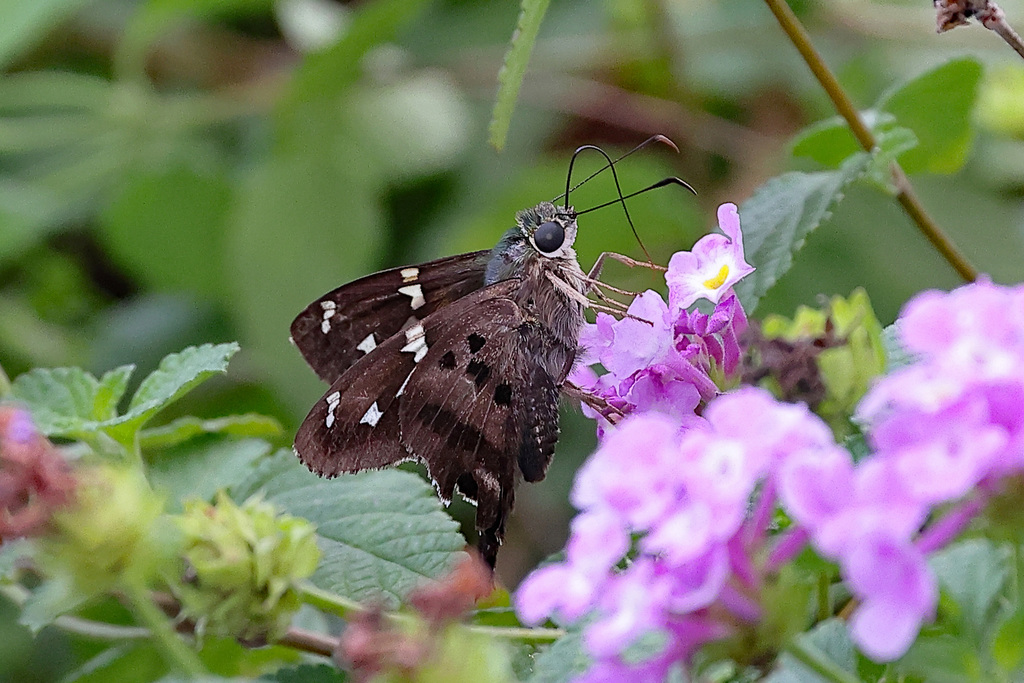
no rights reserved · CC0
Family: Hesperiidae · Class: Insecta · Order: Lepidoptera
Urbanus simplicius (Plain Longtail) is a California animal in the Hesperiidae family.
The Plain Longtail (Urbanus simplicius) is a medium-sized skipper butterfly in the family Hesperiidae, characterized by its distinctive long hindwing tails and understated coloration. Adults have a wingspan of approximately 38-45 mm (1.5-1.8 inches). The forewings are dark brown to blackish-brown with small, semi-translucent white spots arranged in a checkered pattern across the wing surface. The hindwings display the species' diagnostic feature: elongated tails extending 8-10 mm beyond the wing margin. The underwings are lighter brown with pale markings that provide camouflage when the butterfly is at rest with wings folded. The Plain Longtail ranges from Argentina northward through Central America and into Mexico, representing one of the most extensively distributed Urbanus species in the Neotropics. Within the United States, this butterfly occurs only as a rare vagrant to the lower Rio Grande Valley of extreme southern Texas. These occasional appearances typically coincide with favorable weather patterns that facilitate northward movement from established Mexican populations. The species does not maintain breeding populations north of Mexico. This skipper inhabits tropical and subtropical regions where leguminous host plants are abundant. In its native range, the Plain Longtail occurs from sea level to approximately 1,500 meters elevation in areas with adequate rainfall and vegetation cover. The species frequents forest edges, clearings, gardens, and agricultural areas where bean vines and other legume species grow. Adults are often observed along streams and in areas with flowering plants that provide nectar sources. Plain Longtail caterpillars feed exclusively on leguminous vines, particularly beans (Phaseolus species) and related members of the Fabaceae family. Females deposit eggs singly on young leaves of host plants. The larvae construct leaf shelters by folding or rolling leaves together with silk, feeding within these protective structures during development. The species likely completes multiple generations annually in tropical regions, with breeding activity influenced by rainfall patterns and host plant availability. Adults exhibit rapid, erratic flight patterns typical of longtail skippers and are attracted to various flowering plants for nectar, including Lantana, Pentas, and native wildflowers. The Plain Longtail has no special conservation status and is not listed under any federal or state endangered species legislation. As a naturally rare vagrant to the United States, the species faces no significant conservation concerns within U.S. borders. Throughout its primary range in Latin America, populations appear stable, though habitat conversion and agricultural intensification may affect local abundance in some regions. The species' association with cultivated beans may actually benefit populations in areas where legume crops are grown, providing abundant larval food sources. Climate change could potentially influence the frequency of vagrant appearances in Texas, as shifting weather patterns may alter the conditions that facilitate northward dispersal from Mexico.
Classification
Class: Insecta · Order: Lepidoptera · Family: Hesperiidae
Frequently asked questions
How is Urbanus simplicius classified?
Urbanus simplicius belongs to class Insecta, order Lepidoptera, family Hesperiidae.
What family does Urbanus simplicius belong to?
Urbanus simplicius is in the Hesperiidae family.
What is Urbanus simplicius?
The Plain Longtail (Urbanus simplicius) is a medium-sized skipper butterfly in the family Hesperiidae, characterized by its distinctive long hindwing tails and understated coloration.
Is Urbanus simplicius found in California?
Yes. Urbanus simplicius is recorded in California in The California Species Project's catalogue.
Related species
Other California species in the same genus, family, or bioregion.
Data from The California Species Project — 14,000+ California species with verified data from CNPS, CDFW, USFWS, and more.