Uria aalge
Common Murre
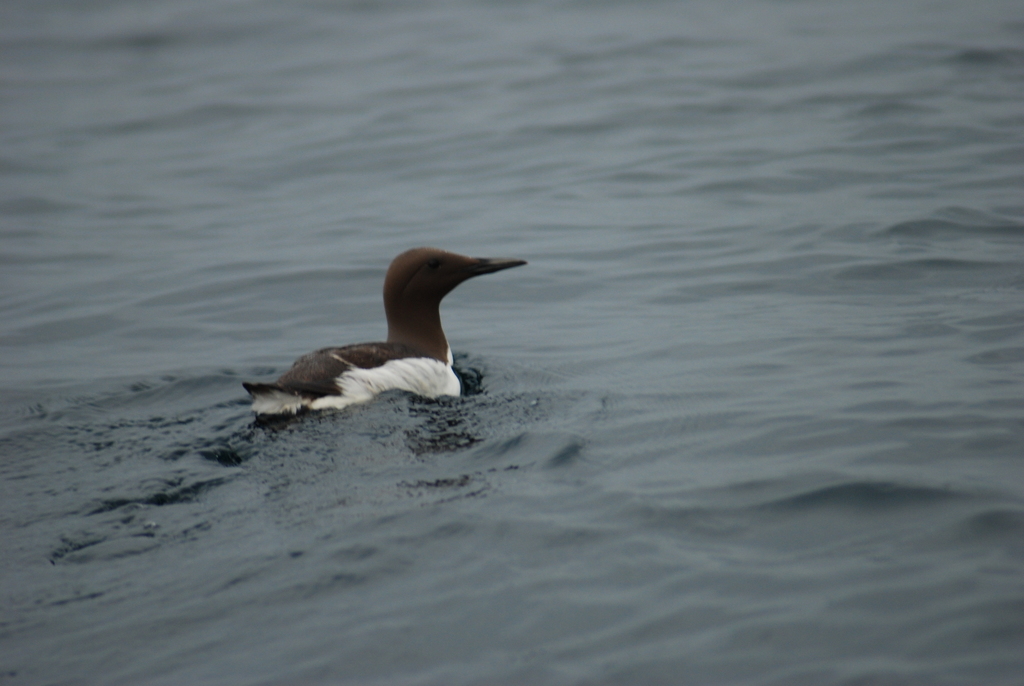
(c) franciscodocampo, some rights reserved (CC BY) · licence
Family: Alcidae · Class: Aves · Order: Charadriiformes
Uria aalge (Common Murre) is a California animal in the Alcidae family.
The Common Murre is a medium-sized seabird with a distinctive torpedo-shaped body adapted for underwater pursuit of prey. Adults measure 38 to 46 cm (15 to 18 inches) in length with a wingspan of 61 to 73 cm (24 to 29 inches), weighing 775 to 1,250 grams (1.7 to 2.8 pounds). During breeding season, the head, neck, and upperparts are dark chocolate brown to black, while the underparts remain bright white. In winter plumage, the throat and sides of the head become white with a distinctive dark line extending behind the eye. The bill is long, straight, and sharply pointed, ranging from black to yellow depending on subspecies and season. Common Murres breed along the California coast from Del Norte County south to Santa Barbara County, with the largest colonies located on offshore rocks and islands including the Farallon Islands, Castle Rock, and Point Reyes. The species occurs year-round in California waters, though birds disperse widely offshore during the non-breeding season. Breeding populations extend north along the Pacific coast to Alaska and across the North Atlantic. The species inhabits rocky coastal areas, sea cliffs, and offshore islands for nesting, requiring flat or gently sloping surfaces for colony formation. Murres nest in dense aggregations on narrow cliff ledges, rocky platforms, and the tops of sea stacks. During the non-breeding season, they occupy nearshore and offshore marine waters, typically within 200 km of the continental shelf edge, preferring areas with strong upwelling currents that concentrate prey. Common Murres are pursuit divers that use their wings for underwater propulsion, reaching depths of up to 180 meters (590 feet) while foraging. Their diet consists primarily of small schooling fish including anchovies, sardines, herring, and rockfish, supplemented by squid and crustaceans. Breeding occurs from May through August, with females laying a single large, pyriform egg directly on bare rock. The egg's pointed shape prevents it from rolling off narrow ledges. Both parents share incubation duties for 28 to 37 days and continue to feed the chick for 18 to 25 days until it fledges. Common Murres are not federally or state listed but face ongoing conservation challenges. Major threats include oil spills, entanglement in fishing gear, climate change effects on prey availability, and disturbance at breeding colonies. The species experienced significant mortality during the 1982-83 El Niño event and continues to be affected by periodic warming events that reduce prey abundance. According to monitoring data from the Farallon Islands, breeding success varies considerably with ocean conditions, declining during warm water years when anchovy and krill abundance decreases. Marine protected areas around key breeding sites and fishing gear modifications have helped reduce some mortality sources, but climate-driven changes in ocean productivity remain a primary concern for long-term population stability.
Classification
Class: Aves · Order: Charadriiformes · Family: Alcidae
Frequently asked questions
How is Uria aalge classified?
Uria aalge belongs to class Aves, order Charadriiformes, family Alcidae.
What family does Uria aalge belong to?
Uria aalge is in the Alcidae family.
What is Uria aalge?
The Common Murre is a medium-sized seabird with a distinctive torpedo-shaped body adapted for underwater pursuit of prey.
Is Uria aalge found in California?
Yes. Uria aalge is recorded in California in The California Species Project's catalogue.
Related species
Other California species in the same genus, family, or bioregion.
Data from The California Species Project — 14,000+ California species with verified data from CNPS, CDFW, USFWS, and more.