Uria lomvia
Thick-billed Murre
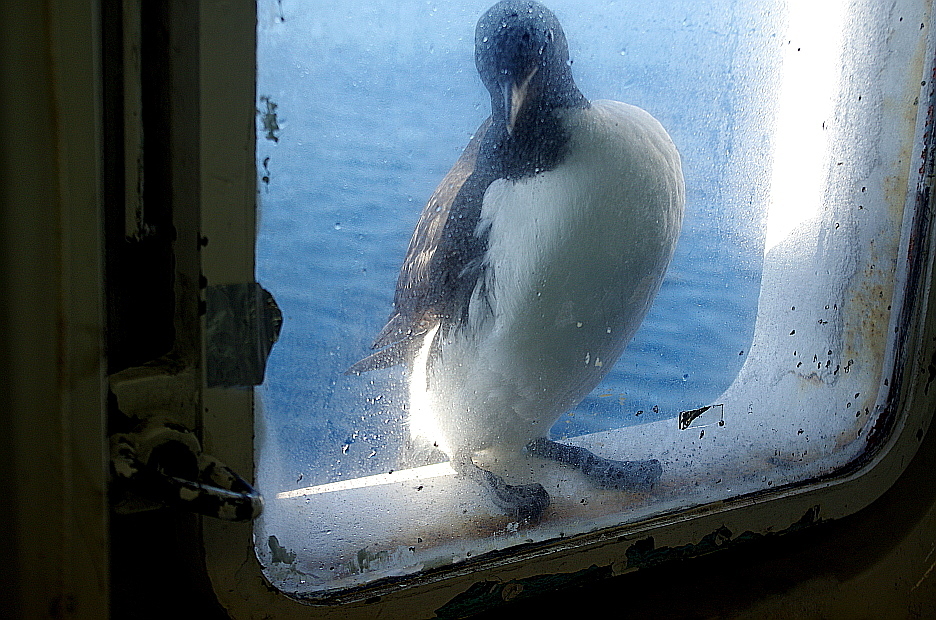
(c) Георгий Виноградов (Georgy Vinogradov), some rights reserved (CC BY) · licence
Family: Alcidae · Class: Aves · Order: Charadriiformes
Uria lomvia (Thick-billed Murre) is a California animal in the Alcidae family.
The Thick-billed Murre is a medium-sized seabird endemic to Arctic and subarctic marine environments. Adults measure 40 to 48 cm (16 to 19 inches) in length with a wingspan of 64 to 71 cm (25 to 28 inches), weighing between 735 to 1,481 grams (1.6 to 3.3 pounds). The species exhibits distinct seasonal plumage variation. During breeding season, adults display blackish-brown upperparts and head with bright white underparts. A distinctive white line extends from the eye toward the back of the head. The bill is thick, pointed, and dark with a yellowish-orange gape line. In winter plumage, the throat and sides of the head become white, with a dark line extending behind the eye. The species can be distinguished from the similar Common Murre by its thicker bill, more compact body, and the white line behind the eye during breeding season. In California, Thick-billed Murres occur as non-breeding visitors along the Pacific Coast, primarily from October through April. The species breeds in large colonies on coastal cliffs and offshore islands throughout the Arctic, including Alaska, northern Canada, Greenland, and northern Europe. During winter months, populations disperse southward along continental coastlines. California represents the southern extent of the species' Pacific winter range, with individuals occasionally observed as far south as Central California. Thick-billed Murres inhabit pelagic marine environments, preferring cold, nutrient-rich waters over continental shelves and offshore areas. The species forages in waters typically ranging from 10 to 100 meters deep, though individuals can dive to depths exceeding 150 meters (492 feet). During the non-breeding season in California waters, the species frequents upwelling zones and areas with high prey density, particularly where cold currents create productive feeding conditions. Thick-billed Murres are pursuit-diving specialists, using their wings for underwater propulsion while hunting fish, crustaceans, and marine worms. Primary prey items include Arctic cod, capelin, krill, and amphipods. The species can remain submerged for up to 4 minutes while pursuing prey. Breeding occurs from May through August in Arctic colonies, where pairs nest on narrow cliff ledges without constructing formal nests. Females lay a single, large pyriform egg directly on bare rock. Both parents share incubation duties for approximately 32 to 36 days. Chicks fledge at 18 to 25 days of age, departing the colony before achieving full flight capability and completing development at sea with the male parent. The Thick-billed Murre is not federally listed in the United States and maintains stable global populations estimated at 15 to 20 million individuals. However, the species faces threats from climate change, which affects prey distribution and breeding habitat availability. Oil spills, fishing net entanglement, and plastic pollution pose additional risks. In California waters, population trends appear stable, with the species remaining a regular winter visitor along the northern and central coastline.
Classification
Class: Aves · Order: Charadriiformes · Family: Alcidae
Frequently asked questions
How is Uria lomvia classified?
Uria lomvia belongs to class Aves, order Charadriiformes, family Alcidae.
What family does Uria lomvia belong to?
Uria lomvia is in the Alcidae family.
What is Uria lomvia?
The Thick-billed Murre is a medium-sized seabird endemic to Arctic and subarctic marine environments.
Is Uria lomvia found in California?
Yes. Uria lomvia is recorded in California in The California Species Project's catalogue.
Related species
Other California species in the same genus, family, or bioregion.
Data from The California Species Project — 14,000+ California species with verified data from CNPS, CDFW, USFWS, and more.