Urile penicillatus
Brandt's Cormorant
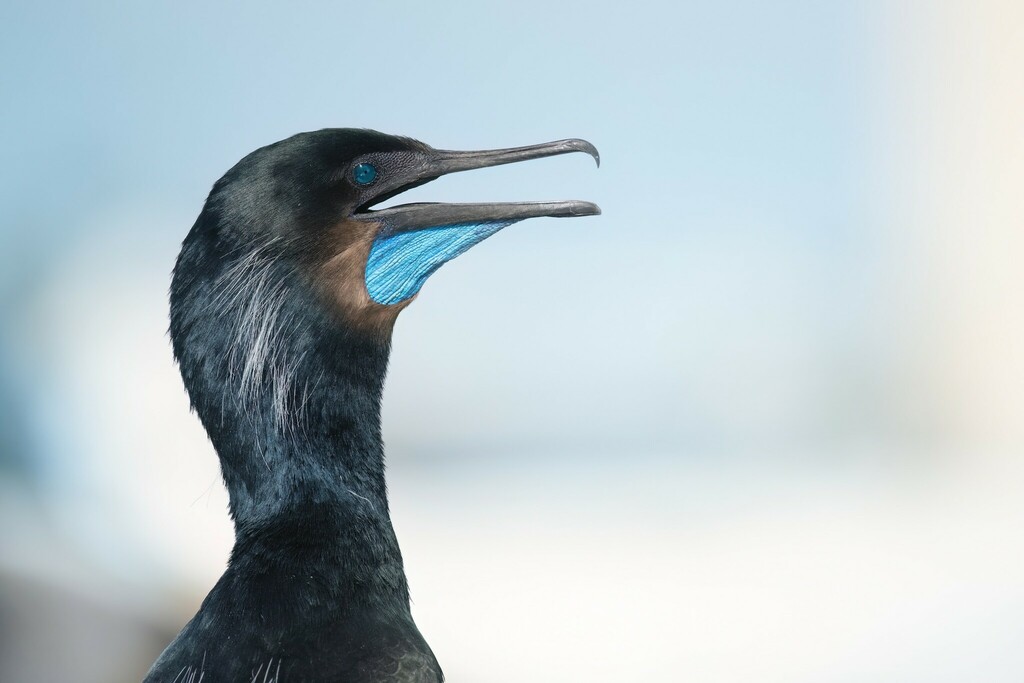
no rights reserved · CC0
Family: Phalacrocoracidae · Class: Aves · Order: Pelecaniformes
Urile penicillatus (Brandt's Cormorant) is a California animal in the Phalacrocoracidae family.
Brandt's Cormorant (Urile penicillatus) is a large seabird endemic to the Pacific Coast of North America. Adults measure 70 to 89 centimeters (28 to 35 inches) in length with a wingspan of 116 to 123 centimeters (46 to 48 inches), weighing 1.2 to 2.5 kilograms (2.6 to 5.5 pounds). During the breeding season, adults develop distinctive bright blue throat patches and fine white plumes along the head and neck. The body is predominantly black with a slight greenish sheen, while non-breeding adults lack the blue throat coloration and ornate plumage. Juveniles are brownish-black above and lighter below, gradually acquiring adult plumage over two years. Brandt's Cormorant ranges from southeastern Alaska to Baja California, Mexico, with the largest breeding populations concentrated along the California coast. In California, the species nests on offshore islands and rocky coastal headlands from the Oregon border south to the Channel Islands. Major breeding colonies occur on the Farallon Islands, Año Nuevo Island, Point Reyes, Alcatraz Island, and throughout the Channel Islands. During winter, some populations disperse southward while others remain near breeding areas year-round. The species inhabits nearshore marine waters, typically foraging within 5 kilometers of shore over continental shelf waters less than 80 meters deep. Brandt's Cormorants nest colonially on flat-topped islands, rocky ledges, and cliff faces, constructing nests from seaweed, grass, and other marine debris. Breeding sites are typically located 3 to 30 meters above sea level, though some colonies extend to elevations of 100 meters or more. Brandt's Cormorants are pursuit divers that feed primarily on schooling fish including anchovies, sardines, rockfish, and mackerel. They dive from the surface to depths of up to 37 meters, using their webbed feet for underwater propulsion while wings remain folded. Breeding occurs from April through August, with peak laying in May and June. Females typically lay 3 to 6 chalky blue-white eggs in nests constructed in dense colonies. Incubation lasts 25 to 32 days, and chicks fledge after 35 to 60 days. Both parents participate in nest construction, incubation, and chick rearing. Brandt's Cormorant is not federally or state listed and maintains stable populations throughout most of its range. According to the North American Bird Conservation Initiative, the species has a continental population estimated at 150,000 to 200,000 individuals. However, populations face ongoing threats from oil spills, marine pollution, fishing net entanglement, and human disturbance at breeding colonies. Climate change may affect prey availability through shifts in ocean temperature and productivity. El Niño events have historically caused breeding failures and population fluctuations. Conservation efforts focus on protecting breeding colonies from human disturbance and monitoring population trends through annual surveys conducted by Point Blue Conservation Science and other organizations.
Classification
Class: Aves · Order: Pelecaniformes · Family: Phalacrocoracidae
Frequently asked questions
How is Urile penicillatus classified?
Urile penicillatus belongs to class Aves, order Pelecaniformes, family Phalacrocoracidae.
What family does Urile penicillatus belong to?
Urile penicillatus is in the Phalacrocoracidae family.
What is Urile penicillatus?
Brandt's Cormorant (Urile penicillatus) is a large seabird endemic to the Pacific Coast of North America.
Is Urile penicillatus found in California?
Yes. Urile penicillatus is recorded in California in The California Species Project's catalogue.
Related species
Other California species in the same genus, family, or bioregion.
Data from The California Species Project — 14,000+ California species with verified data from CNPS, CDFW, USFWS, and more.