Urobatis halleri
Haller's Round Ray
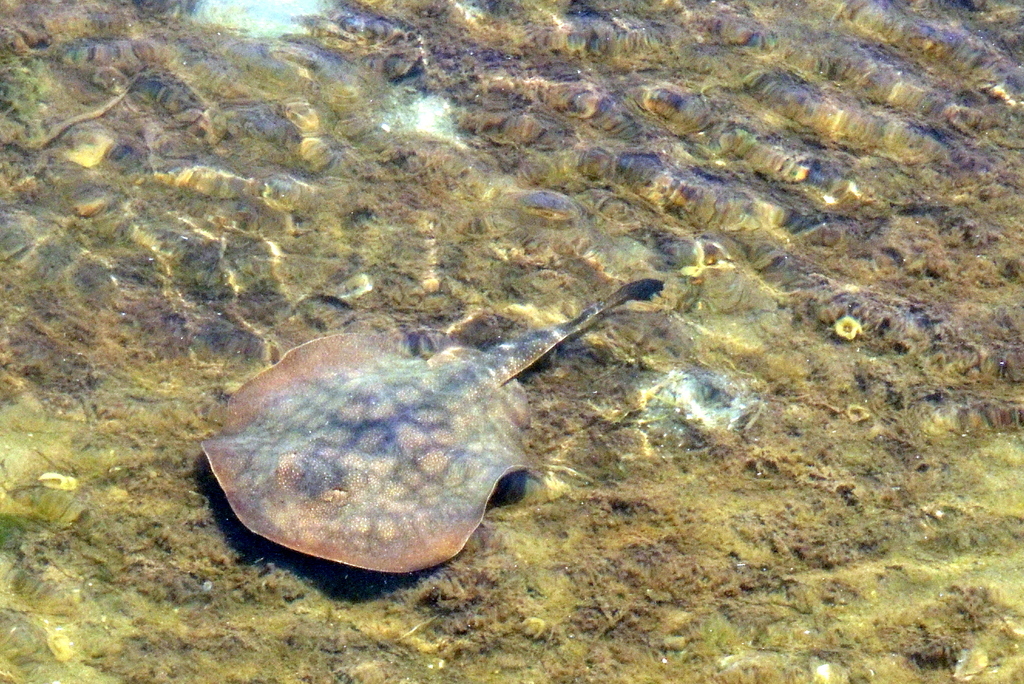
(c) Vijay Barve, some rights reserved (CC BY) · licence
Family: Urolophidae · Class: Chondrichthyes · Order: Myliobatiformes
Urobatis halleri (Haller's Round Ray) is a California animal in the Urolophidae family.
Haller's round ray (Urobatis halleri) is a small to medium-sized stingray native to the Pacific coast. Adults typically reach 30 to 38 cm (12 to 15 inches) in disc width, with a maximum recorded size of approximately 56 cm (22 inches). The species exhibits a circular to oval-shaped disc that is slightly wider than it is long. The dorsal surface is typically brown to gray-brown with darker spots or mottled patterns, while the ventral surface is pale cream to white. A distinctive venomous spine is located on the dorsal surface of the tail, approximately one-third of the way from the base. The species occurs along the Pacific coast from Humboldt Bay, California, south to the Gulf of California, Mexico. In California, round stingrays are documented from numerous coastal and estuarine locations including Upper Newport Bay, Ballona Wetlands Ecological Reserve, and Lower Ballona Creek (California Department of Fish and Wildlife). Historical records indicate the species was more abundant in southern California estuaries, though current distribution patterns suggest potential range contractions in some areas. Haller's round ray inhabits sandy and muddy bottoms in shallow coastal waters, estuaries, and bays. The species demonstrates considerable salinity tolerance, occurring in both marine and brackish water environments. In the Ballona Wetlands system, individuals have been documented exclusively in Fiji Ditch, suggesting preference for specific microhabitat conditions within estuarine systems (CDFW monitoring reports). Depth range extends from intertidal zones to approximately 91 meters (300 feet), though the species is most commonly encountered in waters less than 37 meters (120 feet) deep. Round stingrays are benthic predators that feed primarily on polychaete worms, small crustaceans, and mollusks. Feeding occurs through excavation of sediment, with prey detected through electroreception and mechanoreception. Reproduction is ovoviviparous, with females giving birth to live young after an 8 to 10-month gestation period. Litter sizes range from 1 to 6 pups, with an average of 2 to 3 offspring per female. Sexual maturity is reached at approximately 2 to 3 years of age. The species exhibits seasonal movement patterns, with individuals moving into deeper waters during colder months. The round stingray is currently classified as Least Concern by the International Union for Conservation of Nature (IUCN). However, California populations face ongoing pressure from coastal development, water quality degradation, and habitat modification in estuarine environments. The species serves as an indicator organism for estuarine ecosystem health, as documented in long-term monitoring programs at Ballona Wetlands and other southern California coastal reserves. Climate change may affect distribution patterns through altered water temperatures and sea level rise impacts on critical estuarine nursery habitats. No specific federal or state conservation measures are currently in place for this species.
Classification
Class: Chondrichthyes · Order: Myliobatiformes · Family: Urolophidae
Frequently asked questions
How is Urobatis halleri classified?
Urobatis halleri belongs to class Chondrichthyes, order Myliobatiformes, family Urolophidae.
What family does Urobatis halleri belong to?
Urobatis halleri is in the Urolophidae family.
What is Urobatis halleri?
Haller's round ray (Urobatis halleri) is a small to medium-sized stingray native to the Pacific coast.
Is Urobatis halleri found in California?
Yes. Urobatis halleri is recorded in California in The California Species Project's catalogue.
More California species
This species has no close relatives in our California data — here are other species to explore.
Data from The California Species Project — 14,000+ California species with verified data from CNPS, CDFW, USFWS, and more.