Urocerus californicus
California Horntail
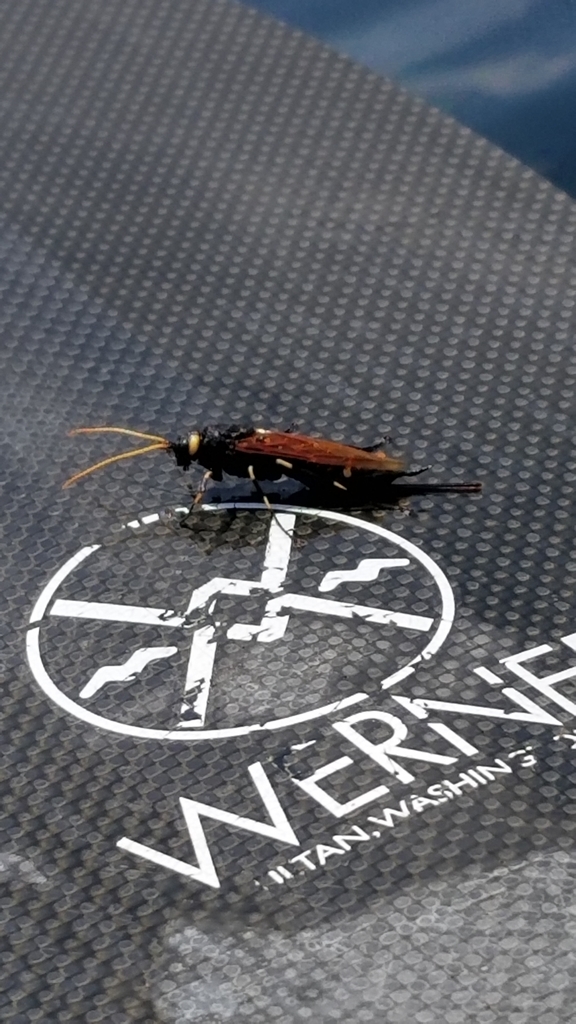
no rights reserved · CC0
Family: Siricidae · Class: Insecta · Order: Hymenoptera
Urocerus californicus (California Horntail) is a California animal in the Siricidae family.
The California horntail (Urocerus californicus) is a large wood wasp in the family Siricidae, characterized by its robust body and distinctive horn-like ovipositor projection in females. Adults typically measure 20-35 mm (0.8-1.4 inches) in length, with females generally larger than males. The body is primarily dark colored with a cylindrical form typical of horntail wasps. Females possess a prominent, spear-like ovipositor that extends beyond the abdomen, used for boring into wood to deposit eggs. Males lack this structure and are generally smaller with more slender builds. This species occurs across western North America, with a range extending from Montana and New Mexico north to British Columbia and west to California (Schiff et al. 2006). Within California, the species is distributed throughout forested regions where suitable coniferous host trees are present. The species has been documented from sea level to montane elevations, adapting to various forest types within its range. California horntails inhabit coniferous forests and mixed woodland areas. According to taxonomic literature, host trees include fir, larch, incense cedar, spruce, Douglas-fir, and hemlock (Schiff et al. 2006). The species shows particular association with stressed, dying, or recently dead conifers, where larvae develop within the wood. Adults may be found in both pure coniferous stands and mixed forests where suitable host species occur. The species has been observed from near sea level to mountainous elevations, demonstrating considerable ecological flexibility. Female California horntails use their specialized ovipositor to drill deep holes into the bark and wood of host trees, depositing eggs along with symbiotic fungi that aid larval development. The fungi help break down wood tissues, providing nutrition for the developing larvae. Larval development occurs entirely within the wood, where they create extensive galleries as they feed and grow. This process can take one to several years depending on environmental conditions and wood quality. Adults emerge by boring circular exit holes through the bark, typically during warmer months when mating and dispersal occur. As a native species with no federal or state conservation listing, Urocerus californicus is not considered threatened. However, like many forest-dependent insects, populations may be affected by forest management practices, wildfire patterns, and climate change impacts on host tree health and distribution. The species plays an ecological role as both a decomposer of dead wood and as part of forest food webs. While not extensively studied, the California horntail appears to maintain stable populations throughout its range where suitable coniferous habitat persists. Forest health monitoring and sustainable forestry practices indirectly support conservation of this and other wood-boring species by maintaining diverse forest ecosystems with natural cycles of tree mortality and regeneration.
Classification
Class: Insecta · Order: Hymenoptera · Family: Siricidae
Frequently asked questions
How is Urocerus californicus classified?
Urocerus californicus belongs to class Insecta, order Hymenoptera, family Siricidae.
What family does Urocerus californicus belong to?
Urocerus californicus is in the Siricidae family.
What is Urocerus californicus?
The California horntail (Urocerus californicus) is a large wood wasp in the family Siricidae, characterized by its robust body and distinctive horn-like ovipositor projection in females.
Is Urocerus californicus found in California?
Yes. Urocerus californicus is recorded in California in The California Species Project's catalogue.
Related species
Other California species in the same genus, family, or bioregion.
Data from The California Species Project — 14,000+ California species with verified data from CNPS, CDFW, USFWS, and more.