Uroctonus franckei
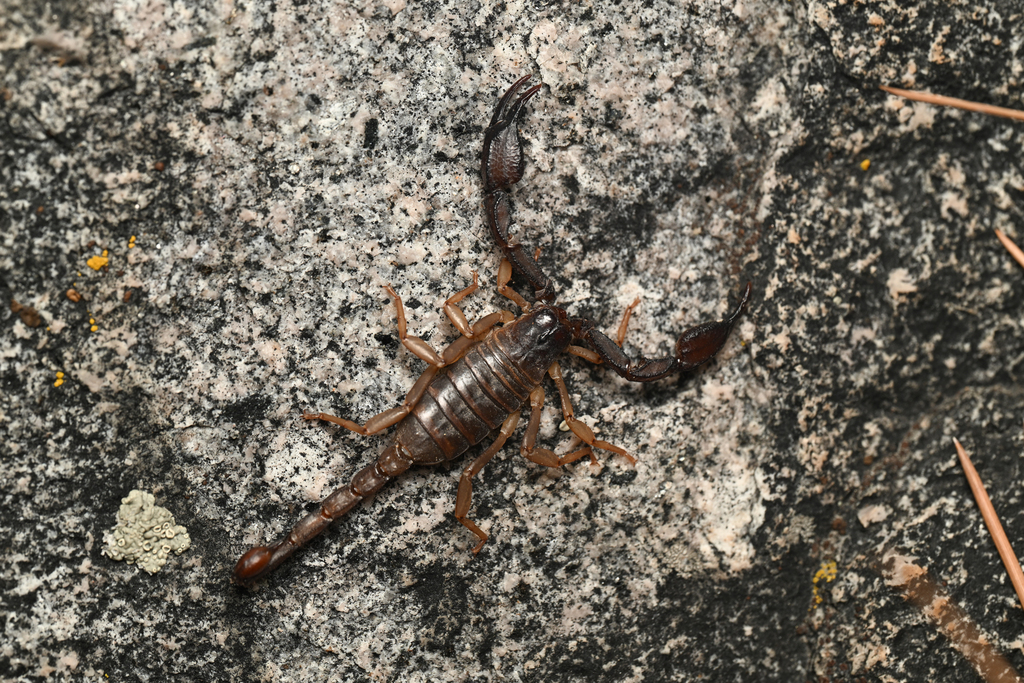
(c) Trevor Van Loon, some rights reserved (CC BY) · licence
Family: Vaejovidae · Class: Arachnida · Order: Scorpiones
Uroctonus franckei is a California animal in the Vaejovidae family.
Uroctonus franckei is a scorpion species within the family Vaejovidae, a group of small to medium-sized scorpions found primarily in western North America. This species belongs to the genus Uroctonus, which comprises several North American scorpion species characterized by their relatively modest size and temperate habitat preferences. The physical characteristics of U. franckei follow the general morphology typical of vaejovid scorpions. Like other members of this family, individuals possess the characteristic scorpion body plan with a segmented tail (metasoma) terminating in a venomous stinger, paired pincers (pedipalps), and four pairs of walking legs. Vaejovid scorpions typically measure between 20-60 millimeters (0.8-2.4 inches) in total length, though specific measurements for U. franckei have not been well documented in available literature. The geographic range and distribution of Uroctonus franckei appears to be poorly documented in current scientific literature. The genus Uroctonus is primarily distributed across western North America, with various species occupying habitats from British Columbia south to Baja California and east to the Rocky Mountains. However, the specific range boundaries and population distribution of U. franckei require further taxonomic and biogeographic investigation. Habitat preferences for this species remain largely undocumented in available sources. Other Uroctonus species typically inhabit temperate forest floors, woodland areas, and rocky substrates where they shelter under logs, rocks, and organic debris. These scorpions generally prefer areas with moderate moisture levels and avoid both extremely arid desert conditions and highly saturated environments. The behavioral ecology and life history of U. franckei have not been comprehensively studied. Like other vaejovid scorpions, this species likely exhibits nocturnal activity patterns, remaining hidden during daylight hours and emerging at night to hunt small arthropod prey including insects, spiders, and other invertebrates. Scorpions in this family typically reproduce through courtship rituals where males deposit spermatophores that females retrieve, followed by a gestation period during which developing young are carried on the mother's back after birth. The conservation status of Uroctonus franckei is not established, as the species lacks federal or state listing designations. The absence of comprehensive population studies, limited distributional data, and unclear taxonomic boundaries make assessment of conservation needs difficult. Many North American scorpion species face potential threats from habitat loss, urbanization, and climate change, though the specific vulnerability of U. franckei cannot be determined without additional research. Scientific documentation for this species remains extremely limited despite searches of available taxonomic and ecological databases. The information presented here synthesizes general knowledge of the genus Uroctonus and family Vaejovidae. Comprehensive studies of U. franckei's morphology, distribution, ecology, and conservation status are needed to develop a complete species account.
Classification
Class: Arachnida · Order: Scorpiones · Family: Vaejovidae
Frequently asked questions
How is Uroctonus franckei classified?
Uroctonus franckei belongs to class Arachnida, order Scorpiones, family Vaejovidae.
What family does Uroctonus franckei belong to?
Uroctonus franckei is in the Vaejovidae family.
What is Uroctonus franckei?
Uroctonus franckei is a scorpion species within the family Vaejovidae, a group of small to medium-sized scorpions found primarily in western North America.
Is Uroctonus franckei found in California?
Yes. Uroctonus franckei is recorded in California in The California Species Project's catalogue.
Related species
Other California species in the same genus, family, or bioregion.
Data from The California Species Project — 14,000+ California species with verified data from CNPS, CDFW, USFWS, and more.