Uroctonus mordax
Western Forest Scorpion
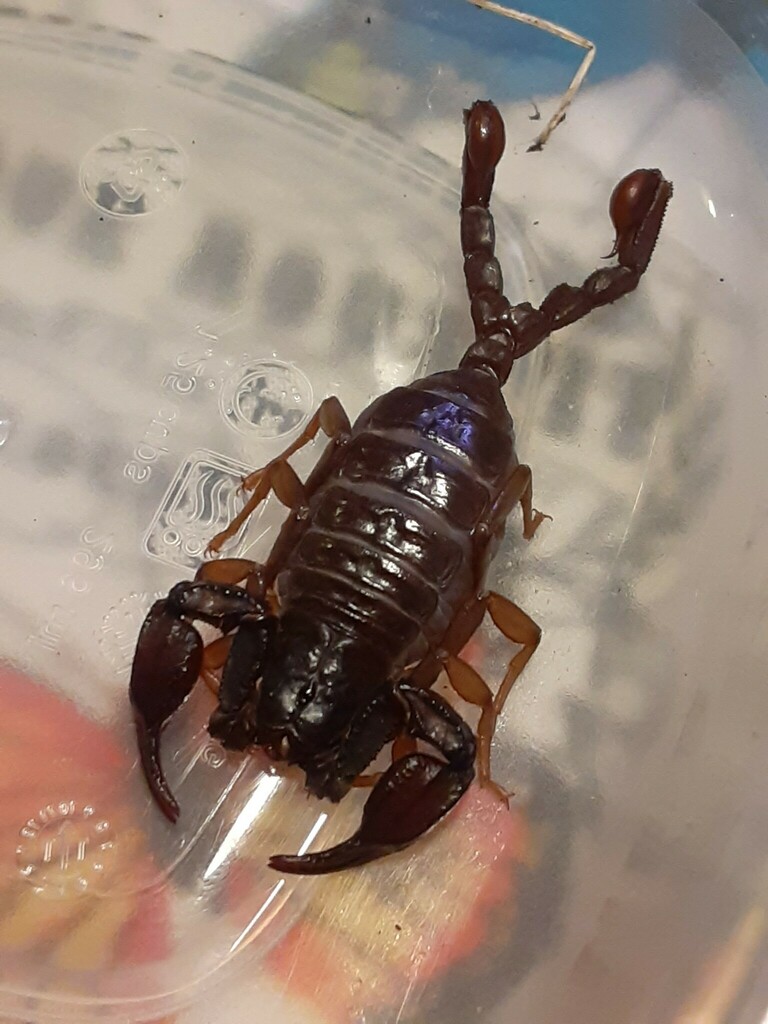
(c) Seth, some rights reserved (CC BY) · licence
Family: Vaejovidae · Class: Arachnida · Order: Scorpiones
Uroctonus mordax (Western Forest Scorpion) is a California animal in the Vaejovidae family.
The Western Forest Scorpion is a moderately-sized arachnid measuring approximately 50 to 70 mm (2.0 to 2.8 inches) in total length. The species exhibits the typical scorpion body plan with a segmented metasoma (tail) ending in a venomous stinger, robust pedipalps (pincers), and eight walking legs. Coloration ranges from yellowish-brown to dark brown, often with darker banding on the tail segments. A key identifying characteristic is the presence of a ventral median carina on the fifth metasomal segment that forks to form distinctive ridges (BugGuide 2025). Uroctonus mordax is endemic to California, where it occurs throughout much of the state's forested regions. The species has been documented from the San Francisco Bay Area north to the Shasta region and occurs across various mountain ranges and coastal areas. Distribution extends from sea level to elevations exceeding 9,000 feet in California's mountains, making it one of the more widely distributed scorpion species in the state (BugGuide 2025). The species is not known to occur outside of California. The Western Forest Scorpion inhabits diverse forest ecosystems, including coniferous forests, mixed woodland, and chaparral communities. Unlike many desert-dwelling scorpion species, U. mordax shows a preference for areas with higher moisture levels and forest cover. Individuals are commonly found under rocks, fallen logs, loose bark of both living and dead trees, and other surface debris. The species also occurs in human-modified environments, occasionally entering buildings and lumber yards where suitable microhabitat exists. This nocturnal predator emerges at night to hunt small invertebrates including insects, spiders, and other arthropods. Like other scorpions, it uses its pedipalps to capture prey and delivers venom through its stinger when necessary. The species exhibits typical scorpion reproductive behavior, with males performing courtship dances and transferring spermatophores to females. Females carry developing young on their backs after birth, providing maternal care until the first molt. The species is generally less aggressive than many desert scorpions, though it will defend itself when threatened. The Western Forest Scorpion is not federally or state listed as threatened or endangered. Current population status and trends are not well documented, as comprehensive surveys of California's native scorpion fauna remain limited. The species appears to be relatively stable across its range, though localized populations may face pressure from habitat loss due to urbanization, intensive forest management, and wildfire. Climate change may pose future challenges as it alters precipitation patterns and forest composition in California. The species has been documented persisting in areas affected by wildfire, suggesting some resilience to natural disturbance regimes. More research is needed to assess long-term population trends and conservation needs for this endemic California species.
Classification
Class: Arachnida · Order: Scorpiones · Family: Vaejovidae
Frequently asked questions
How is Uroctonus mordax classified?
Uroctonus mordax belongs to class Arachnida, order Scorpiones, family Vaejovidae.
What family does Uroctonus mordax belong to?
Uroctonus mordax is in the Vaejovidae family.
What is Uroctonus mordax?
The Western Forest Scorpion is a moderately-sized arachnid measuring approximately 50 to 70 mm (2.0 to 2.8 inches) in total length.
Is Uroctonus mordax found in California?
Yes. Uroctonus mordax is recorded in California in The California Species Project's catalogue.
Related species
Other California species in the same genus, family, or bioregion.
Data from The California Species Project — 14,000+ California species with verified data from CNPS, CDFW, USFWS, and more.