Urocyon littoralis
Island fox
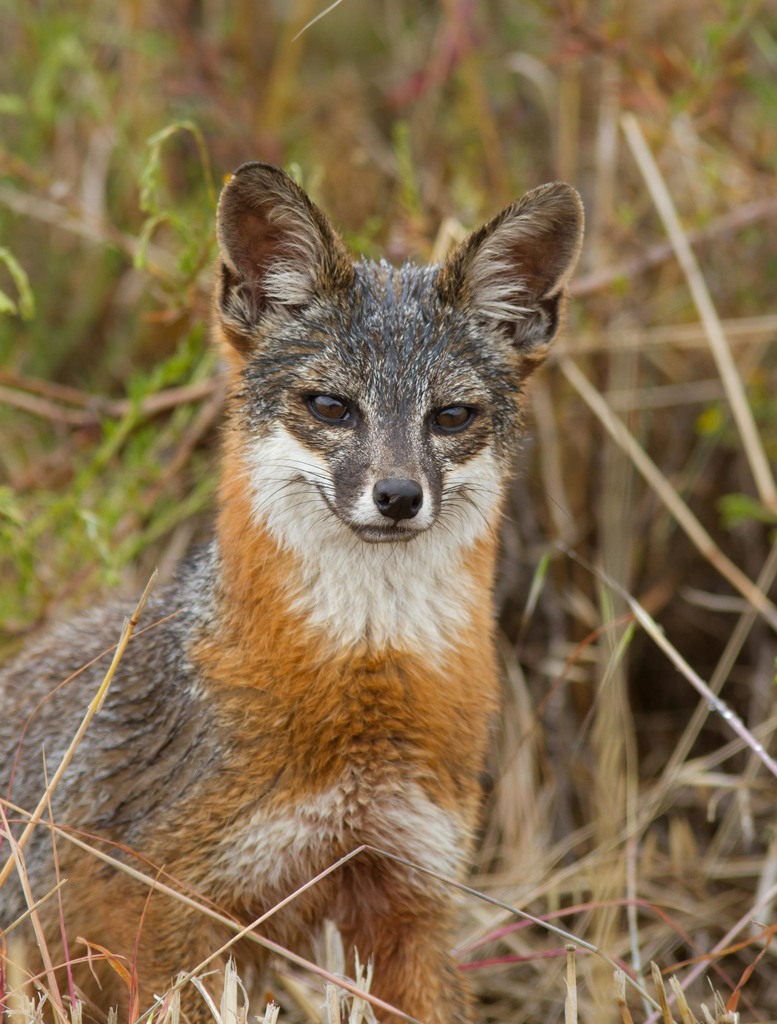
(c) Adam J. Searcy, some rights reserved (CC BY) · licence
Family: Canidae · Class: Mammalia · Order: Carnivora
Conservation status: ST · Threatened
Urocyon littoralis (Island fox) is a California animal in the Canidae family.
The island fox is a small canid endemic to California's Channel Islands, weighing 1.3 to 2.8 kilograms (2.9 to 6.2 pounds) and measuring 48 to 50 centimeters (19 to 20 inches) in body length with a 11 to 29 centimeter (4.3 to 11.4 inch) tail. The species exhibits the typical fox coloration with gray dorsal fur, rusty sides, white chest and belly, and black markings on the legs and tail tip. Island foxes are significantly smaller than their mainland relative, the gray fox, representing an example of island dwarfism. Their compact size and shorter legs are adaptations to the island environment. The island fox occurs exclusively on six of California's Channel Islands: San Miguel, Santa Rosa, Santa Cruz, and Anacapa islands in Channel Islands National Park, plus San Nicolas and Santa Catalina islands. Each island supports a distinct subspecies that has been geographically isolated for thousands of years. The species evolved from gray foxes that colonized the islands approximately 10,400 to 16,000 years ago. Island foxes inhabit diverse vegetation communities across their island ranges, from coastal scrub and chaparral to oak woodlands and grasslands. They utilize areas from sea level to elevations up to 450 meters (1,476 feet). The species adapts to various microhabitats including rocky outcrops, dense shrub cover, and open areas, often denning in hollow logs, rock crevices, or burrows they excavate in soft soil. Island foxes are omnivorous with a diet varying seasonally and by island. Primary food sources include insects, fruits, birds, eggs, and small mammals. On some islands, they consume significant quantities of native fruits such as prickly pear cactus and toyon berries. The species is primarily nocturnal and crepuscular, though individuals may be active during daylight hours. Island foxes are generally solitary except during breeding season from January to March. Females give birth to one to five kits after a gestation period of approximately 50 days. Kits remain in dens for the first month and stay with parents until fall. The island fox was listed as federally threatened in 2004, though according to California Department of Fish and Wildlife, state listing includes all six subspecies on all six islands while federal listing covers only four subspecies on four islands. Populations crashed dramatically in the 1990s due to predation by golden eagles, which colonized the islands after bald eagles were eliminated by DDT. Disease outbreaks, including canine distemper, also contributed to declines. On San Miguel Island, the population dropped from 450 individuals in 1994 to 15 in 1999. Recovery efforts including captive breeding, golden eagle removal, and bald eagle reintroduction have been successful. By 2016, total population exceeded 6,000 individuals across all islands. Current threats include habitat loss from development, vehicle strikes on Santa Catalina Island, and potential disease transmission from domestic animals.
Classification
Class: Mammalia · Order: Carnivora · Family: Canidae
Conservation status
ST · Threatened
Frequently asked questions
How is Urocyon littoralis classified?
Urocyon littoralis belongs to class Mammalia, order Carnivora, family Canidae.
What family does Urocyon littoralis belong to?
Urocyon littoralis is in the Canidae family.
Is Urocyon littoralis protected or of conservation concern?
Urocyon littoralis carries the following status: ST · Threatened.
What is Urocyon littoralis?
The island fox is a small canid endemic to California's Channel Islands, weighing 1.3 to 2.8 kilograms (2.9 to 6.2 pounds) and measuring 48 to 50 centimeters (19 to 20 inches) in body length with a 11 to 29 centimeter (4.3 to 11.4 inch) tail.
Is Urocyon littoralis found in California?
Yes. Urocyon littoralis is recorded in California in The California Species Project's catalogue.
Related species
Other California species in the same genus, family, or bioregion.
Data from The California Species Project — 14,000+ California species with verified data from CNPS, CDFW, USFWS, and more.