Urocyon littoralis dickeyi
San Nicolas Island Fox
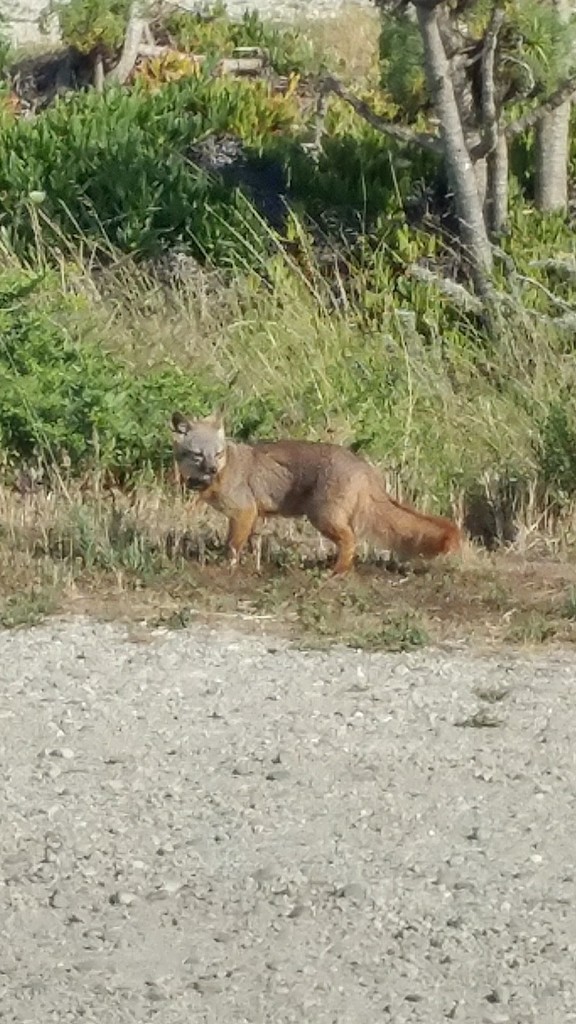
(c) Casey H. Richart, some rights reserved (CC BY) · licence
Family: Canidae · Class: Mammalia · Order: Carnivora
Conservation status: G3T1 S1
Urocyon littoralis dickeyi (San Nicolas Island Fox) is a California animal in the Canidae family.
The San Nicolas Island fox is a small carnivore endemic to San Nicolas Island, California. This subspecies of the island fox measures approximately 23-50 cm (9-20 inches) in body length with a tail length of 11-29 cm (4-11 inches), weighing between 1.3-2.8 kg (2.9-6.2 pounds). The species displays a grizzled gray coat with rusty coloration on the head, neck, legs, and feet, and typically has a black stripe running down the tail. San Nicolas Island foxes are notably smaller than their mainland gray fox relatives, representing an example of island dwarfism. The San Nicolas Island fox occurs exclusively on San Nicolas Island, the outermost of the California Channel Islands, located approximately 100 km (62 miles) southwest of the mainland. This 57-square-kilometer (22-square-mile) island represents the entire range of this subspecies. Historically, the subspecies was distributed across the island, though current distribution may be more limited due to past population declines. The species inhabits a variety of habitats across San Nicolas Island, including coastal sage scrub, grasslands, and rocky areas. As a habitat generalist, the San Nicolas Island fox adapts to the island's diverse microenvironments, from coastal bluffs to interior valleys. The subspecies demonstrates flexibility in habitat use, occupying areas with varying vegetation density and topographical features. San Nicolas Island foxes are omnivorous, feeding on insects, small mammals, birds, eggs, fruits, and marine carrion washed ashore. They are primarily nocturnal but may be active during daylight hours. Breeding occurs from late winter to early spring, with females giving birth to 2-5 kits after a gestation period of approximately 50-63 days. The subspecies exhibits monogamous pair bonding, with breeding pairs maintaining territories. Dens are typically located in rock crevices, hollow trees, or burrows. The San Nicolas Island fox is listed as Threatened under California state law and holds a global conservation rank of G3T1, indicating it is critically imperiled. According to federal documents, the subspecies experienced a severe population bottleneck in the mid-1970s, resulting in extremely low genetic diversity (Gilbert et al. 1990; Goldstein et al. 1999). This genetic bottleneck represents one of the lowest levels of genetic variability documented in mammalian populations. The small island range makes the subspecies vulnerable to catastrophic events, disease outbreaks, and environmental changes. Current threats include habitat modification, potential introduction of diseases or invasive species, and climate change impacts on the island ecosystem. The subspecies' restricted range and small population size necessitate continued monitoring and conservation management to ensure long-term survival.
Classification
Class: Mammalia · Order: Carnivora · Family: Canidae
Conservation status
G3T1 S1
Frequently asked questions
How is Urocyon littoralis dickeyi classified?
Urocyon littoralis dickeyi belongs to class Mammalia, order Carnivora, family Canidae.
What family does Urocyon littoralis dickeyi belong to?
Urocyon littoralis dickeyi is in the Canidae family.
Is Urocyon littoralis dickeyi protected or of conservation concern?
Urocyon littoralis dickeyi carries the following status: G3T1 S1.
What is Urocyon littoralis dickeyi?
The San Nicolas Island fox is a small carnivore endemic to San Nicolas Island, California.
Is Urocyon littoralis dickeyi found in California?
Yes. Urocyon littoralis dickeyi is recorded in California in The California Species Project's catalogue.
Related species
Other California species in the same genus, family, or bioregion.
Data from The California Species Project — 14,000+ California species with verified data from CNPS, CDFW, USFWS, and more.