Urocyon littoralis littoralis
San Miguel Island Fox
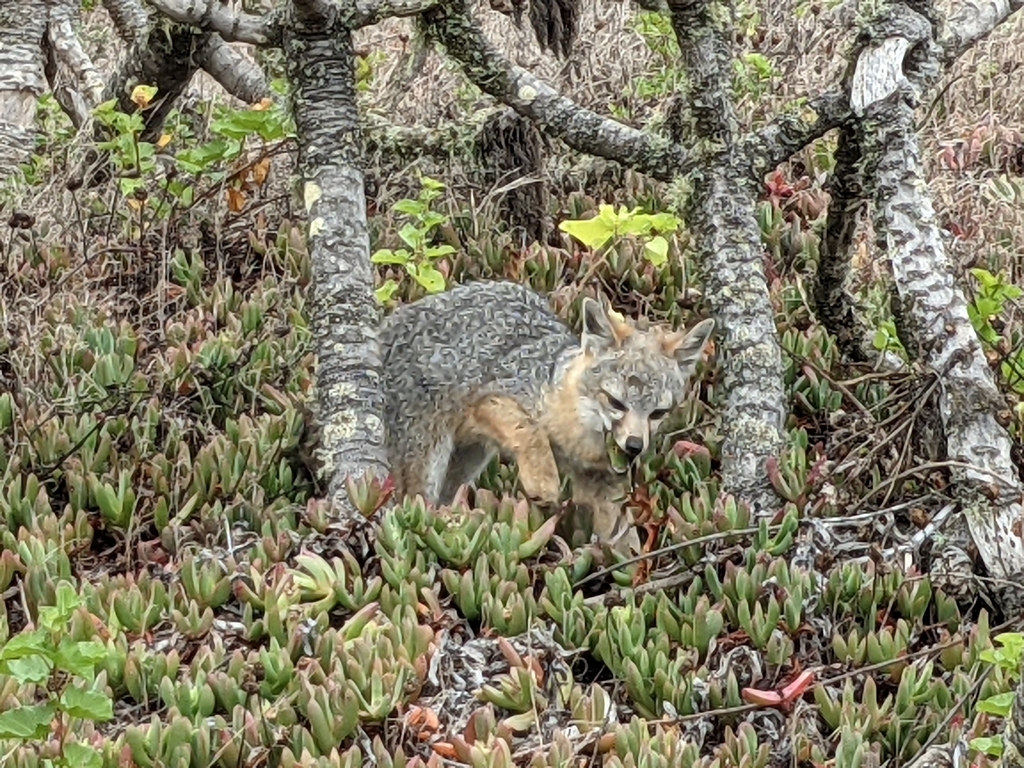
(c) Aaron Kreisberg, some rights reserved (CC BY) · licence
Family: Canidae · Class: Mammalia · Order: Carnivora
Conservation status: Delisted · G3T1 S1
Urocyon littoralis littoralis (San Miguel Island Fox) is a California animal in the Canidae family.
The San Miguel Island fox (Urocyon littoralis littoralis) is one of six subspecies of island fox endemic to the California Channel Islands. This diminutive canid is the smallest fox species known from the United States. Adult males weigh an average of 2.00 kilograms (4.4 pounds), while adult females weigh 1.88 kilograms (4.1 pounds) (USFWS 2016). The species exhibits typical vulpine features scaled down to approximately the size of a domestic cat, with a compact body, pointed ears, and a bushy tail. The pelage is typically grayish with russet tones on the sides and legs, similar to its mainland relative, the gray fox. The San Miguel Island fox is endemic exclusively to San Miguel Island, the westernmost of California's northern Channel Islands. This subspecies represents one of the most geographically restricted mammalian taxa in North America, confined to an island measuring approximately 37 square kilometers (14 square miles). The species evolved in isolation from mainland gray fox populations, likely arriving on the island between 10,400 and 16,000 years ago. San Miguel Island foxes inhabit diverse vegetation communities across the island, from coastal sage scrub and grasslands to maritime chaparral. The species shows considerable habitat flexibility, occupying areas from sea level to the island's highest elevations. They utilize both open grasslands and shrubland areas, adapting to the island's Mediterranean climate characterized by mild, wet winters and dry summers. The foxes create dens in rocky outcrops, hollow logs, and dense vegetation. Island foxes are omnivorous, with diets varying seasonally based on resource availability. They consume insects, fruits, small mammals, birds, eggs, and marine organisms found in intertidal zones. Breeding occurs once annually between February and May, with females producing litters of 1-5 kits after a gestation period of approximately 50 days. The species exhibits monogamous pair bonds and both parents participate in raising offspring. Foxes typically become sexually mature at 10 months of age. The San Miguel Island fox was listed as federally endangered in 2004 due to catastrophic population decline caused primarily by golden eagle predation. The population crashed from an estimated 450 individuals in 1999 to fewer than 15 foxes by 2004 (USFWS 2016). Recovery efforts included golden eagle removal, bald eagle reintroduction, and captive breeding programs. These intensive management actions proved highly successful. The subspecies was federally delisted in 2016 following population recovery to over 400 individuals. However, the species remains listed as threatened under California state law as of December 2025. Current population estimates indicate stable numbers above recovery targets, though ongoing monitoring continues to track population trends. Primary ongoing conservation concerns include potential disease outbreaks, extreme weather events, and the species' continued vulnerability due to its extremely limited geographic range and small population size.
Classification
Class: Mammalia · Order: Carnivora · Family: Canidae
Conservation status
Delisted · G3T1 S1
Frequently asked questions
How is Urocyon littoralis littoralis classified?
Urocyon littoralis littoralis belongs to class Mammalia, order Carnivora, family Canidae.
What family does Urocyon littoralis littoralis belong to?
Urocyon littoralis littoralis is in the Canidae family.
Is Urocyon littoralis littoralis protected or of conservation concern?
Urocyon littoralis littoralis carries the following status: Delisted · G3T1 S1.
What is Urocyon littoralis littoralis?
The San Miguel Island fox (Urocyon littoralis littoralis) is one of six subspecies of island fox endemic to the California Channel Islands.
Is Urocyon littoralis littoralis found in California?
Yes. Urocyon littoralis littoralis is recorded in California in The California Species Project's catalogue.
Related species
Other California species in the same genus, family, or bioregion.
Data from The California Species Project — 14,000+ California species with verified data from CNPS, CDFW, USFWS, and more.