Urocyon littoralis santacruzae
Santa Cruz Island Fox
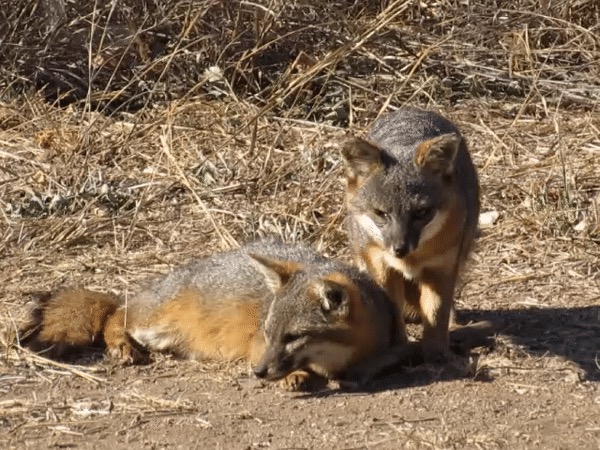
(c) Evan M. Raskin, some rights reserved (CC BY) · licence
Family: Canidae · Class: Mammalia · Order: Carnivora
Conservation status: Delisted · G3T1 S2
Urocyon littoralis santacruzae (Santa Cruz Island Fox) is a California animal in the Canidae family.
The Santa Cruz Island fox is a diminutive subspecies of the island fox (Urocyon littoralis), endemic to Santa Cruz Island in California's Channel Islands. Adults typically measure 48 to 50 cm (19 to 20 inches) in body length with a tail of 11 to 29 cm (4 to 11 inches), weighing between 1.3 to 2.8 kg (2.9 to 6.2 pounds). The subspecies exhibits the characteristic fox features with a pointed snout, erect triangular ears, and a bushy tail. Their coat is typically grayish with rust-colored sides and a black stripe running down the back and tail. The Santa Cruz Island fox is found exclusively on Santa Cruz Island, the largest of the Channel Islands, located approximately 32 km (20 miles) off the coast of Southern California. This subspecies is geographically isolated from mainland fox populations and the other five island fox subspecies found on the remaining Channel Islands. Santa Cruz Island encompasses approximately 249 square kilometers (96 square miles) of diverse terrain. The subspecies inhabits a variety of habitats across Santa Cruz Island, including coastal scrub, chaparral, grasslands, oak woodlands, and pine forests. They utilize both native and non-native vegetation communities, adapting to elevations from sea level to the island's highest peaks. The foxes demonstrate habitat flexibility, occupying territories that can include multiple vegetation types. Santa Cruz Island foxes are omnivorous and opportunistic feeders, with their diet varying seasonally based on resource availability. They consume fruits, insects, small mammals, birds, eggs, and carrion. Breeding typically occurs from February through March, with females giving birth to 1 to 5 kits after a gestation period of approximately 50 days. The foxes are primarily nocturnal but can be active during daylight hours, particularly during breeding season. They maintain territories and use dens in rock crevices, hollow trees, or brush piles. The Santa Cruz Island fox experienced a catastrophic population decline in the late 1990s, dropping from more than 1,400 individuals to only 55 by 2000 due primarily to predation by golden eagles that colonized the island. The subspecies was listed as endangered under the Endangered Species Act in 2004. Recovery efforts included captive breeding programs, golden eagle relocation, and bald eagle restoration to restore the natural predator balance. According to the U.S. Fish and Wildlife Service, the population recovered to approximately 2,100 individuals by 2015 (USFWS 2016). The subspecies was successfully delisted from federal endangered species protection in August 2016, representing one of the fastest mammalian recoveries under the Endangered Species Act. However, the Santa Cruz Island fox remains listed as threatened under California state law. Ongoing monitoring continues to ensure population stability, and disease surveillance remains important given the small island population's vulnerability to catastrophic events.
Classification
Class: Mammalia · Order: Carnivora · Family: Canidae
Conservation status
Delisted · G3T1 S2
Frequently asked questions
How is Urocyon littoralis santacruzae classified?
Urocyon littoralis santacruzae belongs to class Mammalia, order Carnivora, family Canidae.
What family does Urocyon littoralis santacruzae belong to?
Urocyon littoralis santacruzae is in the Canidae family.
Is Urocyon littoralis santacruzae protected or of conservation concern?
Urocyon littoralis santacruzae carries the following status: Delisted · G3T1 S2.
What is Urocyon littoralis santacruzae?
The Santa Cruz Island fox is a diminutive subspecies of the island fox (Urocyon littoralis), endemic to Santa Cruz Island in California's Channel Islands.
Is Urocyon littoralis santacruzae found in California?
Yes. Urocyon littoralis santacruzae is recorded in California in The California Species Project's catalogue.
Related species
Other California species in the same genus, family, or bioregion.
Data from The California Species Project — 14,000+ California species with verified data from CNPS, CDFW, USFWS, and more.