Urocyon littoralis santarosae
Santa Rosa Island Fox
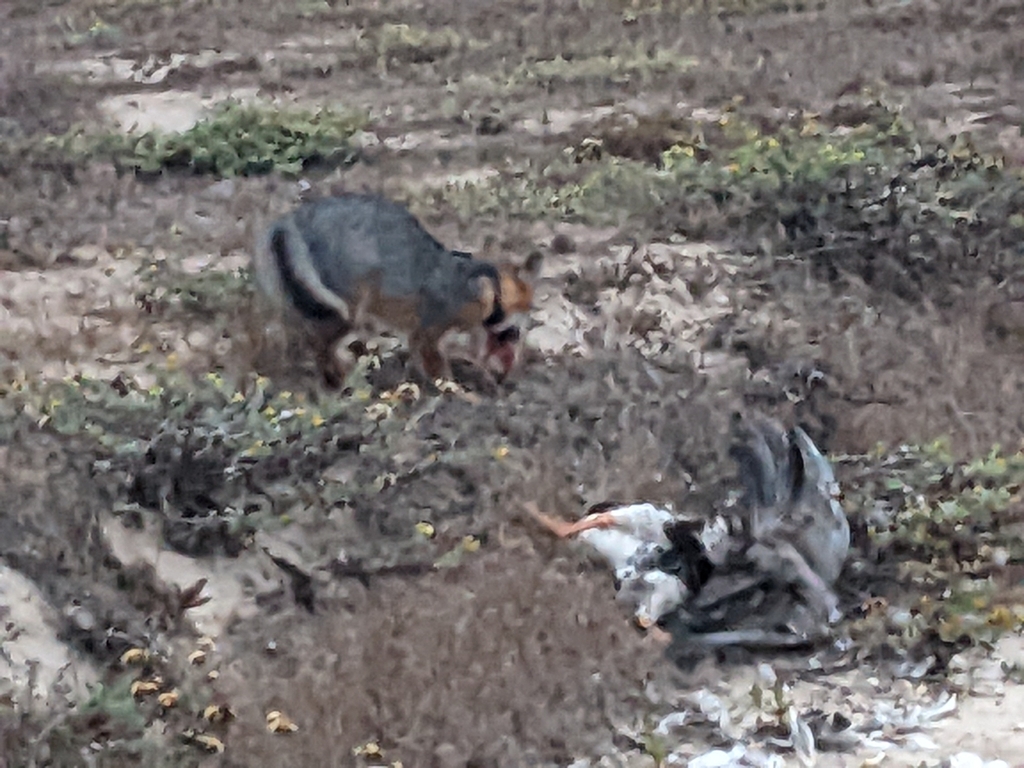
(c) Aaron Kreisberg, some rights reserved (CC BY) · licence
Family: Canidae · Class: Mammalia · Order: Carnivora
Conservation status: Delisted · G3T1 S2
Urocyon littoralis santarosae (Santa Rosa Island Fox) is a California animal in the Canidae family.
The Santa Rosa Island fox is a diminutive carnivore endemic to Santa Rosa Island, one of California's Channel Islands. Adults typically weigh 4 to 7 pounds (1.8 to 3.2 kg) and measure approximately 61 to 79 cm (24 to 31 inches) in total length, making it the second smallest fox species in North America (USFWS 2016). The subspecies displays the typical gray fox coloration with grizzled gray dorsal fur, rusty sides, and white underparts, though island foxes are notably smaller than their mainland relatives. The Santa Rosa Island fox is restricted entirely to Santa Rosa Island, located approximately 26 miles off the coast of Santa Barbara County, California. This 53,000-acre island represents the subspecies' complete natural range, with no populations occurring elsewhere. The island's isolation has resulted in the evolution of this distinct subspecies over thousands of years. The subspecies inhabits diverse island ecosystems including coastal scrub, grasslands, oak woodlands, and chaparral communities. Santa Rosa Island foxes utilize the full elevational range of the island, from sea level to the highest peaks at approximately 1,589 feet. They den in rocky outcrops, hollow trees, dense vegetation, and human-made structures, showing considerable adaptability to available shelter sites. Santa Rosa Island foxes are primarily nocturnal and crepuscular, though daytime activity has been observed. They are omnivorous opportunists, feeding on native fruits, insects, small mammals, birds, eggs, and marine organisms found in intertidal zones. The subspecies exhibits a monogamous mating system, with breeding occurring from late winter through early spring. Females typically produce 1 to 5 kits after a gestation period of approximately 50 days, with young becoming independent by fall. The Santa Rosa Island fox experienced one of the most dramatic population crashes and recoveries in conservation history. In the late 1990s, the population plummeted from approximately 1,780 individuals to just 15 by 2000, representing a decline of over 99 percent (USFWS 2016). This catastrophic decline resulted primarily from predation by golden eagles, which colonized the island after the extirpation of bald eagles by DDT and the introduction of feral pigs that served as alternative prey. The subspecies was listed as federally endangered in 2004. Recovery efforts included captive breeding programs, golden eagle removal and relocation, bald eagle reintroduction, and feral pig elimination. These coordinated conservation actions proved remarkably successful. By 2015, the population had recovered to approximately 1,200 individuals (USFWS 2016). The U.S. Fish and Wildlife Service removed the Santa Rosa Island fox from the federal endangered species list in August 2016, representing the fastest mammalian recovery under the Endangered Species Act. The subspecies remains listed as threatened under California state law as of December 2025, providing continued protection at the state level. Ongoing monitoring ensures population stability and guards against future threats including disease, climate change, and potential recolonization by golden eagles.
Classification
Class: Mammalia · Order: Carnivora · Family: Canidae
Conservation status
Delisted · G3T1 S2
Frequently asked questions
How is Urocyon littoralis santarosae classified?
Urocyon littoralis santarosae belongs to class Mammalia, order Carnivora, family Canidae.
What family does Urocyon littoralis santarosae belong to?
Urocyon littoralis santarosae is in the Canidae family.
Is Urocyon littoralis santarosae protected or of conservation concern?
Urocyon littoralis santarosae carries the following status: Delisted · G3T1 S2.
What is Urocyon littoralis santarosae?
The Santa Rosa Island fox is a diminutive carnivore endemic to Santa Rosa Island, one of California's Channel Islands.
Is Urocyon littoralis santarosae found in California?
Yes. Urocyon littoralis santarosae is recorded in California in The California Species Project's catalogue.
Related species
Other California species in the same genus, family, or bioregion.
Data from The California Species Project — 14,000+ California species with verified data from CNPS, CDFW, USFWS, and more.