Urosalpinx cinerea
Eastern Oyster Drill
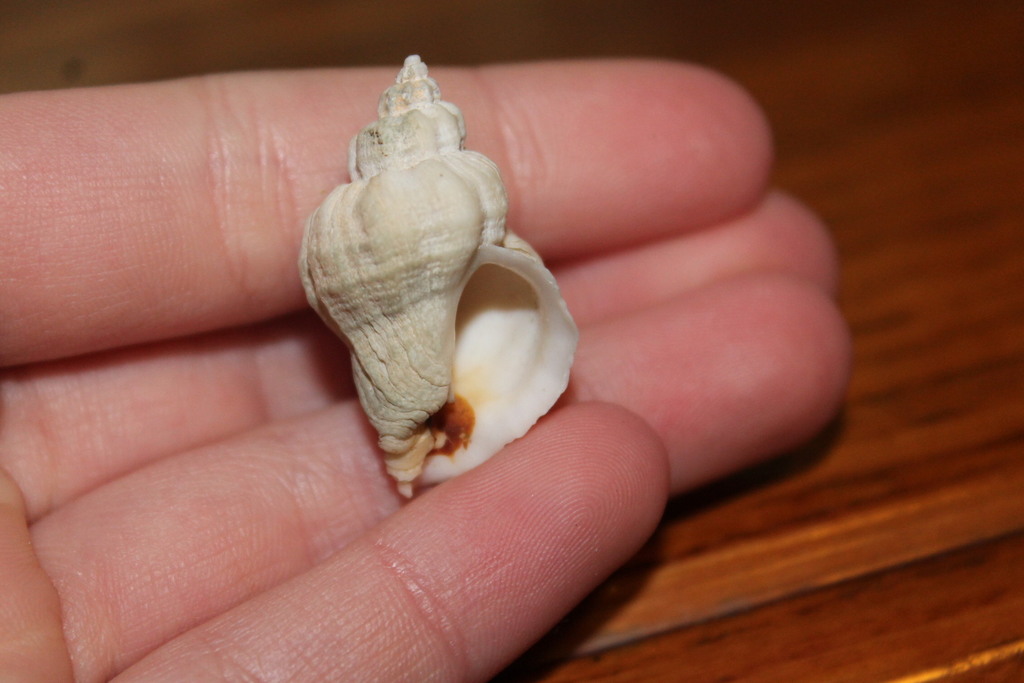
(c) Violet T., some rights reserved (CC BY) · licence
Family: Muricidae · Class: Muricidae · Order: Muricidae
Urosalpinx cinerea (Eastern Oyster Drill) is a California animal in the Muricidae family.
The Eastern oyster drill (Urosalpinx cinerea) is a predatory marine gastropod mollusk in the family Muricidae. This small sea snail typically reaches 15-35 mm (0.6-1.4 inches) in shell length, with a distinctive elongated, spindle-shaped shell featuring prominent spiral ridges and axial ribs that create a cancellate sculpture. The shell coloration ranges from grayish-brown to yellowish-brown, often with darker banding. The aperture is oval with a short siphonal canal, and the outer lip may be thickened in mature specimens. Native to the western Atlantic Ocean, the Eastern oyster drill occurs naturally from Newfoundland south to northeastern Florida and Mexico (SeaLifeBase). The species has been introduced to the Eastern Pacific, including California waters, and the Northeast Atlantic. In California, established populations are documented in San Francisco Bay, Tomales Bay, and other coastal estuaries where commercial oyster cultivation occurs. Eastern oyster drills inhabit intertidal and shallow subtidal zones, typically in areas with hard substrates including oyster beds, rocky shores, and artificial structures. They are commonly found in estuarine environments where salinity ranges from brackish to full seawater. The species tolerates a wide range of temperatures but shows optimal activity in waters between 15-25°C. Adults are often associated with their primary prey species in oyster beds and mussel communities. This species is a specialized predator that feeds primarily on bivalve mollusks, particularly oysters and mussels. Using its radula, the drill bores characteristic circular holes through the shells of prey organisms to access the soft tissues inside. The drilling process can take several hours to complete. Reproduction begins when water temperatures drop into the low 20s°C and remain stable for approximately one week (Animal Diversity Web). Females deposit egg capsules on hard substrates, with each capsule containing multiple developing embryos. The species exhibits direct development, with juveniles emerging as miniature adults rather than planktonic larvae. The Eastern oyster drill is considered a significant pest species in areas where it has been introduced, particularly in commercial oyster farming operations. In California, the species was likely introduced through ballast water or with oyster shipments from the Atlantic coast. Control efforts have included experimental programs in locations such as Tomales Bay, where researchers have tested various management strategies to reduce impacts on cultivated oysters (USGS NAS Database). The species' ability to rapidly colonize new habitats and its efficient predation on economically important bivalves make it a species of concern for aquaculture operations. While not subject to conservation protections, ongoing monitoring of introduced populations helps track the species' spread and ecological impacts in non-native habitats.
Classification
Class: Muricidae · Order: Muricidae · Family: Muricidae
Frequently asked questions
How is Urosalpinx cinerea classified?
Urosalpinx cinerea belongs to class Muricidae, order Muricidae, family Muricidae.
What family does Urosalpinx cinerea belong to?
Urosalpinx cinerea is in the Muricidae family.
What is Urosalpinx cinerea?
The Eastern oyster drill (Urosalpinx cinerea) is a predatory marine gastropod mollusk in the family Muricidae.
Is Urosalpinx cinerea found in California?
Yes. Urosalpinx cinerea is recorded in California in The California Species Project's catalogue.
Related species
Other California species in the same genus, family, or bioregion.
Data from The California Species Project — 14,000+ California species with verified data from CNPS, CDFW, USFWS, and more.