Urosaurus ornatus
Ornate Tree Lizard
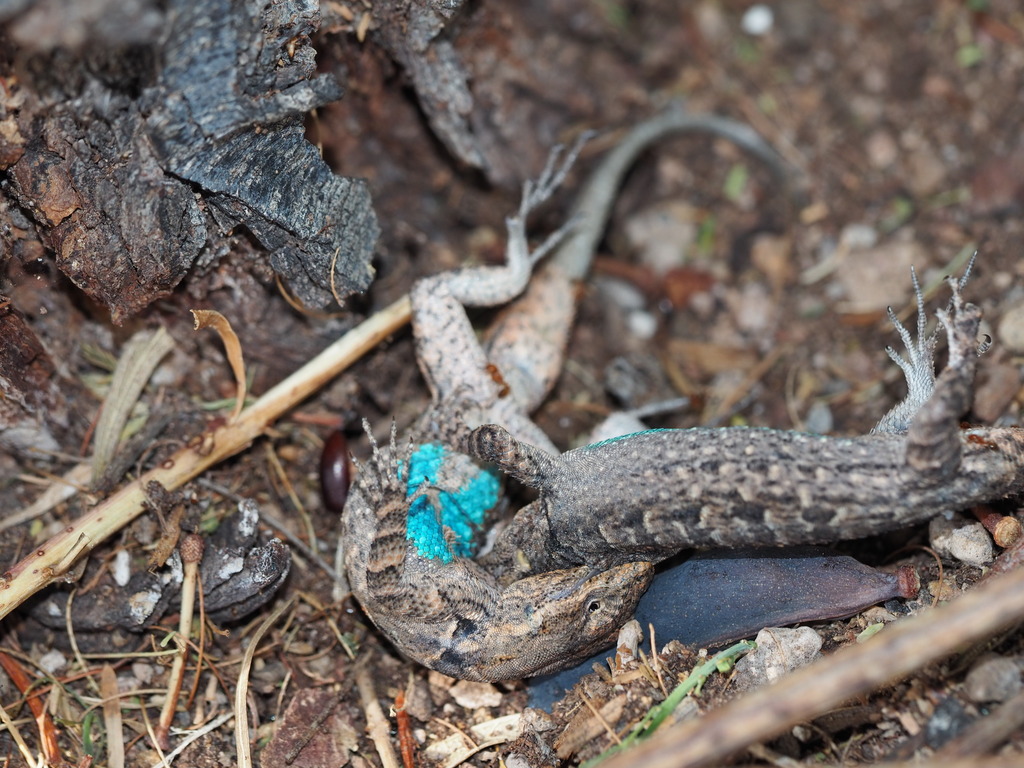
(c) Clay Gibbons, some rights reserved (CC BY) · licence
Family: Phrynosomatidae · Class: Reptilia · Order: Squamata
Urosaurus ornatus (Ornate Tree Lizard) is a California animal in the Phrynosomatidae family.
The Ornate Tree Lizard is a small, agile reptile measuring 40 to 64 millimeters (1.6 to 2.5 inches) in snout-to-vent length, with a total length including tail reaching up to 127 millimeters (5 inches). The species displays considerable color variation, ranging from gray to brown, often with darker crossbands or blotches across the back. Males typically exhibit brighter coloration during breeding season, with blue patches on the belly and throat, and orange or yellow coloration on the sides. A distinctive feature is the band of enlarged, keeled scales running down the center of the back, which is split by a narrow strip of smaller scales. The tail is long and slender, usually exceeding body length. In California, the Ornate Tree Lizard occurs primarily in the southeastern region along the Colorado River corridor. The subspecies present in California is Urosaurus ornatus symmetricus, known as the Colorado River Tree Lizard, which is found continuously along the Colorado River from the Nevada border south through Imperial County. According to field guides, the range extends inland to areas such as the Corn Spring area on the northeastern slope of the Chuckwalla Mountains. The species may be expanding westward along irrigation canals in the Imperial Valley. The species inhabits arid and semi-arid environments from sea level to approximately 2,770 meters (9,000 feet) elevation. Despite its common name, this lizard is frequently found on rocky substrates rather than trees, particularly in the treeless mountainous terrain characteristic of much of its California range. It occupies desert scrub, riparian areas along washes and streams, and has adapted to human-modified environments including buildings, fence posts, and other artificial structures. The species shows a preference for areas near water sources and is especially attracted to the edges of rivers, streams, and washes. Ornate Tree Lizards are diurnal and highly arboreal when suitable vegetation is available, but readily utilize rock faces and human structures as basking and foraging sites. They are active foragers, feeding primarily on insects including ants, beetles, flies, and small arthropods. During hot periods, they seek shade and may become inactive during peak summer temperatures. Breeding occurs in spring and early summer, with females laying clutches of 2 to 8 eggs in sandy or soft soil. The species is known for its territorial behavior, with males defending prime basking and foraging areas. The Ornate Tree Lizard is not federally or state listed in California and maintains stable populations throughout most of its range. NatureServe ranks the species globally as G5, indicating it is secure with no major conservation concerns. The subspecies in California appears to be expanding its range westward, possibly facilitated by irrigation infrastructure that provides suitable habitat corridors. Primary threats are minimal but may include habitat modification and urbanization in some areas along the Colorado River corridor.
Classification
Class: Reptilia · Order: Squamata · Family: Phrynosomatidae
Frequently asked questions
How is Urosaurus ornatus classified?
Urosaurus ornatus belongs to class Reptilia, order Squamata, family Phrynosomatidae.
What family does Urosaurus ornatus belong to?
Urosaurus ornatus is in the Phrynosomatidae family.
What is Urosaurus ornatus?
The Ornate Tree Lizard is a small, agile reptile measuring 40 to 64 millimeters (1.6 to 2.5 inches) in snout-to-vent length, with a total length including tail reaching up to 127 millimeters (5 inches).
Is Urosaurus ornatus found in California?
Yes. Urosaurus ornatus is recorded in California in The California Species Project's catalogue.
Related species
Other California species in the same genus, family, or bioregion.
Data from The California Species Project — 14,000+ California species with verified data from CNPS, CDFW, USFWS, and more.