Ursus americanus
American Black Bear
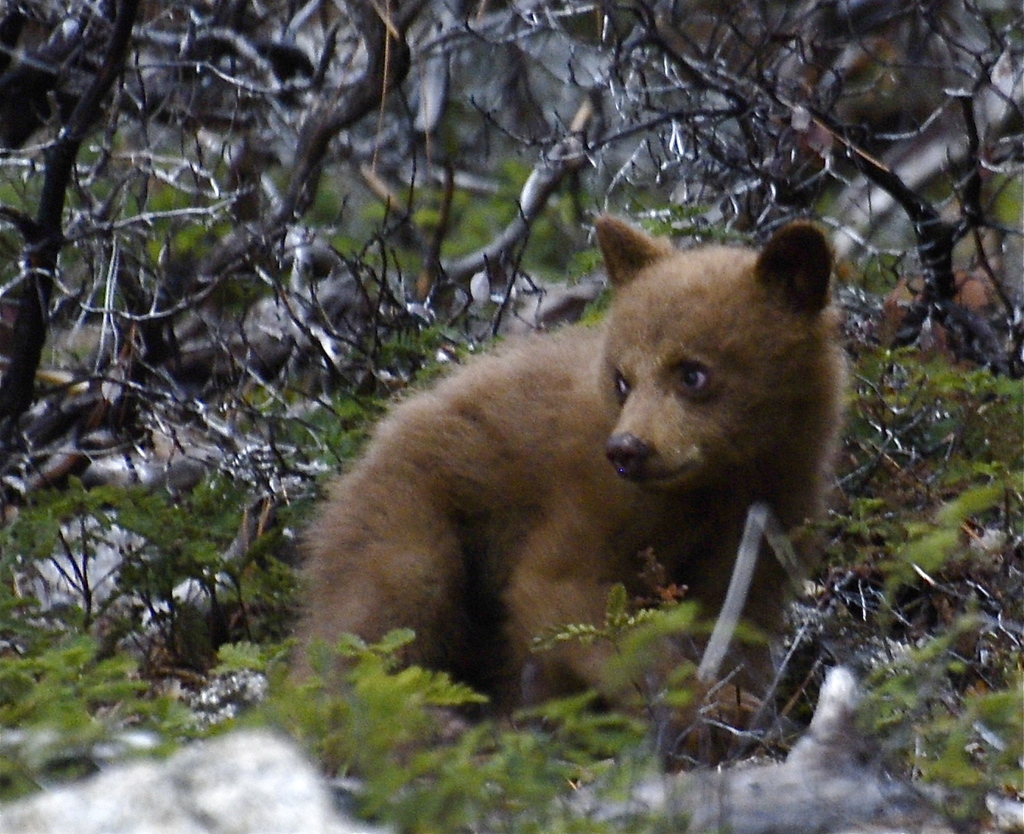
(c) Jay Pruett, some rights reserved (CC BY) · licence
Family: Ursidae · Class: Mammalia · Order: Carnivora
Ursus americanus (American Black Bear) is a California animal in the Ursidae family.
The American black bear is North America's most widely distributed bear species and the only bear found in California. Adults typically measure 1.3 to 1.8 meters (4.3 to 5.9 feet) in length and 0.9 to 1.1 meters (3.0 to 3.6 feet) in height at the shoulder. Males weigh 125 to 250 kilograms (275 to 550 pounds), while females are smaller at 90 to 180 kilograms (200 to 400 pounds). Despite the name, coat coloration varies from jet black to cinnamon brown, with some individuals displaying blonde or glacier blue phases. California bears are predominantly black or dark brown. The species has a straight facial profile, prominent ears, and a short tail. Front claws measure 5 to 7 centimeters (2 to 3 inches) and are well-adapted for climbing. In California, American black bears inhabit forested regions throughout the Sierra Nevada, Cascade Range, Coast Ranges, and scattered populations in the Transverse and Peninsular Ranges. They occur from near sea level in coastal areas to elevations exceeding 3,000 meters (9,800 feet) in the Sierra Nevada. The species was extirpated from the Central Valley and southern deserts by the early 1900s but maintains stable populations in suitable habitat. Current range includes approximately 52,000 square kilometers of the state. Black bears occupy diverse forest habitats including mixed conifer, oak woodland, chaparral, and riparian corridors. They prefer areas with dense understory vegetation for cover and seasonal food sources. Bears utilize different elevational zones seasonally, moving to higher elevations in summer and returning to lower areas for winter denning. Den sites include hollow trees, rock cavities, brush piles, and excavated burrows, typically on north-facing slopes. American black bears are omnivorous with seasonal dietary shifts. Spring foods include grasses, forbs, and emerging vegetation. Summer diet consists of berries, nuts, insects, and small mammals. Fall represents critical hyperphagia when bears consume acorns, manzanita berries, and other high-energy foods to accumulate fat reserves. They are excellent climbers and swimmers. Breeding occurs in June and July, but implantation is delayed until November. Females give birth to one to four cubs in winter dens, with two being typical. Cubs remain with mothers for approximately 17 months. California's black bear population has recovered substantially from historical lows. The California Department of Fish and Wildlife estimates the current population at 25,000 to 35,000 individuals, representing a significant increase from fewer than 10,000 bears in the 1980s. The species is classified as a game animal with regulated hunting seasons. Primary management challenges include human-bear conflicts in wildland-urban interface areas, vehicle strikes, and habitat fragmentation. Climate change may affect food availability and denning patterns. Conservation efforts focus on maintaining habitat connectivity, reducing human-bear conflicts through education and bear-proof storage requirements, and monitoring population trends through harvest data and research studies.
Classification
Class: Mammalia · Order: Carnivora · Family: Ursidae
Frequently asked questions
How is Ursus americanus classified?
Ursus americanus belongs to class Mammalia, order Carnivora, family Ursidae.
What family does Ursus americanus belong to?
Ursus americanus is in the Ursidae family.
What is Ursus americanus?
The American black bear is North America's most widely distributed bear species and the only bear found in California.
Is Ursus americanus found in California?
Yes. Ursus americanus is recorded in California in The California Species Project's catalogue.
Related species
Other California species in the same genus, family, or bioregion.
Data from The California Species Project — 14,000+ California species with verified data from CNPS, CDFW, USFWS, and more.