Ursus arctos horribilis
Grizzly bear
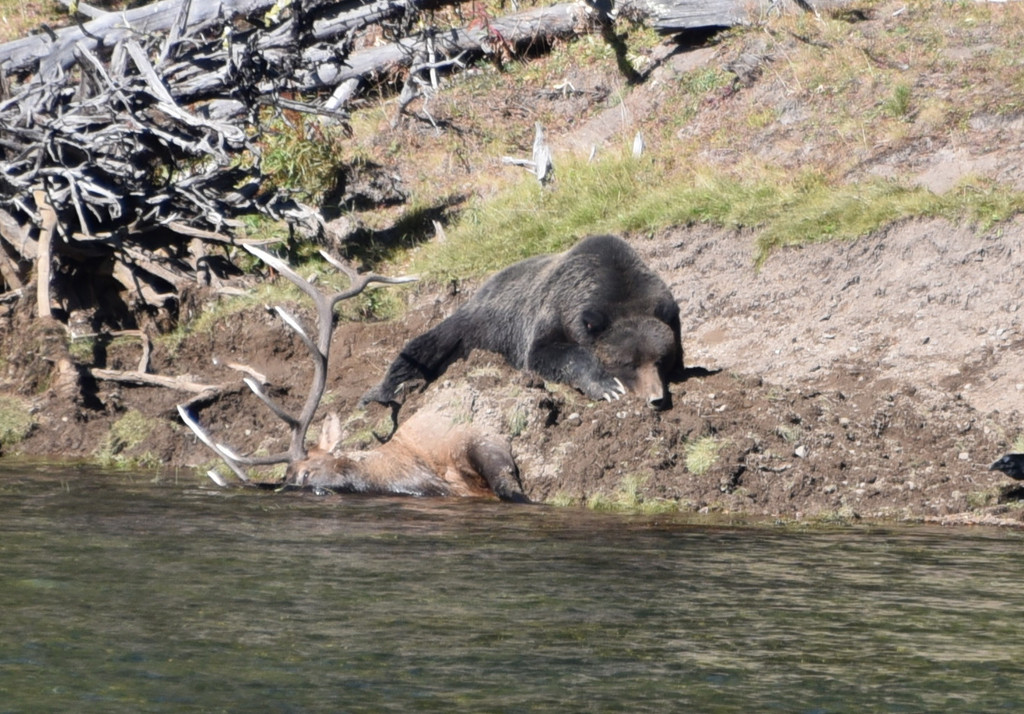
(c) Cody Stricker, some rights reserved (CC BY) · licence
Family: Ursidae · Class: Mammalia · Order: Carnivora
Conservation status: Threatened
Ursus arctos horribilis (Grizzly bear) is a California animal in the Ursidae family.
The grizzly bear is a large subspecies of brown bear endemic to North America. Adult males in the lower 48 states average 200 to 300 kilograms (400 to 600 pounds), while adult females weigh 110 to 160 kilograms (250 to 350 pounds) (USFWS 2024). Their coloration varies from light brown to nearly black, with longer guard hairs over a dense undercoat. Grizzly bears can be distinguished from black bears by their longer, less curved front claws, prominent shoulder hump, and concave facial profile. The distinctive shoulder hump consists of muscle mass that provides power for digging. Historically, grizzly bears occurred throughout much of the western half of the contiguous United States, central Mexico, western Canada, and most of Alaska. Prior to 1800, an estimated 50,000 grizzly bears were distributed across all or portions of 18 western states (USFWS). Currently in the lower 48 states, grizzly bears are restricted to portions of Montana, Wyoming, Idaho, and Washington, with populations also present in western Canada and Alaska. The species has been extirpated from California since the 1920s. Grizzly bears occupy diverse habitats ranging from coastal areas to alpine zones. In the lower 48 states, they inhabit mountainous regions, including subalpine meadows, whitebark pine forests, riparian areas, and avalanche chutes. These bears require large home ranges and utilize seasonal food sources across elevational gradients. Secure habitat availability is a critical factor limiting population recovery in some areas (USFWS 2024). Grizzly bears are omnivorous with seasonal dietary shifts. They consume diverse, high-caloric foods including roots, berries, nuts (particularly whitebark pine nuts), grasses, fish, and ungulates. Bears enter hibernation from October through April, with pregnant females giving birth to 1-4 cubs during winter denning. Cubs remain with mothers for 2-3 years, and females typically reproduce every 2-4 years. Adult female survival rates above 93 percent are considered necessary for population stability (USFWS 2024). The grizzly bear was listed as threatened under the Endangered Species Act in 1975 throughout the conterminous United States, except where listed as an experimental population. As of December 2025, the U.S. Fish and Wildlife Service estimates fewer than 2,000 grizzly bears remain in the lower 48 states, distributed among six recovery areas. The Greater Yellowstone Ecosystem supports approximately 800 bears, while the Northern Continental Divide Ecosystem contains over 1,000 individuals (USFWS 2024). The Cabinet-Yaak recovery area contains fewer than 50 bears, with ongoing augmentation efforts since 1990. Primary threats include habitat loss and fragmentation, human-bear conflicts, climate change affecting food sources, and limited connectivity between populations. On January 8, 2025, USFWS announced a comprehensive approach to long-term recovery, proposing rule revisions to provide additional management flexibility while maintaining species protection.
Classification
Class: Mammalia · Order: Carnivora · Family: Ursidae
Conservation status
Threatened
Frequently asked questions
How is Ursus arctos horribilis classified?
Ursus arctos horribilis belongs to class Mammalia, order Carnivora, family Ursidae.
What family does Ursus arctos horribilis belong to?
Ursus arctos horribilis is in the Ursidae family.
Is Ursus arctos horribilis protected or of conservation concern?
Ursus arctos horribilis carries the following status: Threatened.
What is Ursus arctos horribilis?
The grizzly bear is a large subspecies of brown bear endemic to North America.
Is Ursus arctos horribilis found in California?
Yes. Ursus arctos horribilis is recorded in California in The California Species Project's catalogue.
Related species
Other California species in the same genus, family, or bioregion.
Data from The California Species Project — 14,000+ California species with verified data from CNPS, CDFW, USFWS, and more.