Uta stansburiana
Common Side-Blotched Lizard
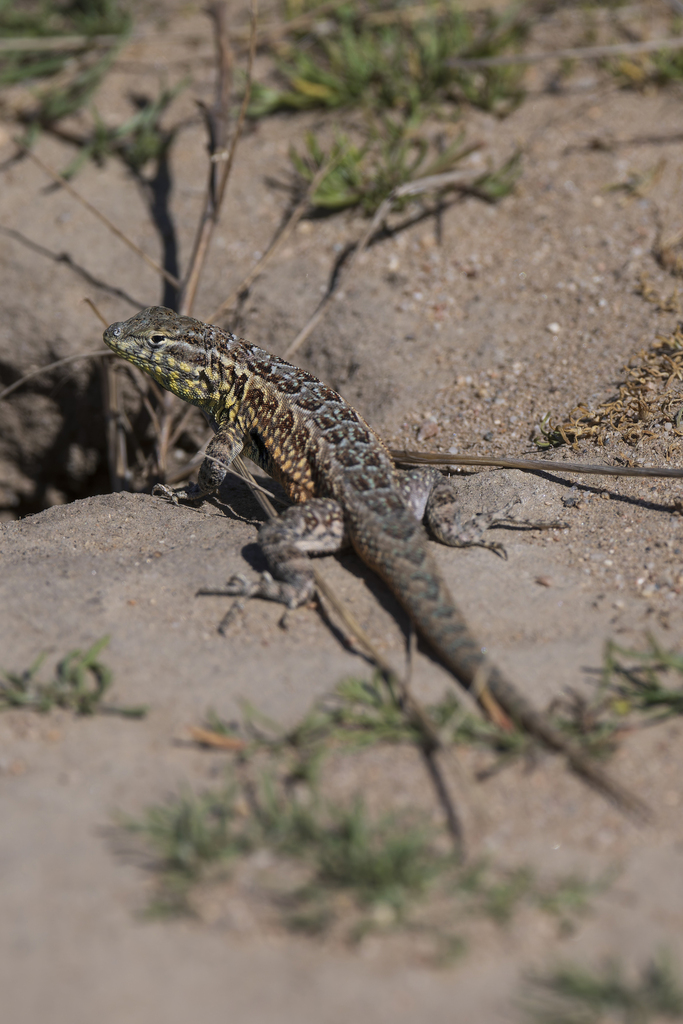
(c) William Walker, some rights reserved (CC BY) · licence
Family: Iguanidae · Class: Reptilia · Order: Squamata
Uta stansburiana (Common Side-Blotched Lizard) is a California animal in the Iguanidae family.
The common side-blotched lizard is a small, ground-dwelling reptile measuring 3.8 to 6.3 centimeters (1.5 to 2.5 inches) in snout-to-vent length, with a total length including tail of 10 to 15 centimeters (4 to 6 inches). The species exhibits notable sexual dimorphism and color polymorphism. Males display bright blue, orange, or yellow throat patches, while females show varying degrees of orange coloration. All individuals possess the characteristic dark blotch behind the front legs that gives the species its common name. The dorsal surface is typically gray, brown, or tan with darker crossbands or spots, providing effective camouflage against desert substrates. The common side-blotched lizard has one of the most extensive ranges of any North American lizard species, occurring throughout most of California except for the northwestern coastal regions and high-elevation Sierra Nevada. The species ranges from sea level to elevations exceeding 2,100 meters (6,900 feet). In California, multiple subspecies are recognized, including U. s. elegans in southern California deserts, U. s. hesperis along the coast and western valleys, and U. s. nevadensis east of the Sierra Nevada in the Great Basin region. The species extends beyond California throughout much of the western United States and northwestern Mexico. This adaptable lizard occupies diverse habitat types, from coastal scrublands and grasslands to desert flats, rocky hillsides, and woodland edges. The species thrives in areas with scattered vegetation including sagebrush, chaparral, Joshua tree woodlands, and desert scrub communities. According to the California Department of Fish and Wildlife, common side-blotched lizards show preferences for cooler locations at higher elevations and areas with adequate vegetation cover. They utilize various substrate types including sandy washes, rocky outcrops, hardpan, and loamy soils. Common side-blotched lizards are primarily insectivorous, feeding on ants, beetles, flies, spiders, and other small arthropods. The species exhibits complex social dynamics, with males defending territories during the breeding season from March through August. Females lay 2 to 7 eggs per clutch, with multiple clutches possible per year in favorable conditions. The species demonstrates complex reproductive strategies, with some populations showing rock-paper-scissors-like mating dynamics where different male color morphs employ distinct territorial and mating behaviors. Activity patterns are typically diurnal, with lizards basking in morning sun and seeking shade during peak heat. The common side-blotched lizard currently lacks federal or state conservation listing status and appears to maintain stable populations across most of its range. The species benefits from its ecological adaptability and broad habitat tolerance. However, local populations may face pressures from habitat conversion, urban development, and climate change effects on desert ecosystems. The species serves as an important prey item for snakes, birds, and other predators, contributing to desert food web dynamics throughout its range.
Classification
Class: Reptilia · Order: Squamata · Family: Iguanidae
Frequently asked questions
How is Uta stansburiana classified?
Uta stansburiana belongs to class Reptilia, order Squamata, family Iguanidae.
What family does Uta stansburiana belong to?
Uta stansburiana is in the Iguanidae family.
What is Uta stansburiana?
The common side-blotched lizard is a small, ground-dwelling reptile measuring 3.8 to 6.3 centimeters (1.5 to 2.5 inches) in snout-to-vent length, with a total length including tail of 10 to 15 centimeters (4 to 6 inches).
Is Uta stansburiana found in California?
Yes. Uta stansburiana is recorded in California in The California Species Project's catalogue.
Related species
Other California species in the same genus, family, or bioregion.
Data from The California Species Project — 14,000+ California species with verified data from CNPS, CDFW, USFWS, and more.