Utetheisa ornatrix
Bella Moth
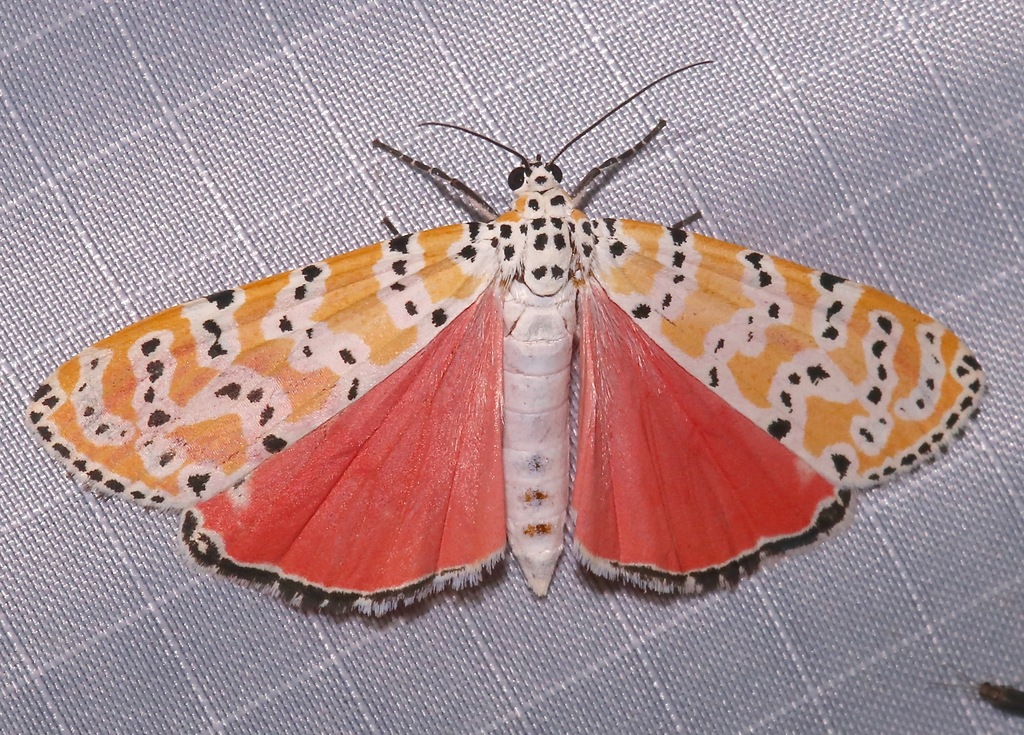
(c) Laura Gaudette, some rights reserved (CC BY) · licence
Family: Erebidae · Class: Insecta · Order: Lepidoptera
Utetheisa ornatrix (Bella Moth) is a California animal in the Erebidae family.
The Bella moth (Utetheisa ornatrix) is a medium-sized moth in the family Erebidae, distinguished by its vibrant warning coloration. Adults have a wingspan of 35 to 45 mm (1.4 to 1.8 inches). The forewings display a complex pattern of white or cream base color with orange-red and black markings, including distinctive black spots arranged in irregular rows. The hindwings are bright pink to red with black marginal borders and scattered black spots. This colorful pattern serves as aposematic coloration, warning predators of the moth's toxicity. The Bella moth ranges from Nova Scotia to Florida, extending west to Minnesota, Kansas, and Texas. In California, the species occurs primarily in the southern regions, though distribution records suggest it may be less common than in southeastern United States. The species' western range limit appears to coincide with suitable host plant availability and climatic conditions favorable for year-round or extended breeding seasons. Bella moths inhabit diverse environments where their host plants occur, including open fields, prairie margins, disturbed areas, roadsides, and forest edges. The species demonstrates broad host plant utilization, feeding primarily on various legumes in the genus Crotalaria. According to Wagner (2005) and other lepidopteran literature, larvae also utilize other legumes including Lespedeza and Lupinus species, as well as non-leguminous hosts such as elm trees (Ulmus species), fireweed (Chamaenerion angustifolium), and Prunus species. This diverse host range allows the species to exploit multiple habitat types from sea level to moderate elevations. Adult Bella moths are primarily nocturnal and are attracted to artificial lights. Males locate females through pheromone detection and engage in courtship behaviors. Females deposit eggs on host plant foliage. Larvae are densely covered in long, black and white hairs and feed openly on leaves during daylight hours. The caterpillars sequester pyrrolizidine alkaloids from their Crotalaria host plants, making both larvae and adults unpalatable to many predators (Conner et al. 1981). This chemical defense system is retained through metamorphosis, providing protection throughout the life cycle. The species typically produces multiple generations annually in warmer climates, with continuous breeding from spring through fall where conditions permit. In northern portions of the range, reproductive cycles may be more restricted by temperature and photoperiod, with fewer generations per year. Pupation occurs in cocoons constructed in protected locations. The Bella moth is not federally or state listed and appears to maintain stable populations throughout most of its range. The species benefits from its broad host plant tolerance and ability to exploit disturbed habitats. However, local populations may be affected by habitat loss, pesticide applications, and the decline of native legume host plants in agricultural landscapes. Climate change may potentially expand the species' northern range while affecting southern populations through increased temperature extremes.
Classification
Class: Insecta · Order: Lepidoptera · Family: Erebidae
Frequently asked questions
How is Utetheisa ornatrix classified?
Utetheisa ornatrix belongs to class Insecta, order Lepidoptera, family Erebidae.
What family does Utetheisa ornatrix belong to?
Utetheisa ornatrix is in the Erebidae family.
What is Utetheisa ornatrix?
The Bella moth (Utetheisa ornatrix) is a medium-sized moth in the family Erebidae, distinguished by its vibrant warning coloration.
Is Utetheisa ornatrix found in California?
Yes. Utetheisa ornatrix is recorded in California in The California Species Project's catalogue.
Related species
Other California species in the same genus, family, or bioregion.
Data from The California Species Project — 14,000+ California species with verified data from CNPS, CDFW, USFWS, and more.