Vanduzeeina borealis californica
California shield-backed bug
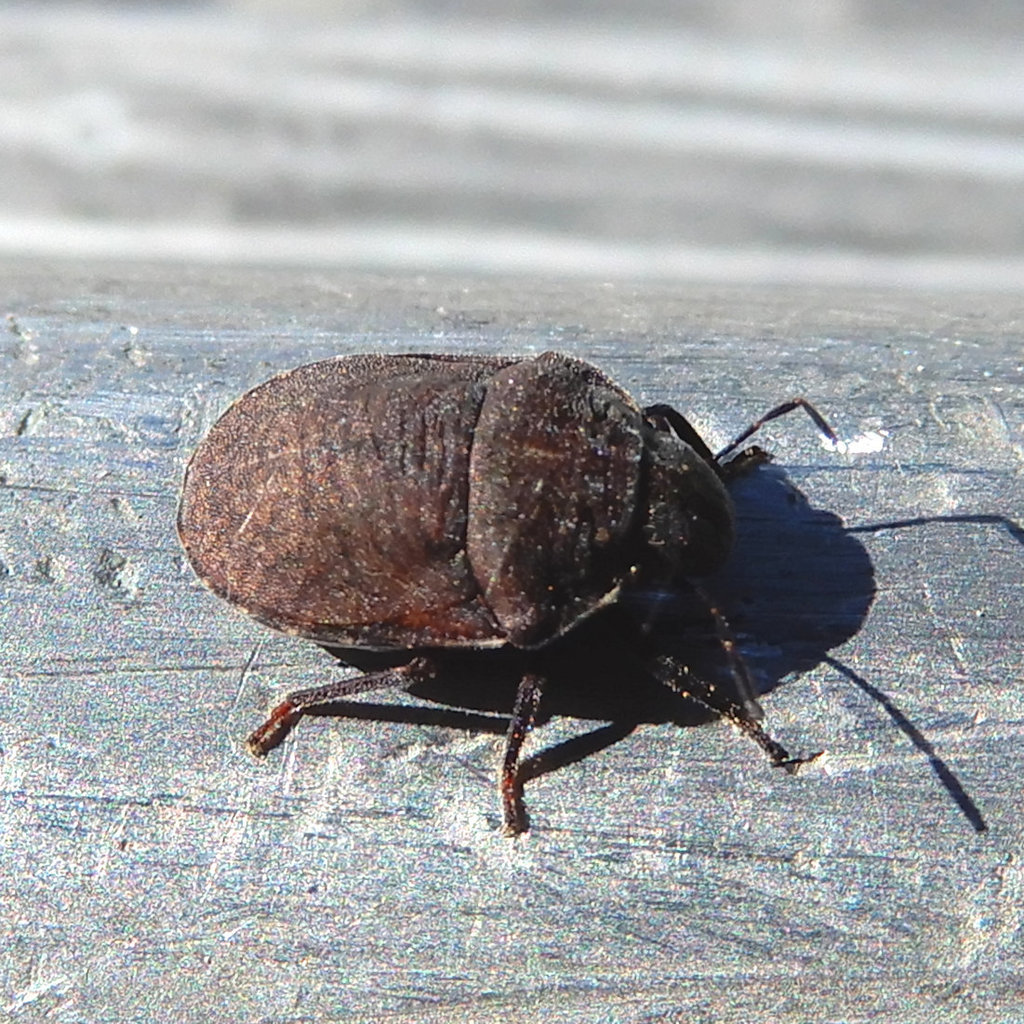
(c) Reiner Jakubowski, some rights reserved (CC BY-SA) · licence
Family: Scutelleridae · Class: Insecta · Order: Hemiptera
Vanduzeeina borealis californica (California shield-backed bug) is a California animal in the Scutelleridae family.
The California shield-backed bug is a small hemipteran insect belonging to the family Scutelleridae. Adults measure approximately 6.3 mm in length and 3.7 mm in width, with distinctive proportional features including a head length of 1.6 mm and width of 2.08 mm including the eyes (Xerces Society 2019). The pronotum measures 1.6 mm in length and 3.58 mm in width, while the scutellum extends 3.52 mm in length and 3.44 mm in width. The species exhibits the characteristic shield-like appearance of scutellerids, with the enlarged scutellum covering most of the abdomen. Antennal segments display specific proportional ratios, and the male reproductive structures are similar to the nominate subspecies but differ in the shape of sclerotized portions of the biramous apical conjunctival appendages. Vanduzeeina borealis californica has an extremely limited distribution, known only from California and Oregon. In California, documented locations include Yosemite National Park and Cisco, located just west of Donner Pass in the Sierra Nevada. Oregon populations occur in the Mt. Hood area of Hood River County and the H.J. Andrews Experimental Forest in eastern Lane County (Xerces Society 2019). This subspecies represents the southern extent of the species' range, as the nominate subspecies V. b. borealis extends northward through western North America to Canada, where it has been recorded in the Yukon, British Columbia, Alberta, Manitoba, and Ontario. This rare subspecies specializes in tall grass prairie habitats, particularly inhabiting high elevation natural balds and meadows at approximately 900 meters elevation. The species shows strong habitat specificity for these montane grassland ecosystems, which are characterized by native bunch grasses and associated forb communities. In Oregon, the subspecies may potentially inhabit Bureau of Land Management lands within the McKenzie Resource Area, though comprehensive habitat surveys remain limited. Specific ecological requirements and behavioral patterns of V. b. californica remain poorly documented in scientific literature. As a member of the Scutelleridae family, the species likely follows typical hemipteran feeding patterns, using piercing-sucking mouthparts to extract plant fluids from host vegetation. The connection to tall grass prairie habitats suggests potential feeding relationships with native grasses, though specific host plant associations have not been definitively established. Reproductive timing, overwintering strategies, and population dynamics require further research to understand the subspecies' life history requirements. NatureServe assigned a global conservation status of G3T3, indicating the subspecies is vulnerable to extinction (Xerces Society 2019). Oregon lists the subspecies as S1, denoting it as critically imperiled within the state, while California has not formally evaluated its conservation status. The species faces significant conservation challenges due to its extremely restricted range, highly specific habitat requirements, and small population sizes. Primary threats likely include habitat loss and degradation of montane grassland ecosystems through development, altered fire regimes, invasive species encroachment, and climate change impacts on high elevation habitats. The limited number of known sites emphasizes the critical need for comprehensive surveys to document additional populations and better understand habitat requirements for effective conservation planning.
Classification
Class: Insecta · Order: Hemiptera · Family: Scutelleridae
Frequently asked questions
How is Vanduzeeina borealis californica classified?
Vanduzeeina borealis californica belongs to class Insecta, order Hemiptera, family Scutelleridae.
What family does Vanduzeeina borealis californica belong to?
Vanduzeeina borealis californica is in the Scutelleridae family.
What is Vanduzeeina borealis californica?
The California shield-backed bug is a small hemipteran insect belonging to the family Scutelleridae.
Is Vanduzeeina borealis californica found in California?
Yes. Vanduzeeina borealis californica is recorded in California in The California Species Project's catalogue.
More California species
This species has no close relatives in our California data — here are other species to explore.
Data from The California Species Project — 14,000+ California species with verified data from CNPS, CDFW, USFWS, and more.