Vanessa atalanta
Red Admiral
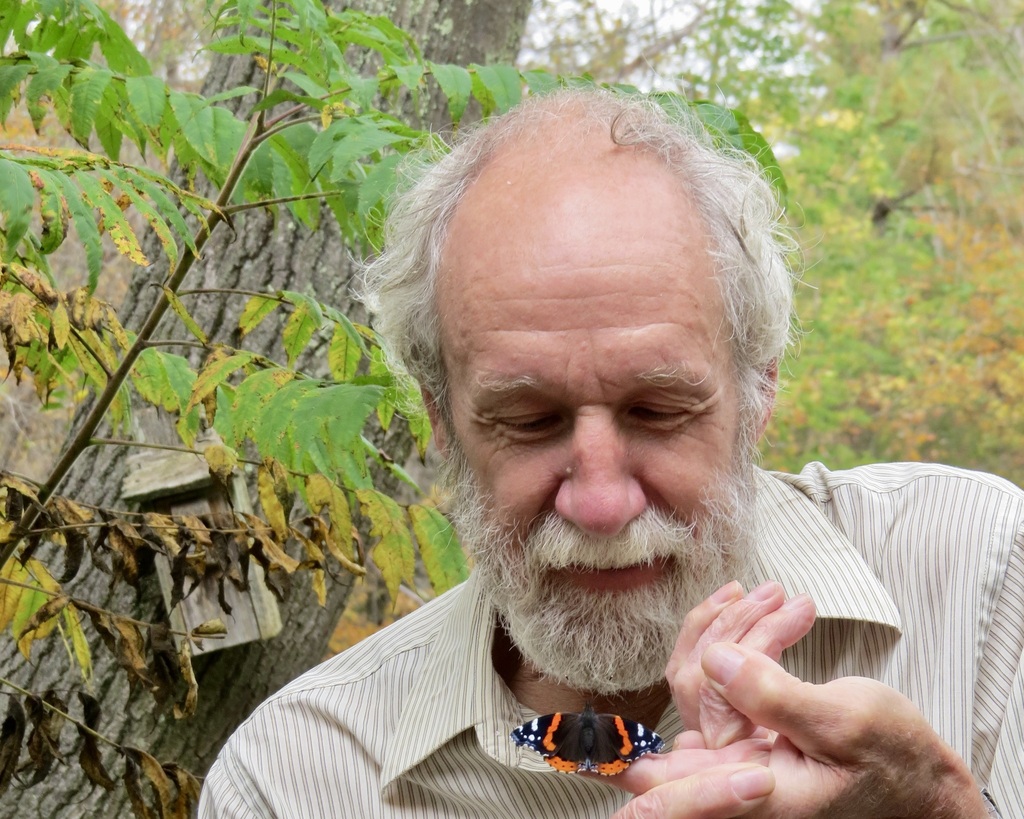
(c) Bernie Paquette, some rights reserved (CC BY) · licence
Family: Nymphalidae · Class: Insecta · Order: Lepidoptera
Vanessa atalanta (Red Admiral) is a California animal in the Nymphalidae family.
The Red Admiral (Vanessa atalanta) is a medium-sized butterfly with distinctive wing patterns that facilitate identification in the field. Adults have a wingspan of 45-60 mm (1.8-2.4 inches). The forewings are primarily black with white spots near the apex and a prominent red band across the middle portion. The hindwings display a red marginal band with small black spots and blue patches near the anal angle. The ventral surfaces are more subdued, with the hindwings showing intricate patterns of brown, white, and blue that provide camouflage when the butterfly is at rest. Red Admirals have one of the most extensive distributions of any butterfly species, ranging from Guatemala north through Mexico and the United States to northern Canada, with populations also established in Hawaii, some Caribbean Islands, New Zealand, Europe, Northern Africa, and Asia. The species cannot survive the coldest winters, requiring most of North America to be recolonized each spring by southern migrants. In California, Red Admirals occur throughout the state from sea level to elevations exceeding 3,000 meters (9,840 feet), including urban areas, gardens, and wildland habitats. The species inhabits diverse environments including gardens, parks, woodland edges, riparian corridors, meadows, and disturbed areas. Red Admirals show particular affinity for areas containing their host plants and nectar sources. Adults are frequently observed in gardens and urban settings where cultivated flowers provide abundant nectar resources. The species demonstrates high adaptability to human-modified landscapes. Red Admiral larvae feed exclusively on plants of the nettle family (Urticaceae), including stinging nettle (Urtica dioica), tall wild nettle (U. gracilis), wood nettle (Laportea canadensis), false nettle (Boehmeria cylindrica), pellitory (Parietaria pennsylvanica), mamaki (Pipturus albidus), and possibly hops (Humulus). Females deposit single eggs on host plant leaves, and larvae construct silk shelters by folding leaves together. The species completes multiple generations annually in favorable climates, with development from egg to adult requiring approximately 4-6 weeks depending on temperature. Adults are strong fliers capable of long-distance migration, with northward movements coinciding with spring warming and southward flights occurring in fall. Males establish territories and engage in aerial interactions with intruders, often perching on elevated objects in sunny locations. Red Admirals have no special conservation status and are considered secure throughout their range. The species benefits from its broad host plant tolerance, strong dispersal ability, and adaptation to human-modified environments. Population levels fluctuate naturally due to weather patterns, migration success, and seasonal breeding cycles. Climate change may alter migration patterns and seasonal timing, but the species' cosmopolitan distribution and ecological flexibility suggest continued stability. Urban development that eliminates host plants may create local population bottlenecks, though the species' mobility allows recolonization from surrounding areas.
Classification
Class: Insecta · Order: Lepidoptera · Family: Nymphalidae
Frequently asked questions
How is Vanessa atalanta classified?
Vanessa atalanta belongs to class Insecta, order Lepidoptera, family Nymphalidae.
What family does Vanessa atalanta belong to?
Vanessa atalanta is in the Nymphalidae family.
What is Vanessa atalanta?
The Red Admiral (Vanessa atalanta) is a medium-sized butterfly with distinctive wing patterns that facilitate identification in the field.
Is Vanessa atalanta found in California?
Yes. Vanessa atalanta is recorded in California in The California Species Project's catalogue.
Related species
Other California species in the same genus, family, or bioregion.
Data from The California Species Project — 14,000+ California species with verified data from CNPS, CDFW, USFWS, and more.