Vanessa cardui
Painted Lady
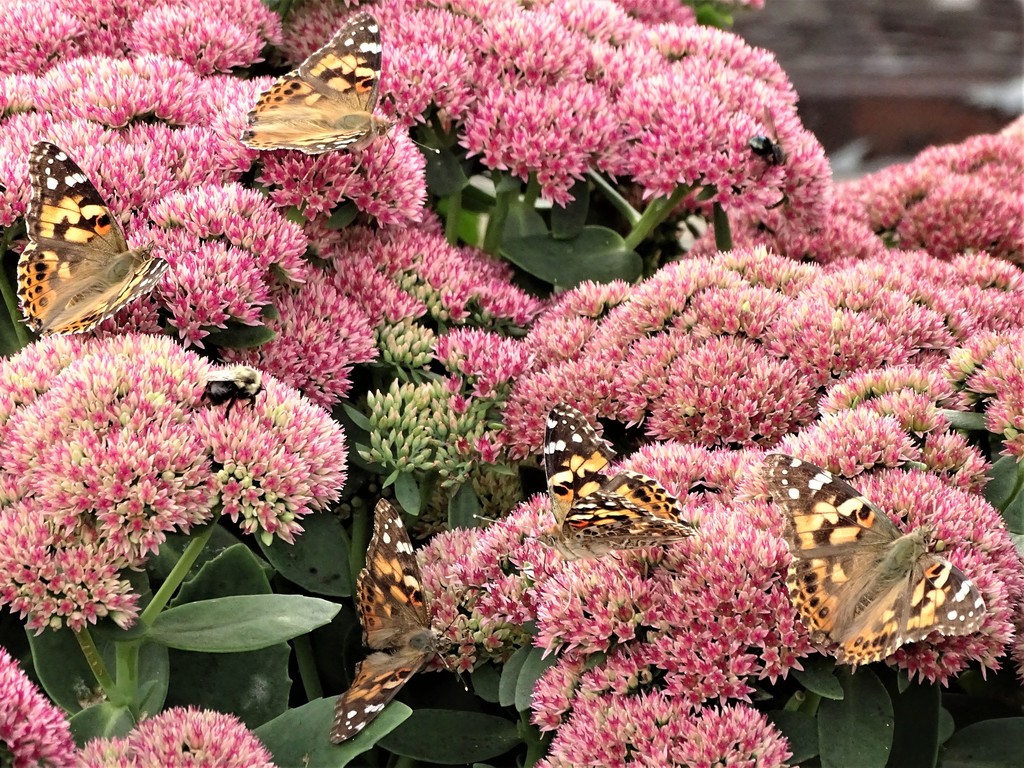
(c) Shirley Zundell, some rights reserved (CC BY) · licence
Family: Nymphalidae · Class: Insecta · Order: Lepidoptera
Vanessa cardui (Painted Lady) is a California animal in the Nymphalidae family.
The Painted Lady (Vanessa cardui) is a medium-sized butterfly with a wingspan ranging from 50 to 65 mm (2.0 to 2.6 inches). The dorsal wing surfaces display orange-brown coloration with black markings and white spots near the forewings' apex. The forewings feature distinctive black patches and white subapical spots, while the hindwings show a row of small eyespots along the margin. The ventral surfaces are mottled brown and gray with intricate patterns that provide effective camouflage when the wings are closed. Males and females are similar in appearance, though females are typically slightly larger. The Painted Lady has the most extensive distribution of any butterfly species, occurring on all continents except Australia and Antarctica. From the deserts of northern Mexico, this species migrates and temporarily colonizes the United States and Canada south of the Arctic. Occasionally, population explosions in Mexico cause massive northward migrations that can reach as far as southern Canada. The species is also known as the Cosmopolitan due to its worldwide distribution and as the Thistle Butterfly because of its caterpillars' feeding preferences. Painted Ladies inhabit diverse environments including gardens, fields, meadows, roadsides, parks, and disturbed areas from sea level to elevations exceeding 3,000 meters (10,000 feet). The species shows substantial adaptability to various climatic conditions and can establish temporary populations in almost any habitat containing suitable host plants. Adults prefer open areas with abundant nectar sources and shelter from strong winds. This species exhibits complex migratory behaviors. Unlike monarchs, Painted Ladies cannot survive freezing temperatures and must continuously recolonize northern regions from southern breeding populations. Migration patterns are irregular and depend on weather conditions, host plant availability, and population density in source areas. Adults are strong fliers capable of traveling hundreds of miles, often assisted by favorable winds. The species uses a multi-generational migration strategy, with successive generations moving progressively northward during spring and summer. Painted Lady larvae feed on more than 100 host plant species across multiple families, with favorites including thistles (Asteraceae), hollyhock and mallow (Malvaceae), and various legumes (Fabaceae). This broad host plant range contributes significantly to the species' global success. Caterpillars create silk shelters by webbing leaves together and feed within these protective structures. Development from egg to adult requires approximately 4 to 6 weeks under favorable conditions. Adults are active during daylight hours and feed on nectar from diverse flowering plants including buddleia, lantana, asters, and thistles. Males establish territories and engage in perching behavior to locate potential mates. Females deposit single eggs on host plant leaves, typically choosing younger, more tender foliage. The Painted Lady is not listed under any conservation status, as populations remain stable globally despite natural fluctuations. The species' adaptability, broad host plant range, and migratory behavior provide resilience against local environmental changes. However, climate change may affect migration timing and success rates, while habitat loss in key breeding areas could impact regional population dynamics.
Classification
Class: Insecta · Order: Lepidoptera · Family: Nymphalidae
Frequently asked questions
How is Vanessa cardui classified?
Vanessa cardui belongs to class Insecta, order Lepidoptera, family Nymphalidae.
What family does Vanessa cardui belong to?
Vanessa cardui is in the Nymphalidae family.
What is Vanessa cardui?
The Painted Lady (Vanessa cardui) is a medium-sized butterfly with a wingspan ranging from 50 to 65 mm (2.0 to 2.6 inches).
Is Vanessa cardui found in California?
Yes. Vanessa cardui is recorded in California in The California Species Project's catalogue.
Related species
Other California species in the same genus, family, or bioregion.
Data from The California Species Project — 14,000+ California species with verified data from CNPS, CDFW, USFWS, and more.