Vanessa virginiensis
American Lady
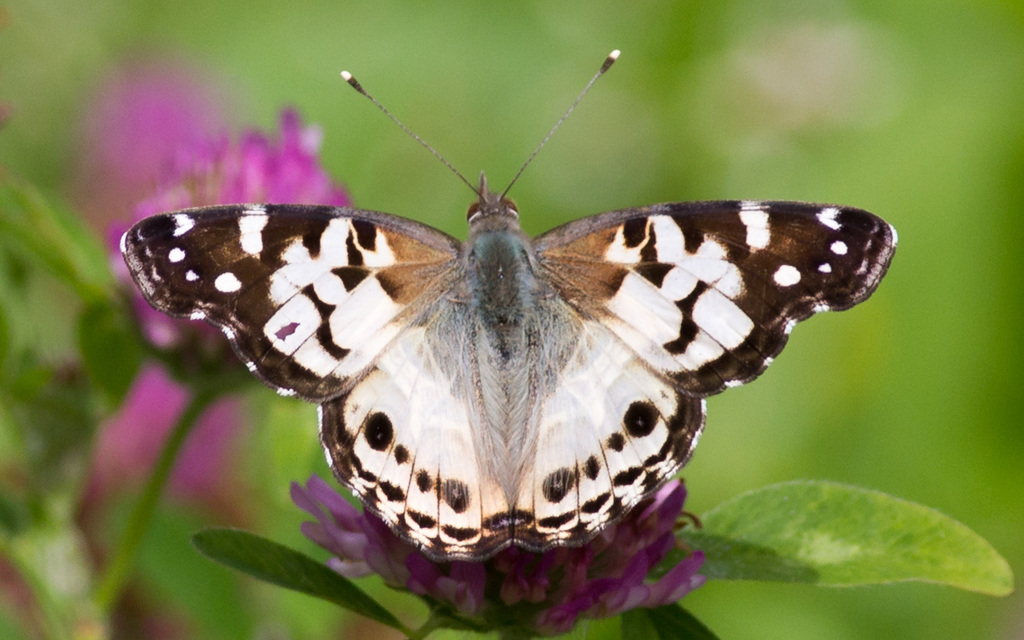
(c) Fyn Kynd, some rights reserved (CC BY-SA) · licence
Family: Nymphalidae · Class: Insecta · Order: Lepidoptera
Vanessa virginiensis (American Lady) is a California animal in the Nymphalidae family.
The American Lady (Vanessa virginiensis) is a medium-sized butterfly in the brush-footed butterfly family Nymphalidae. Adults have a wingspan ranging from 4.4 to 6.4 centimeters (1.7 to 2.5 inches). The dorsal wing surfaces display orange-red coloration with black borders and white spots near the forewings' apex. The hindwings feature distinctive eye-spots, typically two large ones on the ventral surface that help distinguish this species from the similar Painted Lady (Vanessa cardui). The ventral hindwing pattern shows a complex network of brown, white, and pink markings with prominent eye-spots. The American Lady is resident in the southern United States, Mexico, and Central America south to Colombia. The species migrates seasonally to temporarily colonize the northern United States and southern Canada, extending its range as far north as the Canadian provinces during favorable conditions. It also reaches the West Indies and occasionally appears as a rare stray in Europe and Newfoundland and Labrador. In California, the species occurs throughout most of the state but is more common in areas where suitable host plants are abundant. This butterfly inhabits a variety of open habitats including fields, meadows, gardens, roadsides, and disturbed areas from sea level to moderate elevations. The species shows particular affinity for areas containing plants in the sunflower family (Asteraceae), which serve as larval host plants. Suitable habitat includes both natural grasslands and human-modified landscapes such as agricultural areas and suburban gardens where host plants are present. American Lady larvae feed exclusively on plants in the sunflower family, including everlasting (Gnaphalium obtusifolium), pearly everlasting (Anaphalis margaritacea), plantain-leaved pussy toes (Antennaria plantaginifolia), wormwood (Artemisia), ironweed (Vernonia), and burdock (Arctium). Adults are nectar feeders, visiting various flowering plants including asters, goldenrod, and butterfly bush. The species exhibits multiple broods per year in warmer regions, with continuous breeding possible in areas with year-round suitable conditions. Females lay single eggs on host plant leaves, and larvae construct silk shelters by folding leaves together. The species overwinters as adults in southern portions of its range, while northern populations are sustained by annual immigration from southern breeding areas. The American Lady is not federally or state-listed as threatened or endangered. Population trends appear stable across most of its range, though local fluctuations occur due to weather patterns and habitat availability. The species benefits from its ability to utilize a variety of host plants and its strong migratory capabilities, which allow recolonization of areas following local population declines. Climate change may be affecting migration patterns and seasonal timing, potentially altering the species' northern range limits. Conservation efforts focus on maintaining diverse native plant communities and reducing pesticide use in agricultural and urban areas where the species occurs.
Classification
Class: Insecta · Order: Lepidoptera · Family: Nymphalidae
Frequently asked questions
How is Vanessa virginiensis classified?
Vanessa virginiensis belongs to class Insecta, order Lepidoptera, family Nymphalidae.
What family does Vanessa virginiensis belong to?
Vanessa virginiensis is in the Nymphalidae family.
What is Vanessa virginiensis?
The American Lady (Vanessa virginiensis) is a medium-sized butterfly in the brush-footed butterfly family Nymphalidae.
Is Vanessa virginiensis found in California?
Yes. Vanessa virginiensis is recorded in California in The California Species Project's catalogue.
Related species
Other California species in the same genus, family, or bioregion.
Data from The California Species Project — 14,000+ California species with verified data from CNPS, CDFW, USFWS, and more.