Velella velella
By-the-wind Sailor
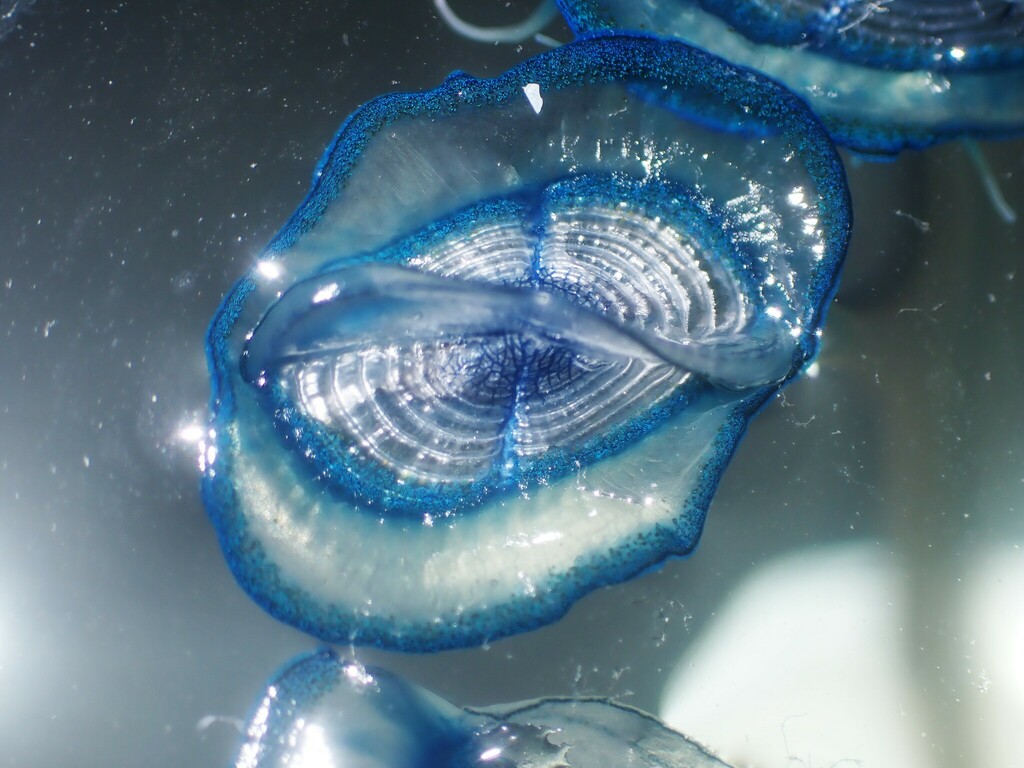
(c) Luca Davenport-Thomas, some rights reserved (CC BY) · licence
Family: Porpitidae · Class: Hydrozoa · Order: Anthoathecata
Velella velella (By-the-wind Sailor) is a California animal in the Porpitidae family.
The by-the-wind sailor (Velella velella) is a colonial cnidarian hydrozoan that inhabits the surface waters of temperate and tropical oceans worldwide. Individual zooids measure 3 to 10 centimeters (1.2 to 4 inches) in length and are characterized by a distinctive oval, transparent blue float topped by a triangular sail. The sail is oriented diagonally across the float and acts as a wind-catching mechanism. The organism displays a deep blue coloration with a clear, jelly-like consistency. Beneath the float, numerous small polyps hang in the water, each specialized for feeding, reproduction, or defense. Velella velella occurs throughout the Pacific Ocean, including California's coastal waters from the Mexican border to the Oregon state line. The species is pelagic, spending its entire life cycle in open ocean surface waters. Populations are found in both nearshore and offshore environments, typically in the upper 50 meters of the water column. The species exhibits a cosmopolitan distribution across temperate and subtropical ocean basins globally. This cnidarian inhabits the neuston layer, the uppermost portion of the ocean where the water meets the atmosphere. Velella velella requires surface waters with temperatures typically ranging from 15 to 25 degrees Celsius (59 to 77 degrees Fahrenheit). The species thrives in areas with moderate wind patterns that facilitate its wind-driven movement across ocean surfaces. It is commonly associated with convergence zones where different water masses meet, creating nutrient-rich conditions. Velella velella feeds primarily on small planktonic organisms, including copepods, fish eggs, larval fish, and other zooplankton. The feeding polyps capture prey using nematocysts (stinging cells) and digest food extracellularly. Reproduction occurs through both sexual and asexual means, with colonies budding off small medusae that eventually develop into new colonial organisms. The species cannot actively control its horizontal movement and relies entirely on wind and surface currents for transportation. This passive dispersal mechanism occasionally results in mass strandings along coastlines when onshore winds persist. As noted by the California Department of Fish and Wildlife, Velella velella cannot actively control their direction and will wash ashore if blown too close to land during appropriate wind conditions. These stranding events occur periodically in California and along the entire west coast. The species is considered relatively common in Pacific waters, though populations are subject to natural fluctuations related to ocean conditions and climate patterns. Velella velella is not protected under federal or state conservation programs, as it maintains stable populations across its global range. The species serves as an important food source for various marine organisms, including ocean sunfish, purple sea snails, and certain seabirds. Climate change and ocean acidification may potentially affect future population dynamics, though specific impacts remain under study. Mass stranding events, while natural phenomena, can provide valuable data for researchers studying ocean circulation patterns and climate variability effects on marine ecosystems.
Classification
Class: Hydrozoa · Order: Anthoathecata · Family: Porpitidae
Frequently asked questions
How is Velella velella classified?
Velella velella belongs to class Hydrozoa, order Anthoathecata, family Porpitidae.
What family does Velella velella belong to?
Velella velella is in the Porpitidae family.
What is Velella velella?
The by-the-wind sailor (Velella velella) is a colonial cnidarian hydrozoan that inhabits the surface waters of temperate and tropical oceans worldwide.
Is Velella velella found in California?
Yes. Velella velella is recorded in California in The California Species Project's catalogue.
More California species
This species has no close relatives in our California data — here are other species to explore.
Data from The California Species Project — 14,000+ California species with verified data from CNPS, CDFW, USFWS, and more.