Venusia cambrica
Welsh Wave
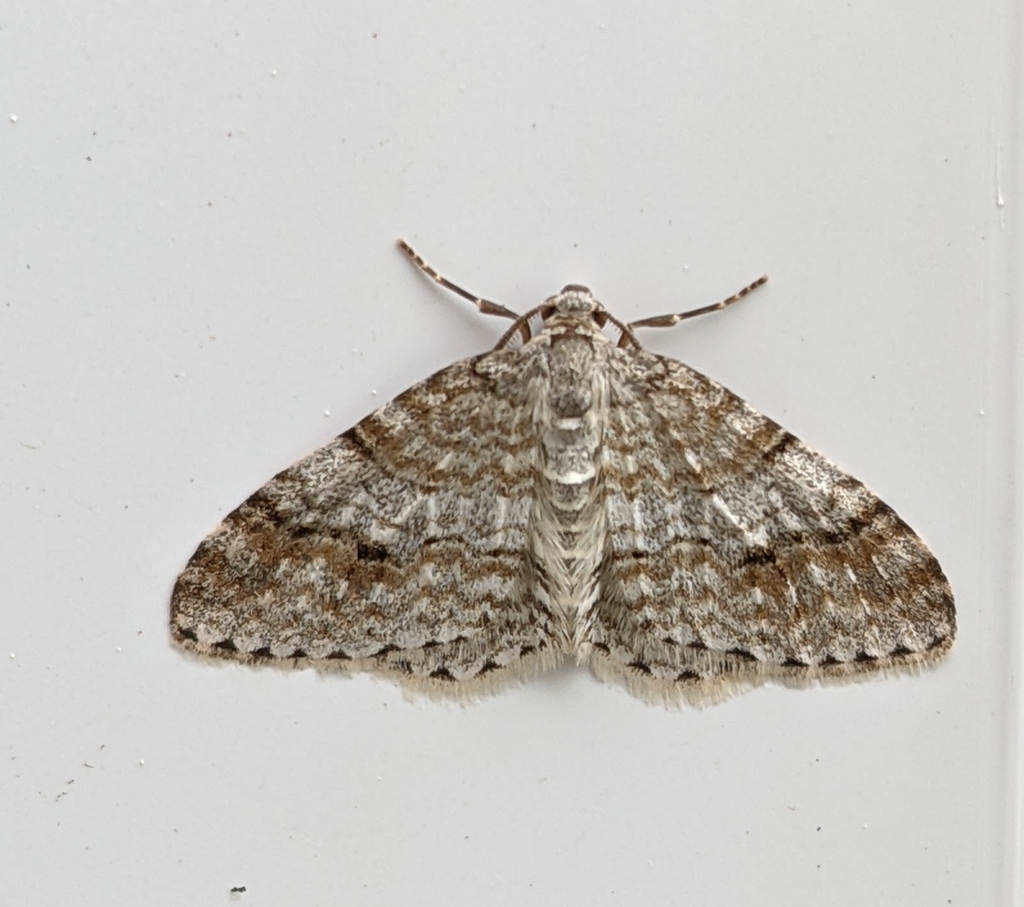
(c) Todd Boland, some rights reserved (CC BY) · licence
Family: Geometridae · Class: Insecta · Order: Lepidoptera
Venusia cambrica (Welsh Wave) is a California animal in the Geometridae family.
The Welsh Wave is a geometrid moth in the subfamily Larentiinae, tribe Asthenini. Adults display characteristic wavy crosslines on their forewings, with a black median line that is irregular but lacks the prominent notch near the costa found in related species. The forewings feature a series of black triangular spots at the ends of veins, which serves as a distinguishing feature. The hindwings show similar patterns but with fainter lines present only on the outer half (BugGuide). Larvae are greenish with purple or brown blotches marking the body. Venusia cambrica has a broad distribution across North America, ranging from Newfoundland to British Columbia across Canada, extending south in western regions to California and south in eastern Appalachian regions to Georgia (BugGuide). The species also occurs throughout Eurasia, indicating a Holarctic distribution pattern. In California, the moth represents the southernmost extent of its western North American range. The species inhabits wet coniferous forests, particularly in western portions of its range (BugGuide). Adults exhibit cryptic behavior, resting on tree trunks during daylight hours where their wave-patterned wings provide camouflage against bark textures. The association with coniferous forest ecosystems suggests larval host plants are likely conifers, though specific host relationships have not been well documented in the available literature. Adult flight periods vary geographically, with moths flying from June to September in New Brunswick and Quebec (BugGuide). This extended flight season suggests either multiple broods or staggered emergence patterns. The species demonstrates typical geometrid behavior, with adults being primarily nocturnal and attracted to artificial lights. Larvae likely feed on coniferous foliage, following the feeding patterns common among Larentiinae moths, though detailed ecological studies of larval biology are lacking. No federal or state conservation status has been assigned to Venusia cambrica. The species appears to maintain stable populations across its extensive range, benefiting from the widespread availability of coniferous forest habitat. However, climate change impacts on montane and boreal forest ecosystems could potentially affect population dynamics in the future. The moth's broad transcontinental and intercontinental distribution suggests genetic connectivity and resilience to local habitat disturbances. Forest management practices that maintain mature coniferous stands would likely benefit this and other forest-dependent geometrid species. Detailed ecological studies of this species remain limited. The information presented here synthesizes available observations from taxonomic databases and regional moth surveys. Additional research on specific host plant relationships, detailed life history characteristics, and population trends would enhance understanding of this widespread but understudied geometrid moth.
Classification
Class: Insecta · Order: Lepidoptera · Family: Geometridae
Frequently asked questions
How is Venusia cambrica classified?
Venusia cambrica belongs to class Insecta, order Lepidoptera, family Geometridae.
What family does Venusia cambrica belong to?
Venusia cambrica is in the Geometridae family.
What is Venusia cambrica?
The Welsh Wave is a geometrid moth in the subfamily Larentiinae, tribe Asthenini.
Is Venusia cambrica found in California?
Yes. Venusia cambrica is recorded in California in The California Species Project's catalogue.
Related species
Other California species in the same genus, family, or bioregion.
Data from The California Species Project — 14,000+ California species with verified data from CNPS, CDFW, USFWS, and more.