Vermivora chrysoptera
Golden-winged Warbler
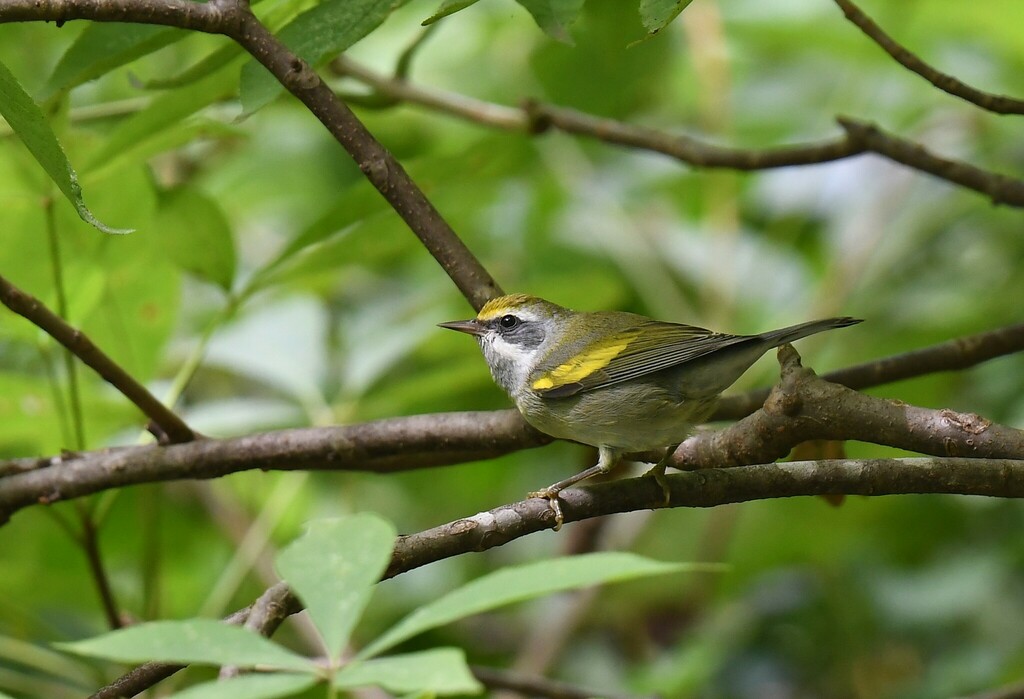
no rights reserved · CC0
Family: Parulidae · Class: Aves · Order: Passeriformes
Vermivora chrysoptera (Golden-winged Warbler) is a California animal in the Parulidae family.
The Golden-winged Warbler is a small neotropical migrant songbird measuring 11.4 to 13.3 cm (4.5 to 5.2 inches) in length with a wingspan of 19 to 24 cm (7.5 to 9.4 inches). Adults weigh 8 to 10 grams. Males display distinctive plumage with a bright yellow wing patch and crown, contrasting black ear patch and throat, and white underparts. The back and wings are blue-gray. Females show similar patterns but with duller coloration, displaying olive-yellow wing patches and gray rather than black markings on the head and throat. Both sexes have thin, pointed bills typical of insectivorous warblers. Historically, Golden-winged Warblers bred across the Great Lakes region, Appalachian Mountains, and into southeastern Canada. The species has experienced significant range shifts, with populations expanding northward and westward while declining in core southeastern breeding areas. In California, Golden-winged Warblers occur primarily as rare migrants and occasional vagrants, with records from coastal counties and mountain areas during spring and fall migration periods. Most California observations are documented from September through early November and April through May. Breeding habitat consists of early successional forests, forest edges, and shrubland areas with a mix of herbaceous openings and woody cover. The species requires a mosaic of habitats including brushy areas for nesting and adjacent mature forest canopy for foraging. During migration, Golden-winged Warblers utilize diverse woodland habitats from sea level to mountainous regions, often found in riparian corridors, oak woodlands, and mixed coniferous forests. Golden-winged Warblers are primarily insectivorous, gleaning arthropods from foliage and bark surfaces. They employ various foraging techniques including leaf probing, bark searching, and occasional fly-catching. The diet consists mainly of lepidopteran larvae, beetles, aphids, and other small insects. Breeding occurs from May through July, with females constructing cup-shaped nests on or near the ground in dense shrub cover. Clutch size typically ranges from 3 to 6 eggs, with an incubation period of 10 to 11 days. Young fledge after 8 to 10 days in the nest. The Golden-winged Warbler has experienced severe population decline across its range, with Breeding Bird Survey data indicating a 2.4% annual decline since 1970, representing a cumulative decline of approximately 94%. The species is considered a conservation priority by Partners in Flight and is listed as Near Threatened by the International Union for Conservation of Nature. Primary threats include habitat loss due to forest succession and agricultural intensification, hybridization with Blue-winged Warblers, and climate change impacts. The Golden-winged Warbler Working Group has developed range-wide conservation plans focusing on habitat management to maintain early successional forest conditions. In California, the species benefits from habitat conservation efforts in riparian corridors and mixed woodland areas that support migrant songbirds.
Classification
Class: Aves · Order: Passeriformes · Family: Parulidae
Frequently asked questions
How is Vermivora chrysoptera classified?
Vermivora chrysoptera belongs to class Aves, order Passeriformes, family Parulidae.
What family does Vermivora chrysoptera belong to?
Vermivora chrysoptera is in the Parulidae family.
What is Vermivora chrysoptera?
The Golden-winged Warbler is a small neotropical migrant songbird measuring 11.4 to 13.3 cm (4.5 to 5.2 inches) in length with a wingspan of 19 to 24 cm (7.5 to 9.4 inches).
Is Vermivora chrysoptera found in California?
Yes. Vermivora chrysoptera is recorded in California in The California Species Project's catalogue.
Related species
Other California species in the same genus, family, or bioregion.
Data from The California Species Project — 14,000+ California species with verified data from CNPS, CDFW, USFWS, and more.