Vermivora cyanoptera
Blue-winged Warbler
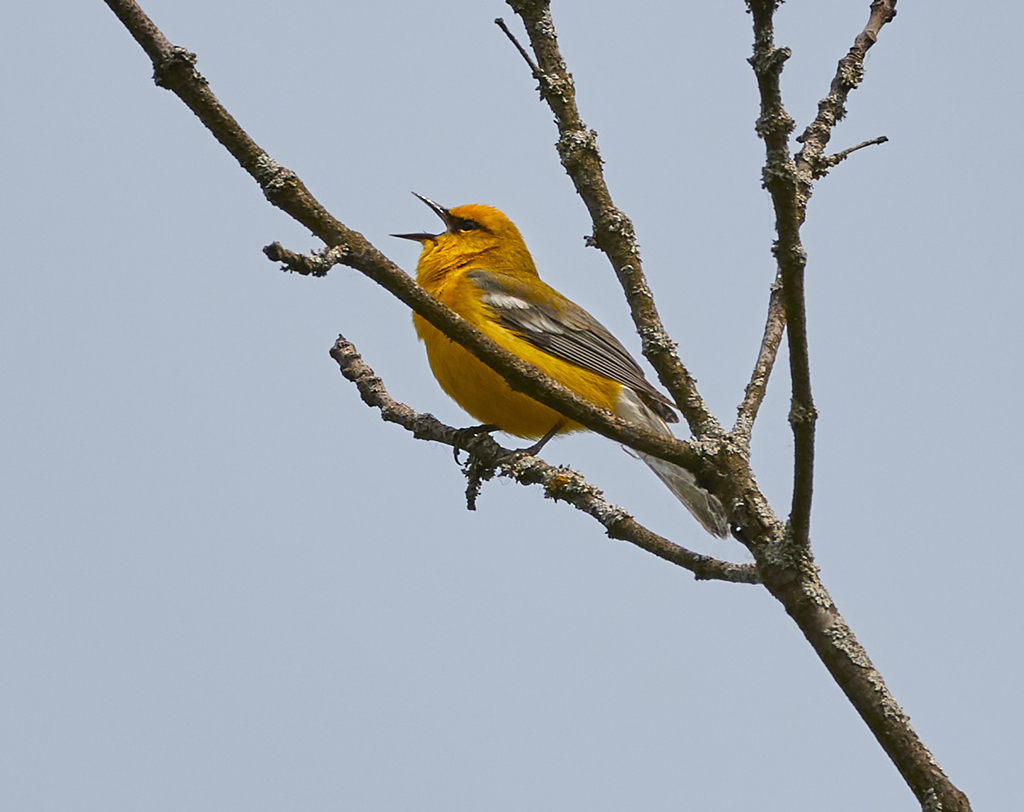
no rights reserved · CC0
Family: Parulidae · Class: Aves · Order: Passeriformes
Vermivora cyanoptera (Blue-winged Warbler) is a California animal in the Parulidae family.
The Blue-winged Warbler is a small songbird measuring 11.5 to 12.7 cm (4.5 to 5.0 inches) in length with a wingspan of 17 to 19.5 cm (6.7 to 7.7 inches). Males in breeding plumage display bright yellow heads and underparts with distinctive black eye-lines extending from the bill through the eye. The wings are blue-gray with two prominent white wing bars, while the back is olive-green. Females are similar but with duller coloration and less contrasting patterns. Both sexes have thin, pointed bills adapted for gleaning insects from foliage. Historically, Blue-winged Warblers bred primarily in the eastern United States, ranging from southern Canada to northern Georgia and west to Nebraska and eastern Kansas. The species has expanded its range northward and westward over the past century, colonizing areas previously occupied by the closely related Golden-winged Warbler. In California, Blue-winged Warblers are extremely rare vagrants, with only a handful of documented records. Most California sightings occur during migration periods in fall and spring, typically in riparian areas and parks along the coast and in the Central Valley. The species occupies early successional habitats including shrublands, forest edges, old fields with scattered trees, and areas of mixed forest and grassland. Breeding habitat typically features a combination of herbaceous openings and woody vegetation at elevations from sea level to 1,500 meters (4,920 feet). During migration, Blue-winged Warblers utilize diverse habitats including riparian corridors, urban parks, and woodland edges where insect prey is abundant. Blue-winged Warblers are primarily insectivorous, feeding on caterpillars, beetles, flies, aphids, and other small arthropods gleaned from leaves and bark surfaces. They also consume spiders and occasionally take nectar from flowers. Breeding occurs from May through July, with females constructing cup-shaped nests on or near the ground in dense vegetation. Clutches typically contain 4 to 5 white eggs with brown spotting. The female incubates eggs for 10 to 11 days, and nestlings fledge after 8 to 10 days. The species is single-brooded in most areas but may attempt second broods in southern portions of its range. The Blue-winged Warbler is not federally listed and maintains stable populations across most of its core range. However, the species faces conservation challenges related to hybridization with Golden-winged Warblers, which can lead to genetic introgression and local population displacement. Habitat loss due to forest maturation and agricultural intensification poses additional threats. Climate change may further alter suitable breeding habitat distribution. The species benefits from forest management practices that maintain early successional habitats and shrubland ecosystems. In California, the extreme rarity of Blue-winged Warblers makes any occurrence noteworthy for documentation and contributes to understanding of vagrant patterns in western North America.
Classification
Class: Aves · Order: Passeriformes · Family: Parulidae
Frequently asked questions
How is Vermivora cyanoptera classified?
Vermivora cyanoptera belongs to class Aves, order Passeriformes, family Parulidae.
What family does Vermivora cyanoptera belong to?
Vermivora cyanoptera is in the Parulidae family.
What is Vermivora cyanoptera?
The Blue-winged Warbler is a small songbird measuring 11.5 to 12.7 cm (4.5 to 5.0 inches) in length with a wingspan of 17 to 19.5 cm (6.7 to 7.7 inches).
Is Vermivora cyanoptera found in California?
Yes. Vermivora cyanoptera is recorded in California in The California Species Project's catalogue.
Related species
Other California species in the same genus, family, or bioregion.
Data from The California Species Project — 14,000+ California species with verified data from CNPS, CDFW, USFWS, and more.