Veromessor andrei
Andre's Harvester Ant
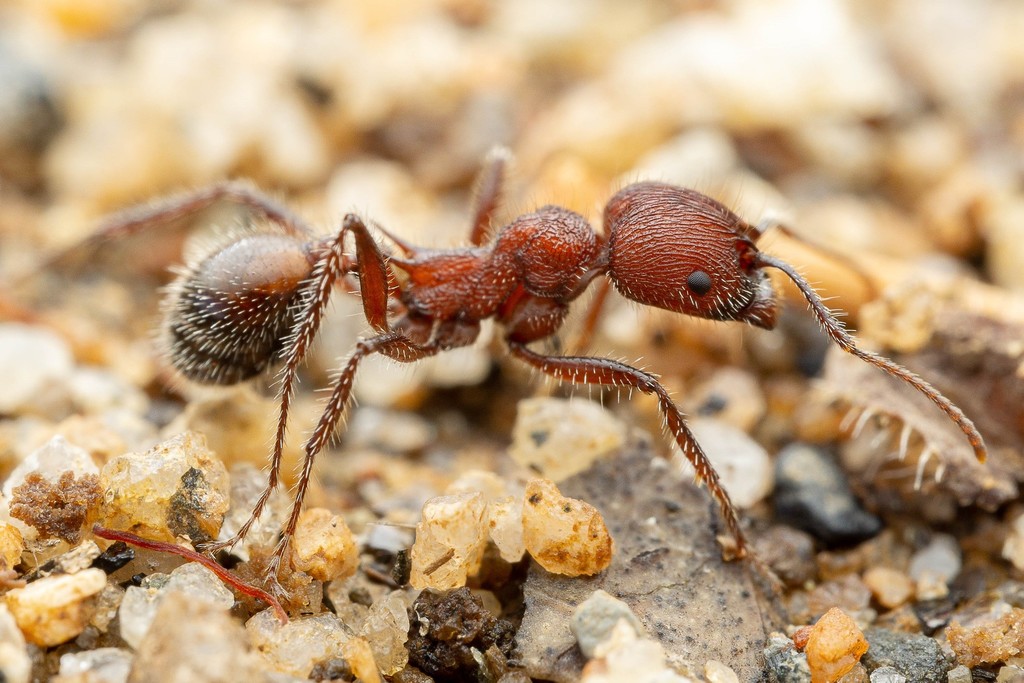
(c) Jake Nitta, some rights reserved (CC BY) · licence
Family: Formicidae · Class: Insecta · Order: Hymenoptera
Veromessor andrei (Andre's Harvester Ant) is a California animal in the Formicidae family.
Andre's Harvester Ant is a species of seed-harvesting ant in the family Formicidae. Like other Veromessor species, workers exhibit polymorphism with distinct size classes adapted for different colony functions. Major workers possess enlarged heads and mandibles suited for processing seeds, while minor workers handle general foraging and nest maintenance duties. The species displays the typical reddish-brown to dark brown coloration common among harvester ants, with a robust build characteristic of the genus. Veromessor andrei occurs across a broad range in western North America, extending from California and Oregon south into Baja California, Mexico (iNaturalist). The species possibly extends into Nevada, Arizona, and Colorado, though the eastern extent of its range requires further documentation. In California, the species is distributed across various habitat types from coastal regions to interior valleys and foothills. This harvester ant inhabits open areas with sandy or well-drained soils, typically in grasslands, chaparral, oak woodlands, and scrub habitats. The species constructs underground nests with characteristic cleared areas or "discs" around nest entrances where vegetation has been removed. These clearing behaviors help colonies maintain access routes for foraging activities. Nests may extend several feet underground with multiple chambers for seed storage, brood rearing, and waste disposal. As granivorous ants, colonies of V. andrei collect and store seeds from various plant species. Workers forage along established trails, gathering seeds which are transported back to the nest for processing and storage. Major workers use their powerful mandibles to crack open seed coats, making the contents accessible for consumption. Like other harvester ants, colonies likely maintain extensive seed caches that sustain them through periods of resource scarcity. Colony founding occurs when winged reproductive individuals emerge during nuptial flights, typically coinciding with favorable weather conditions in late summer or fall. New queens establish colonies independently after mating, initially caring for the first brood while the colony grows to functional size. Veromessor andrei has no formal conservation status and appears to face no immediate threats across its range. The species benefits from its broad habitat tolerance and generalized seed-collecting behavior, which provides resilience against environmental changes. However, like many native ant species, populations may be affected by habitat conversion, invasive species, and pesticide use in agricultural and urban areas. The species' ecological role as a seed disperser and soil aerator makes it an important component of western North American ecosystems. Scientific documentation for this species remains limited compared to more extensively studied harvester ant species. The information presented here is based on available sources including iNaturalist observations and general Veromessor ecology. If you have additional verified information about this species' biology, distribution, or ecology, please contact us to help improve this species account.
Classification
Class: Insecta · Order: Hymenoptera · Family: Formicidae
Frequently asked questions
How is Veromessor andrei classified?
Veromessor andrei belongs to class Insecta, order Hymenoptera, family Formicidae.
What family does Veromessor andrei belong to?
Veromessor andrei is in the Formicidae family.
What is Veromessor andrei?
Andre's Harvester Ant is a species of seed-harvesting ant in the family Formicidae.
Is Veromessor andrei found in California?
Yes. Veromessor andrei is recorded in California in The California Species Project's catalogue.
Related species
Other California species in the same genus, family, or bioregion.
Data from The California Species Project — 14,000+ California species with verified data from CNPS, CDFW, USFWS, and more.