Veromessor pergandei
Black Harvester Ant
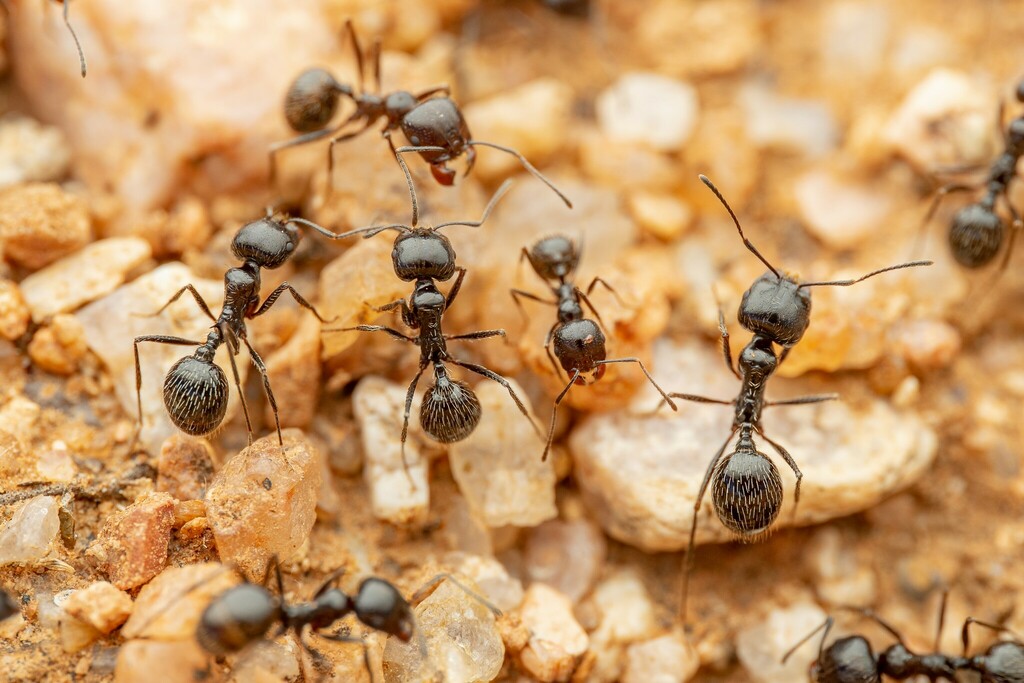
(c) Jake Nitta, some rights reserved (CC BY) · licence
Family: Formicidae · Class: Insecta · Order: Hymenoptera
Veromessor pergandei (Black Harvester Ant) is a California animal in the Formicidae family.
The Black Harvester Ant (Veromessor pergandei) is a granivorous ant species distinguished by its uniformly glossy black coloration and highly polymorphic worker caste. Workers range from 4-10 mm in length, displaying a continuous size gradient from small minors to large-headed majors. Queens measure 11-13 mm, while males are 7-9 mm. The species exhibits smooth body surfaces lacking the heavy sculpturing found in related Pogonomyrmex species, and workers possess a distinctive psammophore (specialized hair structure) beneath the head for seed manipulation. This species is endemic to the arid southwestern United States, with primary populations in the low-elevation deserts of southeastern California, Arizona, and Nevada. The species also extends into the Baja California peninsula of Mexico. In California, populations are concentrated in the Mojave and Sonoran desert regions, where they occupy some of the harshest thermal environments in North America. Black Harvester Ants inhabit desert floor environments characterized by extreme temperatures and low humidity. They construct ground-dwelling colonies in areas with fine sand substrates that facilitate their specialized foraging behavior. The species requires strong thermal gradients, with nest temperatures maintained at 26-30°C and foraging areas reaching 30-45°C. Unlike many desert ant species that avoid extreme heat, V. pergandei has evolved to function in high-temperature conditions while maintaining very low moisture requirements (10-30% humidity in nest areas). The species exhibits distinctive column foraging behavior, where thousands of workers form dense, organized trails extending dozens of meters across desert terrain to seed sources. This collective foraging strategy represents a departure from the more solitary foraging patterns typical of other harvester ant species. Mature colonies contain 10,000-15,000 workers that maintain extensive seed storage chambers. The species is strictly granivorous, collecting seeds from desert grasses and wildflowers. Colony founding may involve pleometrosis, where multiple queens cooperate to establish new colonies before reducing to a single reproductive queen as the colony matures. Queens have lifespans of 15-20 years, while workers typically survive one year with rapid colony turnover maintaining consistent workforce levels. Currently, V. pergandei has no formal conservation status listings at federal or state levels. The species was originally described by Gustav Mayr as Aphaenogaster pergandei and has undergone taxonomic revision, with Veromessor now considered a junior synonym of Messor by some authorities. While specific population trends have not been comprehensively assessed, the species' specialization for extreme desert conditions may make it vulnerable to climate change impacts and habitat modifications in its limited range. The species' dependence on specific thermal and moisture conditions, combined with its restricted desert habitat, suggests that monitoring of population trends would be valuable for long-term conservation assessment.
Classification
Class: Insecta · Order: Hymenoptera · Family: Formicidae
Frequently asked questions
How is Veromessor pergandei classified?
Veromessor pergandei belongs to class Insecta, order Hymenoptera, family Formicidae.
What family does Veromessor pergandei belong to?
Veromessor pergandei is in the Formicidae family.
What is Veromessor pergandei?
The Black Harvester Ant (Veromessor pergandei) is a granivorous ant species distinguished by its uniformly glossy black coloration and highly polymorphic worker caste.
Is Veromessor pergandei found in California?
Yes. Veromessor pergandei is recorded in California in The California Species Project's catalogue.
Related species
Other California species in the same genus, family, or bioregion.
Data from The California Species Project — 14,000+ California species with verified data from CNPS, CDFW, USFWS, and more.