Vespericola pressleyi
Big Bar Hesperian
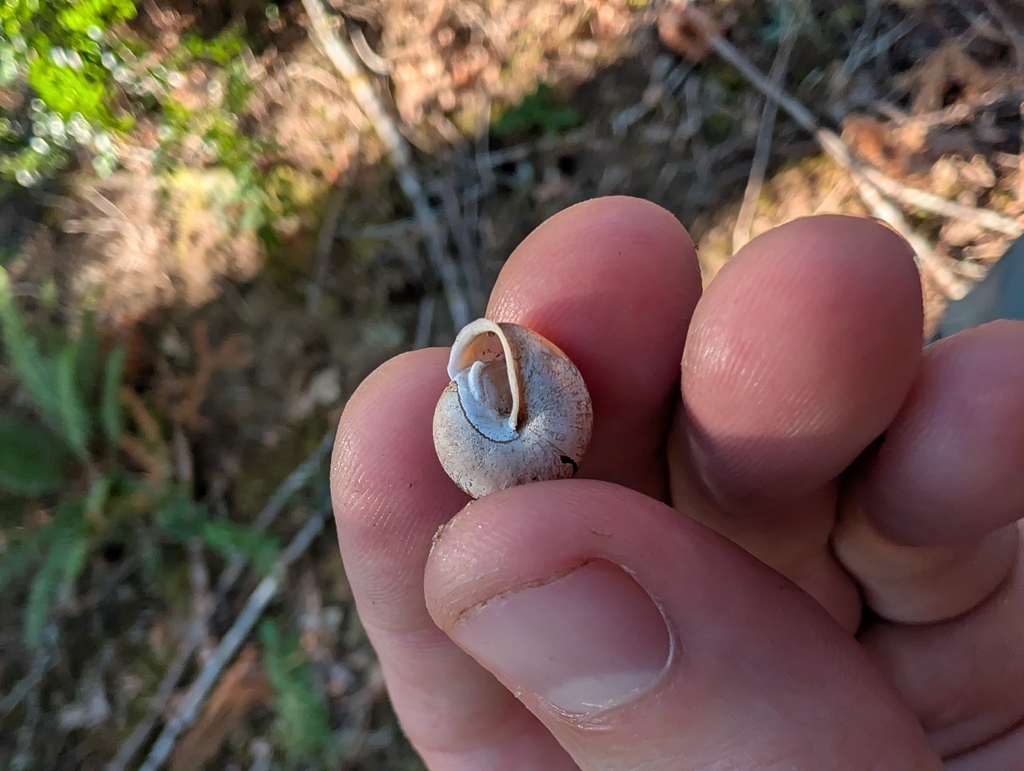
no rights reserved · CC0
Family: Polygyridae · Class: Gastropoda · Order: Stylommatophora
Conservation status: G1 S1
Vespericola pressleyi (Big Bar Hesperian) is a California animal in the Polygyridae family.
The Big Bar hesperian is a terrestrial snail endemic to Trinity County, California. This species belongs to the family Polygyridae and represents one of several rare terrestrial mollusks found in the mountains of northern California. Physical characteristics specific to this species have not been well documented in the scientific literature, though as a member of the genus Vespericola, it likely exhibits the typical spiral shell morphology characteristic of hesperian snails. The Big Bar hesperian is known from 27 locations within the Trinity National Forest in Trinity County, California (Burke et al. 1999). Its distribution appears to be highly restricted to this specific geographic region in the northern California mountains. The species' limited range makes it particularly vulnerable to environmental changes and habitat disturbance within its small area of occupancy. Habitat requirements for the Big Bar hesperian have not been thoroughly studied, though it occurs in forested environments within the Trinity National Forest. As a terrestrial mollusk, the species likely requires specific microhabitat conditions including appropriate moisture levels, organic matter for shelter, and suitable substrate conditions. Many terrestrial snails in this region are associated with leaf litter, decaying wood, and areas that maintain adequate humidity throughout the year. Ecological information regarding diet, reproduction, and seasonal activity patterns remains largely undocumented for this species. Like other terrestrial gastropods, the Big Bar hesperian likely feeds on decomposing organic matter, fungi, and possibly algae. Reproduction in terrestrial snails typically involves hermaphroditic individuals that exchange sperm, with eggs deposited in suitable microhabitats within the soil or leaf litter. The Big Bar hesperian currently holds a global rank of G1, indicating it is critically imperiled with typically 5 or fewer occurrences or very few remaining individuals. The species also carries a state rank of S1 in California, reflecting its critical conservation status within the state. The U.S. Fish and Wildlife Service has included this species in multiple National Domestic Listing Workplans as a candidate for potential federal listing consideration, appearing consistently in workplans from 2022 through 2028 with a Priority Bin ranking of 5. The species is classified as "Under Review" for potential federal protection under the Endangered Species Act. The primary threats to the Big Bar hesperian likely include habitat modification, forest management activities, and climate change impacts on its specialized microhabitat requirements. Given its extremely limited distribution within Trinity County, any significant disturbance to its habitat could have severe population-level consequences. The species' inclusion in federal listing workplans indicates ongoing concern about its conservation status and the need for potential regulatory protection. Conservation efforts would benefit from detailed surveys to better understand current population status, habitat requirements, and specific threats facing this rare California endemic.
Classification
Class: Gastropoda · Order: Stylommatophora · Family: Polygyridae
Conservation status
G1 S1
Frequently asked questions
How is Vespericola pressleyi classified?
Vespericola pressleyi belongs to class Gastropoda, order Stylommatophora, family Polygyridae.
What family does Vespericola pressleyi belong to?
Vespericola pressleyi is in the Polygyridae family.
Is Vespericola pressleyi protected or of conservation concern?
Vespericola pressleyi carries the following status: G1 S1.
What is Vespericola pressleyi?
The Big Bar hesperian is a terrestrial snail endemic to Trinity County, California.
Is Vespericola pressleyi found in California?
Yes. Vespericola pressleyi is recorded in California in The California Species Project's catalogue.
Related species
Other California species in the same genus, family, or bioregion.
Data from The California Species Project — 14,000+ California species with verified data from CNPS, CDFW, USFWS, and more.