Vireo bellii arizonae
Arizona Bell’s vireo
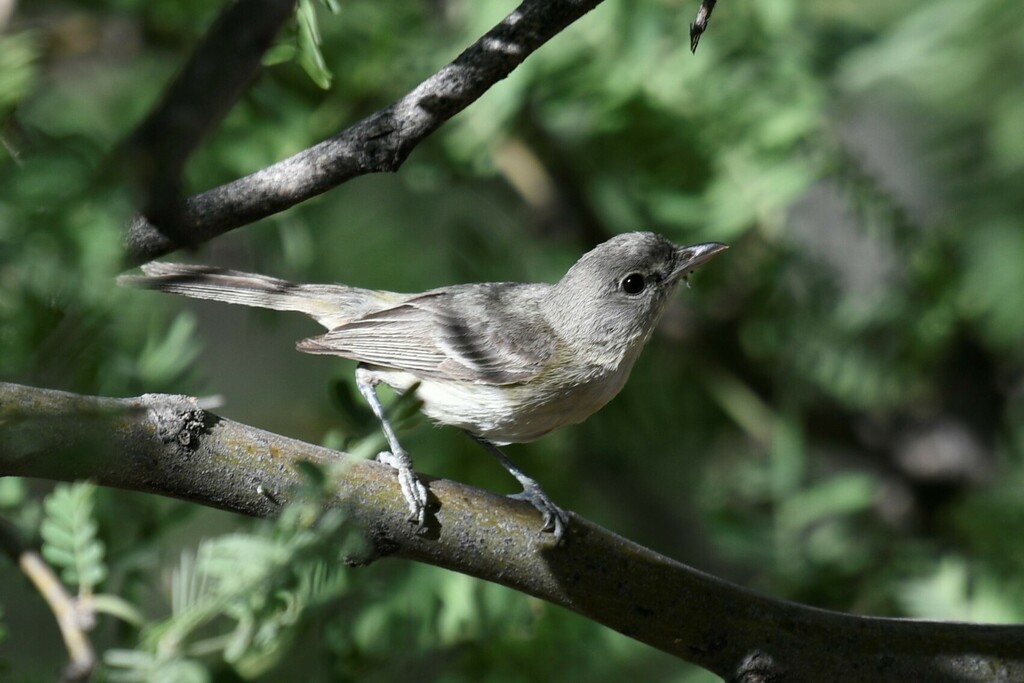
no rights reserved · CC0
Family: Vireonidae · Class: Aves · Order: Passeriformes
Conservation status: SE · G5T4 S3
Vireo bellii arizonae (Arizona Bell’s vireo) is a California animal in the Vireonidae family.
The Arizona Bell's vireo is a small passerine bird and one of four recognized subspecies of Bell's vireo (Vireo bellii). Adults measure approximately 11.5-12.5 cm (4.5-5.0 inches) in length and weigh 7-10 grams. The species exhibits olive-gray upperparts with whitish to pale yellow underparts and indistinct whitish wing bars. A faint whitish eye-ring and pale supercilium distinguish it from other vireo species. The bill is relatively thick and slightly hooked, adapted for gleaning insects from vegetation. Historically, the Arizona Bell's vireo bred throughout riparian areas of the Colorado River and its tributaries in southeastern California, southwestern Arizona, southern Nevada, and northwestern Mexico. The subspecies has experienced severe range contraction, with current California populations restricted to remnant riparian habitats along the Colorado River and its associated wetlands in Imperial and Riverside counties. Small populations may persist in Arizona along the Colorado, Salt, and Gila river systems (Birds of the World 2024). This subspecies inhabits dense, low riparian vegetation dominated by willows (Salix spp.), cottonwoods (Populus spp.), and mesquite (Prosopis spp.). Optimal habitat consists of multilayered canopy structure with dense understory vegetation 1-4 meters in height. The species requires permanent or seasonal water sources and typically occurs at elevations below 500 meters. Arizona Bell's vireos construct cup-shaped nests suspended from forked branches 1-3 meters above ground in dense shrubby vegetation. Arizona Bell's vireos are insectivorous, foraging by gleaning insects and spiders from leaves and bark surfaces. The diet consists primarily of lepidopteran larvae, aphids, beetles, and flies. Breeding occurs from April through July, with females laying 3-4 white eggs marked with dark spots. Incubation lasts 14 days, and nestlings fledge after 11-12 days. Like other Bell's vireo subspecies, Arizona Bell's vireo experiences significant brood parasitism by brown-headed cowbirds (Molothrus ater), which can reduce reproductive success by 50% or more in some populations (Birds of the World 2024). California listed the Arizona Bell's vireo as endangered in 1988 due to severe habitat loss and fragmentation. The subspecies has experienced population declines exceeding 90% from historical levels, primarily due to dam construction, water diversions, agricultural conversion, and urban development that have eliminated or degraded riparian forests throughout the Colorado River system. Current California populations are estimated at fewer than 50 breeding pairs. Brown-headed cowbird parasitism compounds these threats, particularly in fragmented habitats. Recovery efforts focus on habitat restoration, cowbird control programs, and protection of remaining riparian areas. The subspecies' small population size and restricted range make it vulnerable to local extinction from catastrophic events or continued habitat degradation.
Classification
Class: Aves · Order: Passeriformes · Family: Vireonidae
Conservation status
SE · G5T4 S3
Frequently asked questions
How is Vireo bellii arizonae classified?
Vireo bellii arizonae belongs to class Aves, order Passeriformes, family Vireonidae.
What family does Vireo bellii arizonae belong to?
Vireo bellii arizonae is in the Vireonidae family.
Is Vireo bellii arizonae protected or of conservation concern?
Vireo bellii arizonae carries the following status: SE · G5T4 S3.
What is Vireo bellii arizonae?
The Arizona Bell's vireo is a small passerine bird and one of four recognized subspecies of Bell's vireo (Vireo bellii).
Is Vireo bellii arizonae found in California?
Yes. Vireo bellii arizonae is recorded in California in The California Species Project's catalogue.
Related species
Other California species in the same genus, family, or bioregion.
Data from The California Species Project — 14,000+ California species with verified data from CNPS, CDFW, USFWS, and more.