Vireo bellii pusillus
Least Bell’s vireo
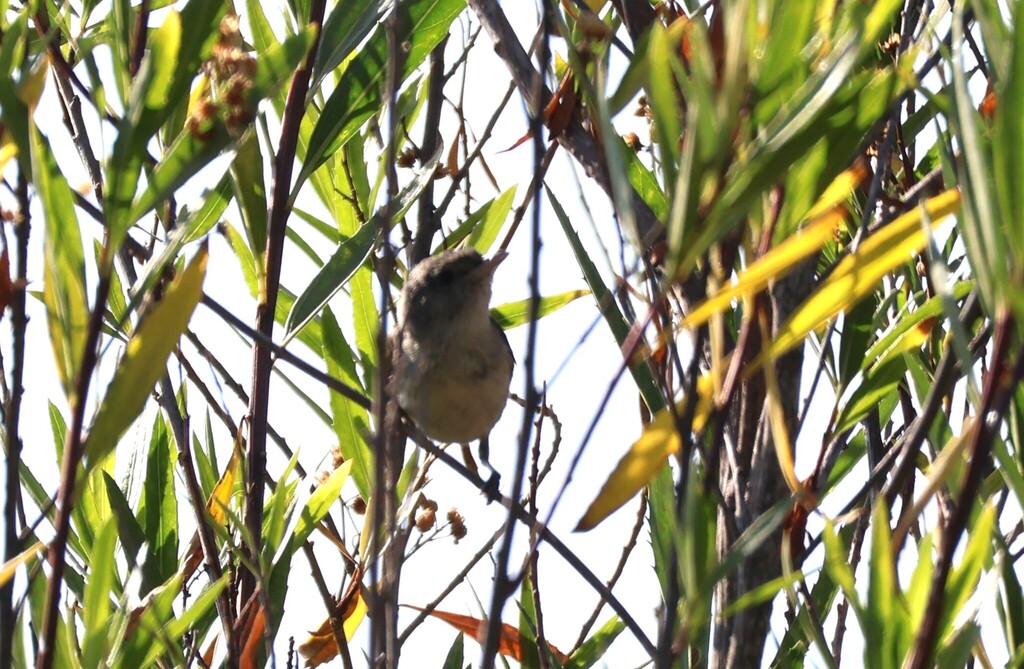
(c) Millie Basden, some rights reserved (CC BY) · licence
Family: Vireonidae · Class: Aves · Order: Passeriformes
Conservation status: SE · Endangered · G5T2 S3
Vireo bellii pusillus (Least Bell’s vireo) is a California animal in the Vireonidae family.
The Least Bell's vireo is a small passerine bird measuring 11.5 to 12.5 centimeters (4.5 to 5.0 inches) in length. This subspecies exhibits typical vireo characteristics with short, rounded wings and a short, straight bill. Adults display a faint white eye ring and relatively drab plumage that aids in camouflage within dense vegetation. The species shows subtle sexual dimorphism, with males typically being slightly larger than females. Historically, the Least Bell's vireo occupied riparian woodlands throughout much of California's Central Valley and coastal regions, extending south into Baja California, Mexico, and east into Arizona. The subspecies has experienced severe range contraction, with populations extirpated from approximately 70% of their former California range. Current breeding populations are concentrated primarily in southern California, with smaller populations persisting in scattered locations throughout the state. The species winters in southern Baja California, Mexico, occupying mesquite scrub within arroyos and palm groves. Least Bell's vireos require dense, low vegetation in shrub-dominated riparian habitats. They typically nest in willow thickets, cottonwood groves, and mixed riparian woodlands along rivers and streams. The species shows strong fidelity to areas with dense understory vegetation, typically 1 to 4 meters in height, which provides both nesting sites and foraging opportunities. Critical habitat was designated for this species on December 19, 2007, with the final rule published in the Federal Register (72 FR 72213-72234). As insectivorous birds, Least Bell's vireos feed primarily on small insects and spiders gleaned from foliage and bark surfaces. Breeding occurs from March through September, with peak activity from April to July. Females construct cup-shaped nests suspended from forked branches in dense shrubs, typically 0.6 to 4 meters above ground. Clutch size averages 3 to 4 eggs, with incubation lasting approximately 14 days. The species is heavily parasitized by Brown-headed Cowbirds (Molothrus ater), which has significantly contributed to population declines. The Least Bell's vireo was listed as federally endangered in 1986 due to severe habitat loss and degradation. Primary threats include riparian habitat destruction from urban development, agriculture, water diversions, and invasive plant species. Brown-headed Cowbird parasitism remains a critical threat, with parasitism rates exceeding 90% in some areas. Conservation efforts have focused on habitat restoration, cowbird control programs, and protection of existing breeding sites. These management actions have resulted in localized population increases, though the subspecies remains vulnerable. The species readily colonizes restored habitats, making habitat restoration a viable conservation strategy for maintaining and expanding populations.
Classification
Class: Aves · Order: Passeriformes · Family: Vireonidae
Conservation status
SE · Endangered · G5T2 S3
Frequently asked questions
How is Vireo bellii pusillus classified?
Vireo bellii pusillus belongs to class Aves, order Passeriformes, family Vireonidae.
What family does Vireo bellii pusillus belong to?
Vireo bellii pusillus is in the Vireonidae family.
Is Vireo bellii pusillus protected or of conservation concern?
Vireo bellii pusillus carries the following status: SE · Endangered · G5T2 S3.
What is Vireo bellii pusillus?
The Least Bell's vireo is a small passerine bird measuring 11.5 to 12.5 centimeters (4.5 to 5.0 inches) in length.
Is Vireo bellii pusillus found in California?
Yes. Vireo bellii pusillus is recorded in California in The California Species Project's catalogue.
Related species
Other California species in the same genus, family, or bioregion.
Data from The California Species Project — 14,000+ California species with verified data from CNPS, CDFW, USFWS, and more.