Vireo bellii ssp. arizonae
Arizona Bell's Vireo
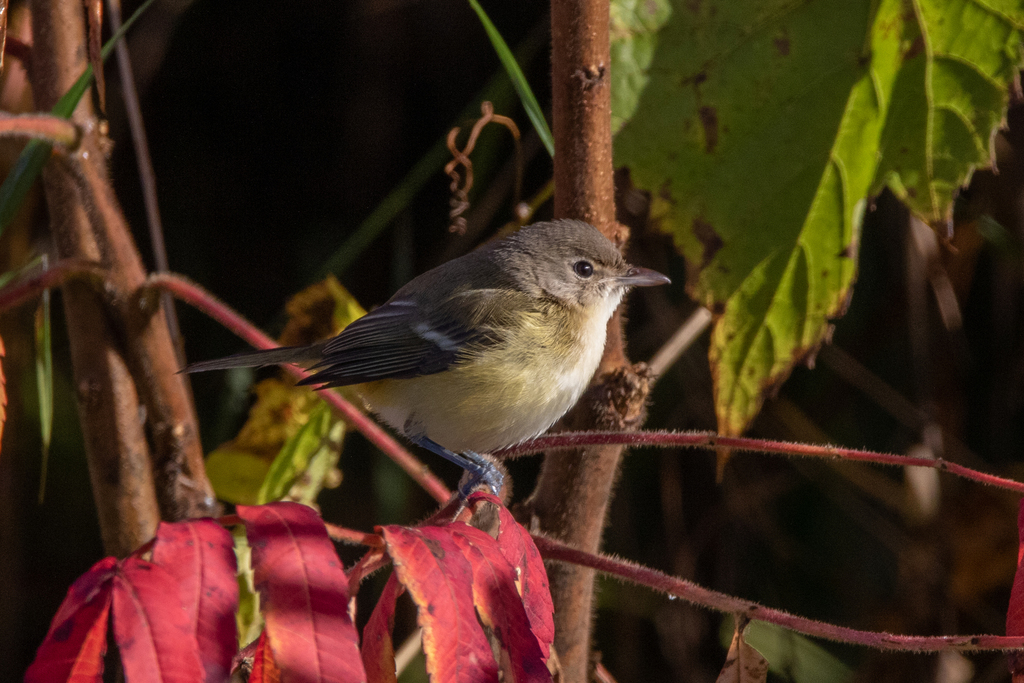
no rights reserved · CC0
Family: Vireonidae · Class: Aves · Order: Passeriformes
Conservation status: SE · G5T4 S1S2
Vireo bellii ssp. arizonae (Arizona Bell's Vireo) is a California animal in the Vireonidae family.
The Arizona Bell's Vireo is a small, grayish songbird measuring 11.4 to 12.7 centimeters (4.5 to 5.0 inches) in length with a wingspan of approximately 17.8 centimeters (7.0 inches). Adults weigh 7 to 10 grams. The upperparts are dull olive-gray to brownish-gray, while the underparts are pale gray to whitish with a faint yellowish wash on the flanks. The head features indistinct whitish spectacles formed by pale eye-rings and loral areas. A faint whitish wing bar is present on each wing. The bill is relatively thick for a vireo, with a dark upper mandible and pale lower mandible. Juveniles appear similar to adults but with more brownish tones. Historically, the Arizona Bell's Vireo bred throughout riparian areas of southern California, including the Colorado River valley, the Mojave River system, and coastal drainages from Ventura County south to San Diego County. The subspecies has experienced severe range contraction and currently persists in only a few locations in California. The largest remaining population occurs along the lower Colorado River near Blythe in Riverside County. Small populations may persist in the Santa Clara River system in Ventura County and along the Mojave River, though recent surveys have detected few individuals in these areas. This subspecies inhabits dense riparian woodlands dominated by willows, cottonwoods, and mesquite. Optimal habitat consists of structurally diverse riparian forests with dense understory vegetation typically 1 to 4 meters in height. Along the Colorado River, Arizona Bell's Vireos utilize habitat patches containing Goodding's willow, Fremont cottonwood, salt cedar, and arrowweed. The species requires continuous canopy cover and avoids fragmented or degraded riparian areas. Breeding territories range from 0.4 to 2.0 hectares and are typically located within 100 meters of water sources. Arizona Bell's Vireos are insectivorous, foraging primarily in the middle to upper canopy for lepidopteran larvae, beetles, flies, and other small arthropods. Males establish territories in April and engage in persistent singing from concealed perches within dense vegetation. The breeding season extends from April through August, with peak nesting activity occurring from May through July. Females construct cup-shaped nests suspended from forked branches 1 to 3 meters above ground. Clutch size is typically 3 to 4 eggs, and pairs may attempt multiple broods per season. Incubation lasts 14 days, and nestlings fledge after 11 to 12 days. The Arizona Bell's Vireo is listed as endangered by the state of California. The subspecies has declined precipitously due to habitat loss from water diversions, agricultural conversion, urban development, and invasion by non-native vegetation, particularly salt cedar. Brown-headed Cowbird parasitism poses an additional threat, with parasitism rates exceeding 60 percent in some areas. According to California Department of Fish and Wildlife, fewer than 300 breeding pairs likely remain in California as of 2024. Recovery efforts focus on habitat restoration, cowbird control, and water management to maintain suitable riparian conditions.
Classification
Class: Aves · Order: Passeriformes · Family: Vireonidae
Conservation status
SE · G5T4 S1S2
Frequently asked questions
How is Vireo bellii ssp. arizonae classified?
Vireo bellii ssp. arizonae belongs to class Aves, order Passeriformes, family Vireonidae.
What family does Vireo bellii ssp. arizonae belong to?
Vireo bellii ssp. arizonae is in the Vireonidae family.
Is Vireo bellii ssp. arizonae protected or of conservation concern?
Vireo bellii ssp. arizonae carries the following status: SE · G5T4 S1S2.
What is Vireo bellii ssp. arizonae?
The Arizona Bell's Vireo is a small, grayish songbird measuring 11.4 to 12.7 centimeters (4.5 to 5.0 inches) in length with a wingspan of approximately 17.8 centimeters (7.0 inches).
Is Vireo bellii ssp. arizonae found in California?
Yes. Vireo bellii ssp. arizonae is recorded in California in The California Species Project's catalogue.
Related species
Other California species in the same genus, family, or bioregion.
Data from The California Species Project — 14,000+ California species with verified data from CNPS, CDFW, USFWS, and more.