Vireo bellii ssp. pusillus
Least Bell's Vireo
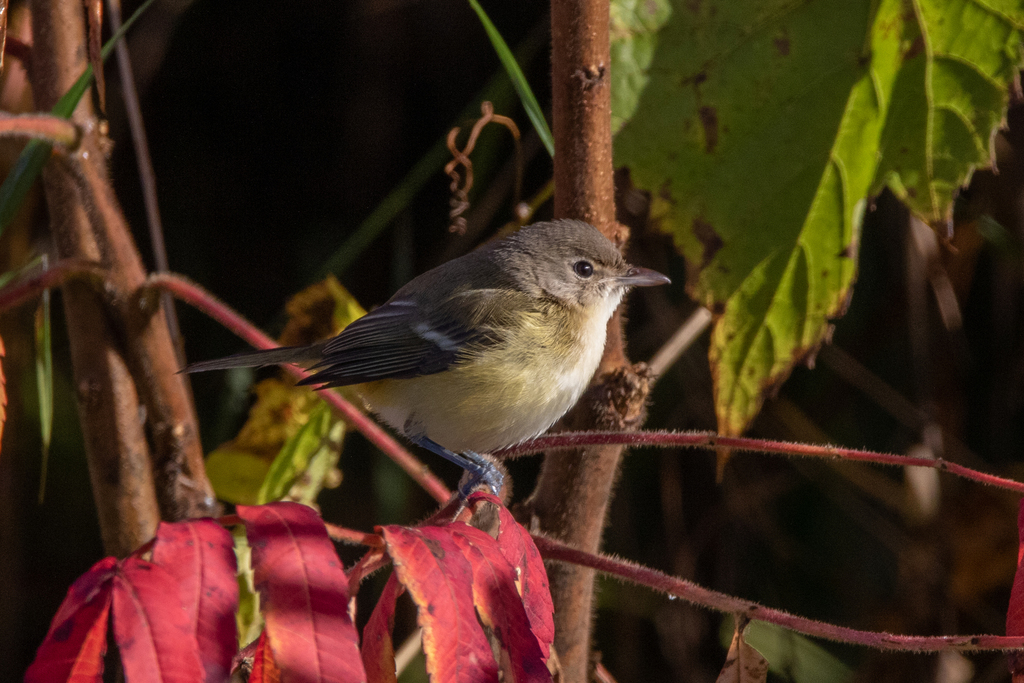
no rights reserved · CC0
Family: Vireonidae · Class: Aves · Order: Passeriformes
Conservation status: SE · Endangered · G5T2 S2
Vireo bellii ssp. pusillus (Least Bell's Vireo) is a California animal in the Vireonidae family.
The Least Bell's Vireo is a small, migratory songbird measuring 11-12 centimeters (4.3-4.7 inches) in length with a wingspan of approximately 18 centimeters (7 inches). Adults weigh 7-10 grams and display subdued gray-olive upperparts with pale yellow to whitish underparts. The species exhibits faint wing bars and a pale supercilium above a dark eye line. Males and females appear similar, though males may show slightly brighter coloration during breeding season. Juveniles are paler overall with less distinct facial markings. Historically, the Least Bell's Vireo ranged from northern California through Baja California, with populations extending inland to Arizona and New Mexico. The subspecies pusillus is endemic to California and Baja California. Current breeding range in California is restricted to scattered locations in riparian habitats from Santa Barbara County south to San Diego County, with the largest populations in San Diego County. Small populations persist in Riverside, Orange, Ventura, and Kern counties. The species winters primarily in Baja California and western Mexico. Least Bell's Vireos require dense riparian woodland with a well-developed understory layer. Optimal habitat consists of willow-dominated riparian forests with cottonwoods, mule fat, and dense shrub layers including elderberry, wild rose, and wild grape. Nesting typically occurs 0.3-4 meters (1-13 feet) above ground in willow thickets or other dense vegetation. The species shows strong fidelity to areas with permanent or seasonal water flow and avoids fragmented or degraded riparian corridors. Breeding occurs from March through September, with peak activity from April to July. Females construct cup-shaped nests suspended from forked branches, weaving together plant fibers, spider webs, and other materials. Clutch size ranges from 2-4 eggs, with an incubation period of 14 days. Both parents feed nestlings, which fledge after 11-12 days. The species typically produces 1-2 broods per season. Least Bell's Vireos are insectivorous, gleaning small arthropods including aphids, caterpillars, beetles, and spiders from leaves and branches through deliberate foraging movements. The U.S. Fish and Wildlife Service listed the Least Bell's Vireo as endangered in 1986 following severe population declines. Pre-1940s populations exceeded 100,000 individuals, but habitat destruction reduced numbers to fewer than 300 pairs by the 1980s. According to USFWS recovery data, populations have increased to approximately 3,000 pairs as of recent surveys, primarily due to habitat restoration and Brown-headed Cowbird control programs. Primary threats include riparian habitat loss to development and agriculture, brood parasitism by Brown-headed Cowbirds, and habitat degradation from invasive plant species. Climate change poses additional risks through altered precipitation patterns affecting riparian systems. Recovery efforts focus on habitat restoration, cowbird management, and population monitoring across the species' range.
Classification
Class: Aves · Order: Passeriformes · Family: Vireonidae
Conservation status
SE · Endangered · G5T2 S2
Frequently asked questions
How is Vireo bellii ssp. pusillus classified?
Vireo bellii ssp. pusillus belongs to class Aves, order Passeriformes, family Vireonidae.
What family does Vireo bellii ssp. pusillus belong to?
Vireo bellii ssp. pusillus is in the Vireonidae family.
Is Vireo bellii ssp. pusillus protected or of conservation concern?
Vireo bellii ssp. pusillus carries the following status: SE · Endangered · G5T2 S2.
What is Vireo bellii ssp. pusillus?
The Least Bell's Vireo is a small, migratory songbird measuring 11-12 centimeters (4.3-4.7 inches) in length with a wingspan of approximately 18 centimeters (7 inches).
Is Vireo bellii ssp. pusillus found in California?
Yes. Vireo bellii ssp. pusillus is recorded in California in The California Species Project's catalogue.
Related species
Other California species in the same genus, family, or bioregion.
Data from The California Species Project — 14,000+ California species with verified data from CNPS, CDFW, USFWS, and more.