Vireo cassinii
Cassin's Vireo
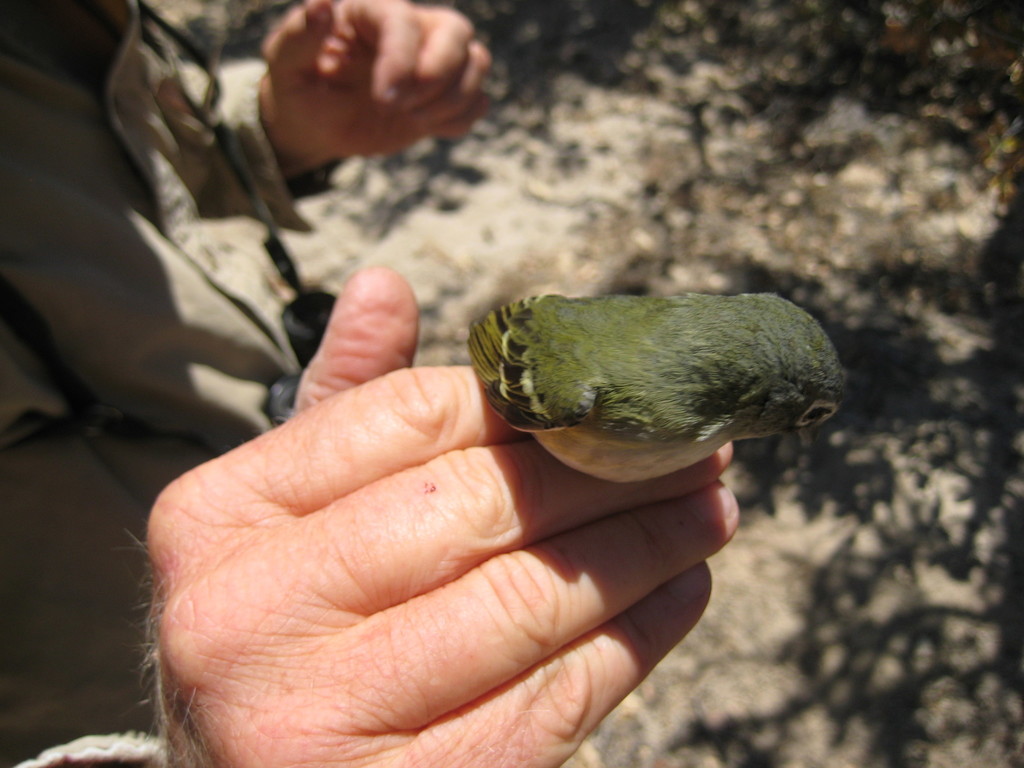
(c) kclarksdnhmorg, some rights reserved (CC BY) · licence
Family: Vireonidae · Class: Aves · Order: Passeriformes
Vireo cassinii (Cassin's Vireo) is a California animal in the Vireonidae family.
Cassin's Vireo is a small songbird measuring 11 to 14 cm (4.3 to 5.5 inches) in length with a wingspan of 22 to 24 cm (8.7 to 9.4 inches). Adults weigh 16 to 26 grams. The species displays prominent white spectacles formed by white eye-rings connected by a white supraloral stripe. The upperparts are grayish-olive to brownish-gray, while the underparts are white with pale yellowish flanks and undertail coverts. Two distinct white wing bars mark the dark wings. The thick, slightly hooked bill is dark above with a pale base below, adapted for gleaning insects from foliage. Males and females appear similar, though males may show slightly brighter plumage during breeding season. Cassin's Vireo breeds across western North America from British Columbia south through California, extending east to Montana, Wyoming, Colorado, and Arizona. In California, the species occurs in mountainous regions including the Sierra Nevada, Coast Ranges, Cascade Range, and mountains of southern California. The breeding range encompasses elevations from sea level to 2,750 meters (9,020 feet). During winter, most populations migrate to Mexico and Central America, though some individuals remain in coastal California and the southwestern United States. The species inhabits mixed coniferous and deciduous forests, particularly favoring areas with oak woodland components. Preferred habitats include pine-oak forests, riparian woodlands, and mixed evergreen forests. Cassin's Vireo shows strong associations with oak species, including coast live oak, canyon live oak, and black oak. The species also utilizes coniferous forests dominated by Douglas fir, ponderosa pine, and white fir. During migration and winter, birds occupy a broader range of woodland habitats including scrub oak and chaparral edges. Cassin's Vireo feeds primarily on insects and spiders gleaned from foliage and bark surfaces. The diet includes caterpillars, beetles, flies, aphids, and scale insects. During fall and winter, the species supplements its diet with small fruits and berries. Breeding occurs from April through July, with peak activity in May and June. Males establish territories through persistent singing from exposed perches. The female constructs a cup-shaped nest suspended from a forked branch, typically 1 to 4 meters above ground. Nests are built with plant fibers, spider webs, and lichens, lined with fine grasses and hair. Clutch size ranges from 3 to 5 eggs, with an incubation period of 14 to 16 days. Both parents feed nestlings, which fledge after 14 to 16 days. Cassin's Vireo is not federally or state listed and maintains stable populations across most of its range as of December 2025. The species is classified as Least Concern by the International Union for Conservation of Nature. Partners in Flight estimates the global population at approximately 4.2 million individuals. While overall populations remain stable, some regional declines have been documented, particularly in areas experiencing habitat loss from development, logging, and fire management practices. Climate change may affect the species through alterations in forest composition and prey availability. Conservation efforts focus on maintaining diverse forest habitats and protecting key breeding areas through land management practices that preserve oak woodland components.
Classification
Class: Aves · Order: Passeriformes · Family: Vireonidae
Frequently asked questions
How is Vireo cassinii classified?
Vireo cassinii belongs to class Aves, order Passeriformes, family Vireonidae.
What family does Vireo cassinii belong to?
Vireo cassinii is in the Vireonidae family.
What is Vireo cassinii?
Cassin's Vireo is a small songbird measuring 11 to 14 cm (4.3 to 5.5 inches) in length with a wingspan of 22 to 24 cm (8.7 to 9.4 inches).
Is Vireo cassinii found in California?
Yes. Vireo cassinii is recorded in California in The California Species Project's catalogue.
Related species
Other California species in the same genus, family, or bioregion.
Data from The California Species Project — 14,000+ California species with verified data from CNPS, CDFW, USFWS, and more.