Vireo flavifrons
Yellow-throated Vireo
no rights reserved · CC0
Family: Vireonidae · Class: Aves · Order: Passeriformes
Vireo flavifrons (Yellow-throated Vireo) is a California animal in the Vireonidae family.
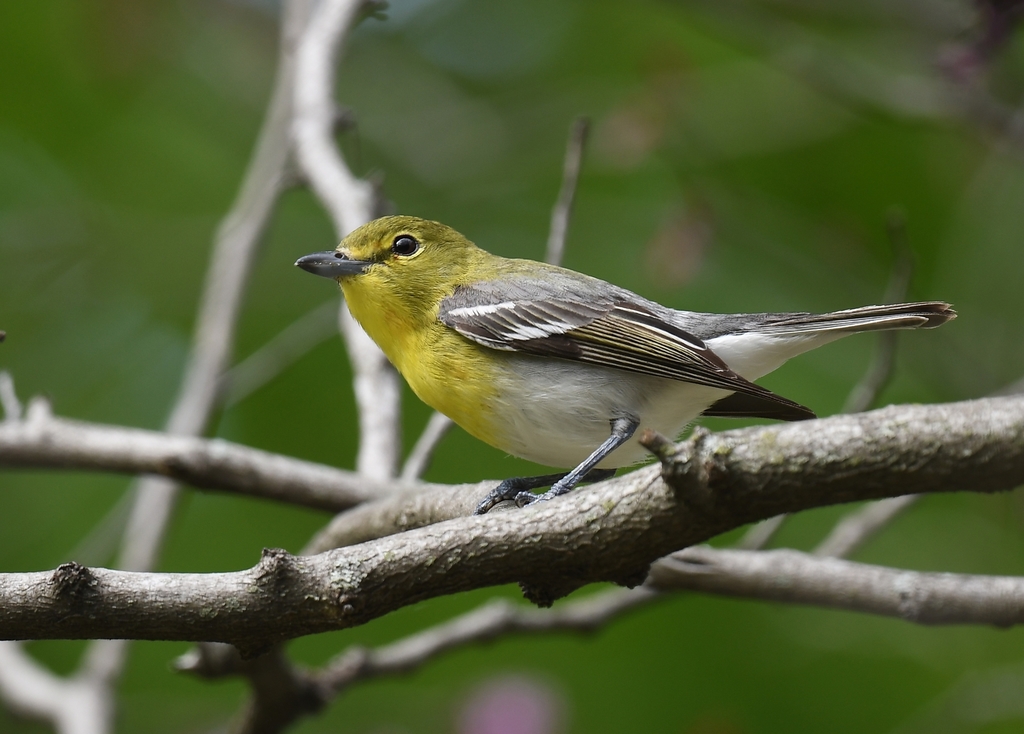
The Yellow-throated Vireo is a medium-sized songbird measuring 13 to 15 cm (5.1 to 5.9 inches) in length with a wingspan of 22 to 24 cm (8.7 to 9.4 inches). Adults weigh between 15 to 19 grams. The species exhibits distinct sexual dimorphism in plumage. Males display bright yellow throat, breast, and spectacles, contrasting with olive-green upperparts and white underparts with pale yellow flanks. Two prominent white wing bars cross the dark wings. The bill is thick and slightly hooked, typical of insectivorous birds. Females and juveniles show similar but duller coloration patterns. The Yellow-throated Vireo breeds across eastern North America from southeastern Canada south to the Gulf Coast states. In California, this species is considered a rare vagrant, with documented sightings primarily occurring during spring and fall migration periods in coastal areas and desert oases. Most California records come from Point Reyes, the Farallon Islands, and scattered locations in Southern California including the Salton Sea region. The species winters primarily in Central America and northern South America, from Mexico to Venezuela and Colombia. Breeding habitat consists of mature deciduous and mixed forests with open canopies, particularly favoring oak, maple, and elm woodlands. The species selects territories in forest edges, riparian corridors, and parklands with large trees. Nesting occurs in the outer branches of deciduous trees, typically 4 to 18 meters above ground. In California, vagrant individuals are most often detected in coastal scrub, riparian woodlands, and migrant traps with mature trees. Yellow-throated Vireos are primarily insectivorous, foraging deliberately through the canopy by gleaning insects, larvae, and spiders from leaves and bark surfaces. Their diet includes caterpillars, beetles, moths, flies, and aphids. During fall migration, they supplement their diet with small fruits and berries. The species constructs a distinctive pendant nest suspended from forked branches, woven from plant fibers, spider silk, and decorated with lichen. Females typically lay 3 to 4 white eggs marked with brown spots. Incubation lasts 14 days, with both parents feeding the nestlings for approximately 14 to 15 days until fledging. The Yellow-throated Vireo is not federally listed and maintains stable populations across most of its breeding range. According to the North American Breeding Bird Survey, populations have remained relatively stable since 1966, with some regional variations. The species faces threats from habitat loss due to forest fragmentation, agricultural conversion, and urban development. Nest parasitism by Brown-headed Cowbirds affects reproductive success in some areas. Climate change may impact the timing of insect emergence relative to breeding cycles. In California, the species remains a casual vagrant with no established breeding population, making it of interest primarily to birders and researchers studying avian vagrancy patterns along the Pacific Coast.
Classification
Class: Aves · Order: Passeriformes · Family: Vireonidae
Frequently asked questions
How is Vireo flavifrons classified?
Vireo flavifrons belongs to class Aves, order Passeriformes, family Vireonidae.
What family does Vireo flavifrons belong to?
Vireo flavifrons is in the Vireonidae family.
What is Vireo flavifrons?
The Yellow-throated Vireo is a medium-sized songbird measuring 13 to 15 cm (5.1 to 5.9 inches) in length with a wingspan of 22 to 24 cm (8.7 to 9.4 inches).
Is Vireo flavifrons found in California?
Yes. Vireo flavifrons is recorded in California in The California Species Project's catalogue.
Related species
Other California species in the same genus, family, or bioregion.
Data from The California Species Project — 14,000+ California species with verified data from CNPS, CDFW, USFWS, and more.