Vireo flavoviridis
Yellow-green Vireo
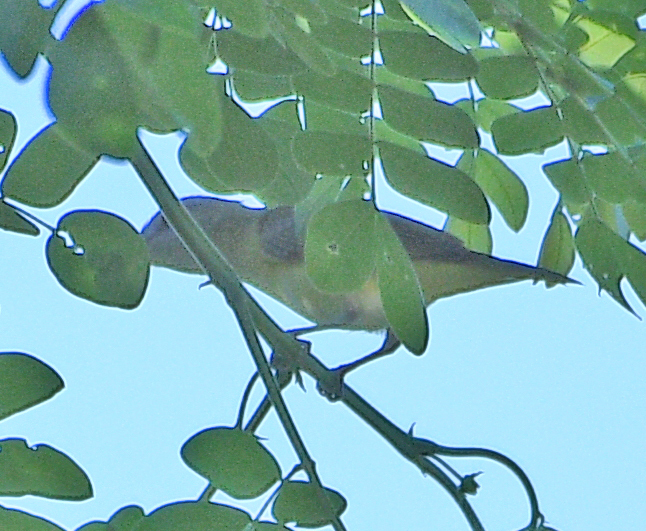
(c) Pål A. Olsvik, some rights reserved (CC BY) · licence
Family: Vireonidae · Class: Aves · Order: Passeriformes
Vireo flavoviridis (Yellow-green Vireo) is a California animal in the Vireonidae family.
The Yellow-green Vireo is a medium-sized songbird measuring 14 to 15 cm (5.5 to 5.9 inches) in length with a wingspan of approximately 24 cm (9.4 inches). Adults weigh between 16 to 20 grams. The species displays olive-green to yellowish-green upperparts with a gray crown and distinct white eyebrow stripe. The underparts are pale yellow, becoming whiter on the throat and belly. Wings show two prominent white wing bars, and the bill is relatively thick and slightly hooked at the tip, typical of vireos. The legs are blue-gray, and the eye is dark brown. The Yellow-green Vireo has an extensive range from southern Texas through Central America to northern South America, including Colombia, Venezuela, and northern Brazil. In California, this species is considered a vagrant, with extremely rare occurrences documented primarily along the coast during migration periods. Most California records consist of individual birds detected during fall migration, typically between September and November. Throughout its primary range, the Yellow-green Vireo inhabits a variety of forest types including tropical deciduous forests, gallery forests, forest edges, and woodland areas from sea level to approximately 2,000 meters (6,560 feet) elevation. The species shows preference for areas with dense canopy cover and abundant insect populations. In riparian zones, it frequently occurs in association with large trees such as cottonwoods and sycamores. Yellow-green Vireos are primarily insectivorous, foraging methodically through the forest canopy for caterpillars, beetles, flies, and other arthropods. They also consume small fruits and berries, particularly during winter months. The species employs a deliberate foraging strategy, carefully examining leaves and bark crevices while moving slowly through vegetation. Breeding occurs from April through July, with pairs constructing cup-shaped nests suspended from horizontal tree branches. Females typically lay 2 to 4 white eggs with brown spotting. The incubation period lasts 12 to 14 days, and nestlings fledge after 12 to 13 days. Populations of Yellow-green Vireo in Central and South America are considered stable, and the species is not currently listed under any federal or state conservation programs. The International Union for Conservation of Nature classifies the species as Least Concern. However, like many Neotropical migrants, Yellow-green Vireos face habitat loss pressures from deforestation and agricultural conversion throughout their range. Climate change may also affect migration timing and route selection. In California, the species remains an extremely rare vagrant with no established breeding populations. Conservation efforts focus primarily on maintaining habitat quality in core breeding and wintering areas rather than specific protections in California, where occurrence is incidental.
Classification
Class: Aves · Order: Passeriformes · Family: Vireonidae
Frequently asked questions
How is Vireo flavoviridis classified?
Vireo flavoviridis belongs to class Aves, order Passeriformes, family Vireonidae.
What family does Vireo flavoviridis belong to?
Vireo flavoviridis is in the Vireonidae family.
What is Vireo flavoviridis?
The Yellow-green Vireo is a medium-sized songbird measuring 14 to 15 cm (5.5 to 5.9 inches) in length with a wingspan of approximately 24 cm (9.4 inches).
Is Vireo flavoviridis found in California?
Yes. Vireo flavoviridis is recorded in California in The California Species Project's catalogue.
Related species
Other California species in the same genus, family, or bioregion.
Data from The California Species Project — 14,000+ California species with verified data from CNPS, CDFW, USFWS, and more.