Vireo gilvus
Warbling Vireo
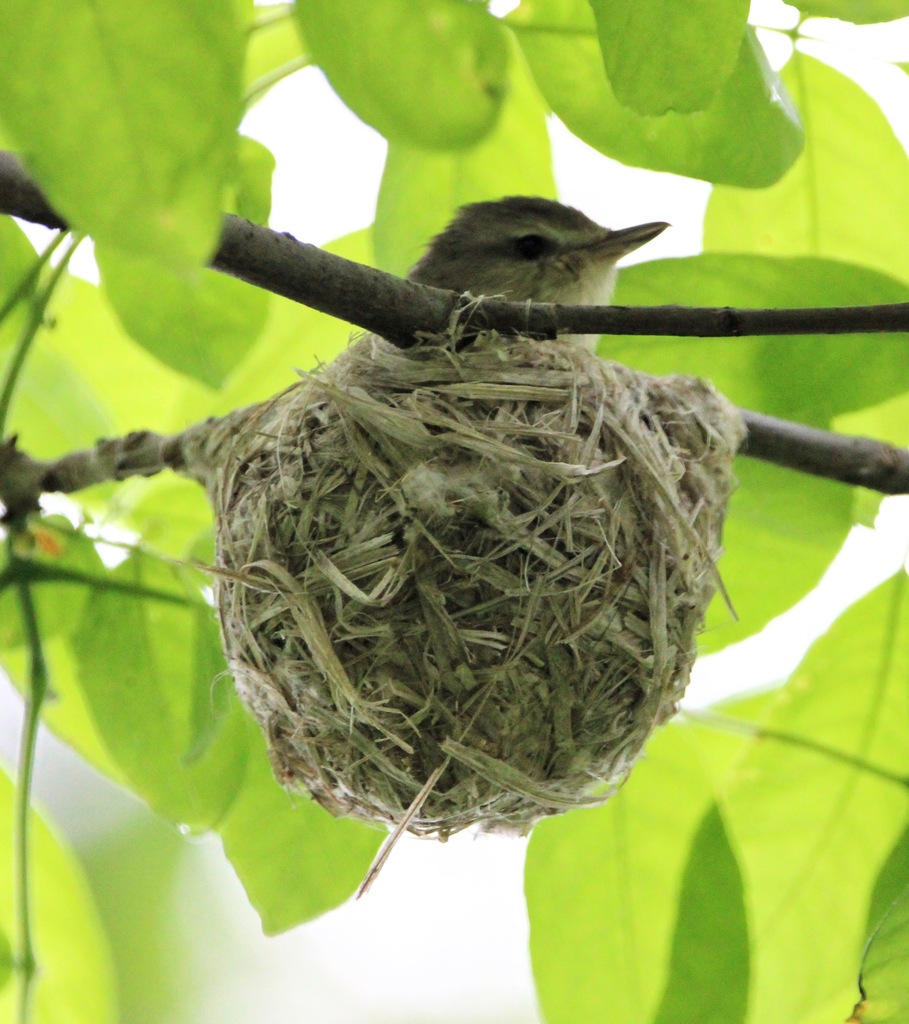
(c) Michael, Antoni and Nihat Hinczewski, some rights reserved (CC BY) · licence
Family: Vireonidae · Class: Aves · Order: Passeriformes
Vireo gilvus (Warbling Vireo) is a California animal in the Vireonidae family.
The Warbling Vireo is a small, plain songbird measuring 11.5 to 12.7 cm (4.5 to 5.0 inches) in length with a wingspan of 22 to 24 cm (8.7 to 9.4 inches). Adults weigh 10 to 13 grams. The species exhibits subtle plumage with grayish-olive to brownish-olive upperparts and whitish to pale yellow underparts. A prominent whitish eyebrow stripe contrasts with a dark line through the eye. The bill is relatively thick and slightly hooked at the tip, adapted for gleaning insects. Unlike many vireos, this species lacks distinct wing bars, presenting a relatively uniform appearance. The Warbling Vireo breeds across much of North America, from southern Canada to northern Mexico. In California, the species occurs throughout most of the state during breeding season, from sea level to approximately 2,400 meters (7,900 feet) elevation. Populations are found in the Central Valley, Coast Ranges, Sierra Nevada, and southern California mountains. The species is largely absent from desert regions and the immediate coast. California supports both the eastern subspecies (V. g. gilvus) and the western subspecies (V. g. swainsonii), with the latter being slightly grayer and larger. Warbling Vireos inhabit deciduous and mixed woodlands, particularly favoring riparian forests dominated by cottonwoods, willows, and alders. The species also occurs in oak woodlands, aspen groves, and urban parks with mature trees. In California, they are strongly associated with riparian corridors along streams and rivers, especially those with tall canopy trees. During migration, birds utilize a broader range of wooded habitats including suburban areas with large trees. This species is primarily insectivorous, gleaning caterpillars, beetles, flies, and other small arthropods from foliage and bark. During late summer and fall, Warbling Vireos supplement their diet with berries and small fruits. Males establish territories in April and May, defending areas of 0.4 to 1.2 hectares through persistent singing. The species constructs a distinctive hanging cup nest suspended from a horizontal fork in the outer branches of trees, typically 4.5 to 18 meters above ground. Females lay 3 to 5 white eggs spotted with brown, which are incubated for 12 to 14 days. Both parents feed the nestlings for 13 to 15 days until fledging. The Warbling Vireo is not federally or state-listed and maintains stable populations across most of its range. According to the North American Breeding Bird Survey, populations have remained relatively stable since 1966, with some regional fluctuations. The species benefits from habitat restoration efforts in riparian areas, particularly in California's Central Valley where much historic riparian forest has been lost. Primary conservation concerns include continued loss of riparian habitat, degradation of stream corridors, and potential impacts from climate change on breeding habitat availability. Urban development and agricultural conversion pose localized threats, though the species shows some adaptability to modified landscapes with adequate tree cover.
Classification
Class: Aves · Order: Passeriformes · Family: Vireonidae
Frequently asked questions
How is Vireo gilvus classified?
Vireo gilvus belongs to class Aves, order Passeriformes, family Vireonidae.
What family does Vireo gilvus belong to?
Vireo gilvus is in the Vireonidae family.
What is Vireo gilvus?
The Warbling Vireo is a small, plain songbird measuring 11.5 to 12.7 cm (4.5 to 5.0 inches) in length with a wingspan of 22 to 24 cm (8.7 to 9.4 inches).
Is Vireo gilvus found in California?
Yes. Vireo gilvus is recorded in California in The California Species Project's catalogue.
Related species
Other California species in the same genus, family, or bioregion.
Data from The California Species Project — 14,000+ California species with verified data from CNPS, CDFW, USFWS, and more.