Vireo griseus
White-eyed Vireo
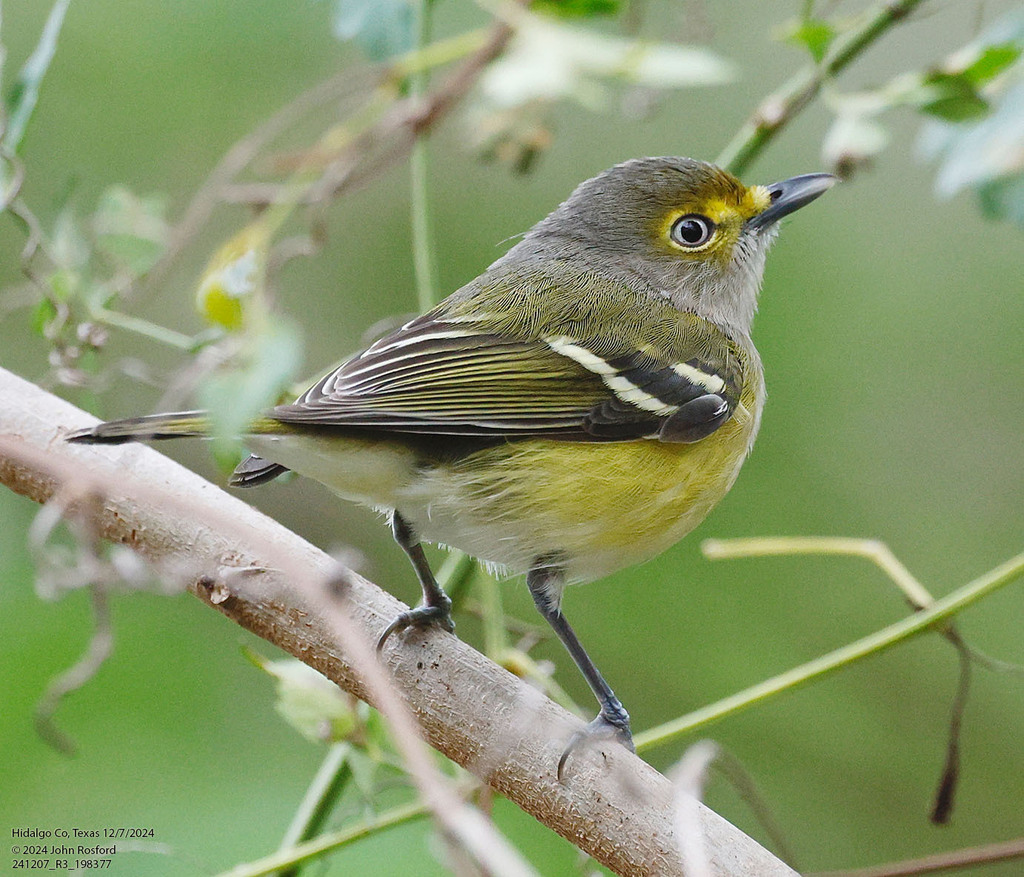
(c) John Rosford, some rights reserved (CC BY) · licence
Family: Vireonidae · Class: Aves · Order: Passeriformes
Vireo griseus (White-eyed Vireo) is a California animal in the Vireonidae family.
The White-eyed Vireo is a small passerine bird measuring 11 to 13 cm (4.3 to 5.1 inches) in length with a wingspan of 16 to 21 cm (6.3 to 8.3 inches). Adults weigh 8 to 15 grams. The species displays olive-green to grayish upperparts and white to pale yellow underparts. The most distinctive feature is the white iris in adults, which gives the species its common name. A prominent yellow patch extends from the bill to above the eye, bordered by dark lines. Two white wing bars are visible on each wing. Juveniles have brown or dark gray eyes that develop the characteristic white coloration during their first year. The White-eyed Vireo breeds across the eastern United States from southern New England west to southeastern Nebraska and south to Texas and Florida. The species also breeds in eastern Mexico and parts of Central America. In California, the White-eyed Vireo is considered a vagrant, with rare occurrences documented primarily during migration periods. Most California records come from coastal areas and desert oases, particularly in fall migration from September through November. The species winters primarily in the southeastern United States, Mexico, and Central America. Breeding habitat consists of dense shrublands, woodland edges, overgrown fields, and early successional forests with thick understory vegetation. The species shows a preference for areas with thorny shrubs, brambles, and vine tangles. During migration, White-eyed Vireos utilize riparian woodlands, parks, and desert oases. They typically forage at heights of 1 to 4 meters above ground in dense vegetation. White-eyed Vireos are primarily insectivorous, feeding on caterpillars, beetles, flies, ants, and other small arthropods gleaned from foliage and bark. During fall and winter, they supplement their diet with small fruits and berries. Males are known for their persistent, varied vocalizations, producing a distinctive song often transcribed as "quick-with-the-beer-check" or similar phrases. The breeding season extends from April through July, with peak activity in May and June. Females construct cup-shaped nests suspended from forked branches in dense shrubs or small trees, typically 1 to 3 meters above ground. Clutches contain 3 to 5 white eggs with sparse brown spotting. Incubation lasts 12 to 16 days, and nestlings fledge after 10 to 12 days. The White-eyed Vireo is not federally listed and maintains stable populations across most of its range. The species is classified as Least Concern by the International Union for Conservation of Nature. North American Breeding Bird Survey data indicate relatively stable long-term population trends, though some regional declines have been noted in portions of the breeding range. Primary threats include habitat loss due to agricultural conversion and urban development, particularly the removal of shrubland and early successional habitats. Brown-headed Cowbird parasitism can locally impact reproductive success. Climate change may affect the species through shifts in insect prey availability and suitable breeding habitat.
Classification
Class: Aves · Order: Passeriformes · Family: Vireonidae
Frequently asked questions
How is Vireo griseus classified?
Vireo griseus belongs to class Aves, order Passeriformes, family Vireonidae.
What family does Vireo griseus belong to?
Vireo griseus is in the Vireonidae family.
What is Vireo griseus?
The White-eyed Vireo is a small passerine bird measuring 11 to 13 cm (4.3 to 5.1 inches) in length with a wingspan of 16 to 21 cm (6.3 to 8.3 inches).
Is Vireo griseus found in California?
Yes. Vireo griseus is recorded in California in The California Species Project's catalogue.
Related species
Other California species in the same genus, family, or bioregion.
Data from The California Species Project — 14,000+ California species with verified data from CNPS, CDFW, USFWS, and more.