Vireo huttoni
Hutton's Vireo
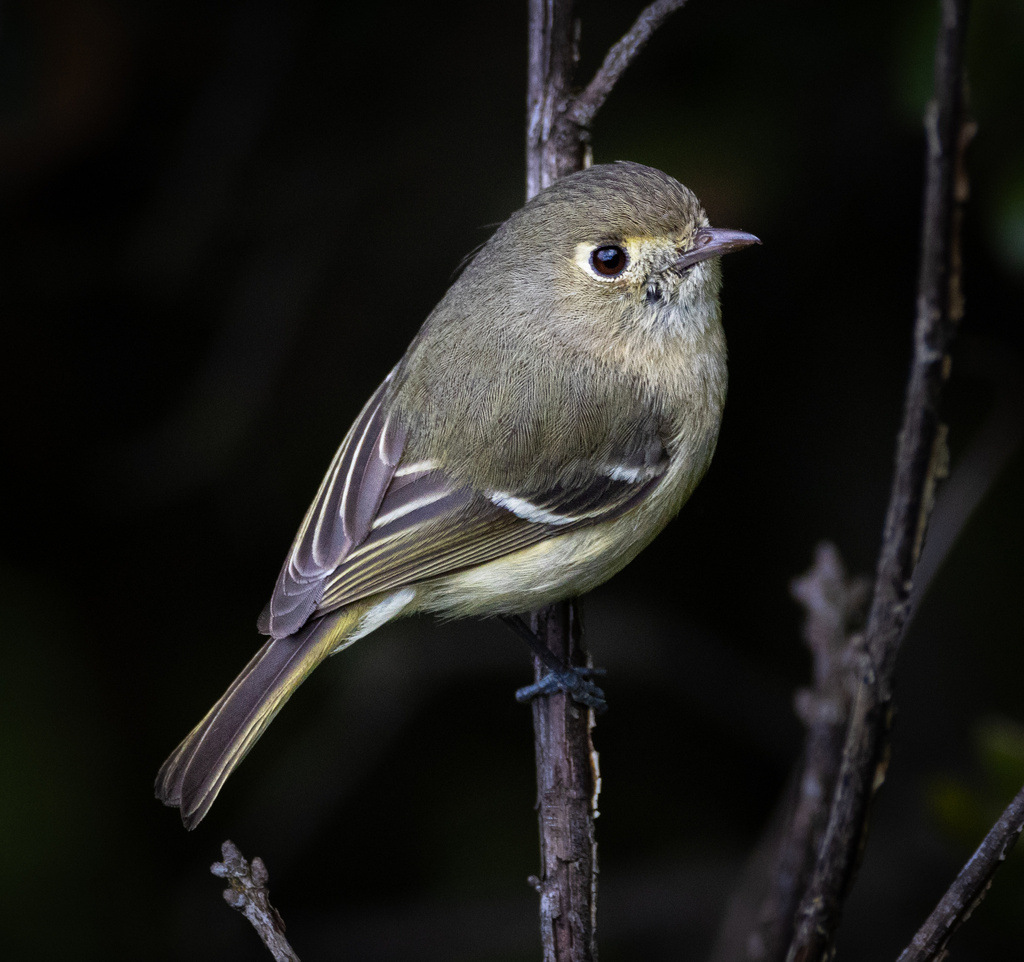
(c) Brooke J., some rights reserved (CC BY) · licence
Family: Vireonidae · Class: Aves · Order: Passeriformes
Vireo huttoni (Hutton's Vireo) is a California animal in the Vireonidae family.
Hutton's Vireo is a small, compact songbird measuring 11 to 12 cm (4.3 to 4.7 inches) in length with a wingspan of approximately 18 cm (7.1 inches). Adults weigh 8 to 12 grams. The species displays olive-gray to brownish-gray upperparts with paler underparts, typically whitish to pale yellow on the throat and belly. Two distinct white wing bars contrast with darker flight feathers, and a partial white eye-ring creates a distinctive broken spectacle appearance. The bill is short, slightly hooked, and dark gray to black, while the legs are bluish-gray. Males and females appear similar, though males may be slightly larger during breeding season. Hutton's Vireo occurs along the Pacific Coast from British Columbia south through California into Baja California, Mexico. In California, the species is resident throughout much of the state, from sea level to approximately 2,100 meters (6,900 feet) elevation. Populations are found in the Coast Ranges, Sierra Nevada foothills, and Transverse and Peninsular ranges. Northern populations may show some seasonal movement to lower elevations during winter months. The species inhabits oak woodlands, mixed evergreen forests, and riparian corridors dominated by live oaks, particularly coast live oak and interior live oak. Hutton's Vireo also occurs in oak-pine associations and mixed hardwood-conifer forests. The species shows strong preference for areas with dense canopy cover and understory vegetation. In urban and suburban areas, the bird adapts to mature landscaping with native oak trees and dense shrubland. Hutton's Vireo is primarily insectivorous, gleaning small arthropods from foliage, bark crevices, and clusters of dead leaves. The diet includes aphids, scale insects, caterpillars, beetles, and spiders, with some seasonal fruit consumption, particularly elderberries and poison oak berries. During breeding season from March through July, pairs construct cup-shaped nests suspended in tree forks 1 to 4 meters above ground. Females lay 3 to 5 white eggs speckled with brown, incubating them for 13 to 15 days. Both parents feed nestlings for approximately 14 days until fledging. The species typically raises one brood per year, occasionally two in favorable conditions. Hutton's Vireo maintains stable populations throughout most of its California range and is not federally or state-listed as threatened or endangered. According to North American Breeding Bird Survey data, populations have remained relatively stable over the past several decades, with some regional variations. The species benefits from oak woodland conservation efforts and restoration projects. Primary threats include habitat loss from urban development, oak woodland conversion, and climate change effects on oak forest distribution. Fire management practices that maintain oak canopy cover support population stability. The species' adaptability to modified habitats and association with common oak species contributes to its current conservation security in California.
Classification
Class: Aves · Order: Passeriformes · Family: Vireonidae
Frequently asked questions
How is Vireo huttoni classified?
Vireo huttoni belongs to class Aves, order Passeriformes, family Vireonidae.
What family does Vireo huttoni belong to?
Vireo huttoni is in the Vireonidae family.
What is Vireo huttoni?
Hutton's Vireo is a small, compact songbird measuring 11 to 12 cm (4.3 to 4.7 inches) in length with a wingspan of approximately 18 cm (7.1 inches).
Is Vireo huttoni found in California?
Yes. Vireo huttoni is recorded in California in The California Species Project's catalogue.
Related species
Other California species in the same genus, family, or bioregion.
Data from The California Species Project — 14,000+ California species with verified data from CNPS, CDFW, USFWS, and more.