Vireo huttoni unitti
Catalina Hutton's Vireo
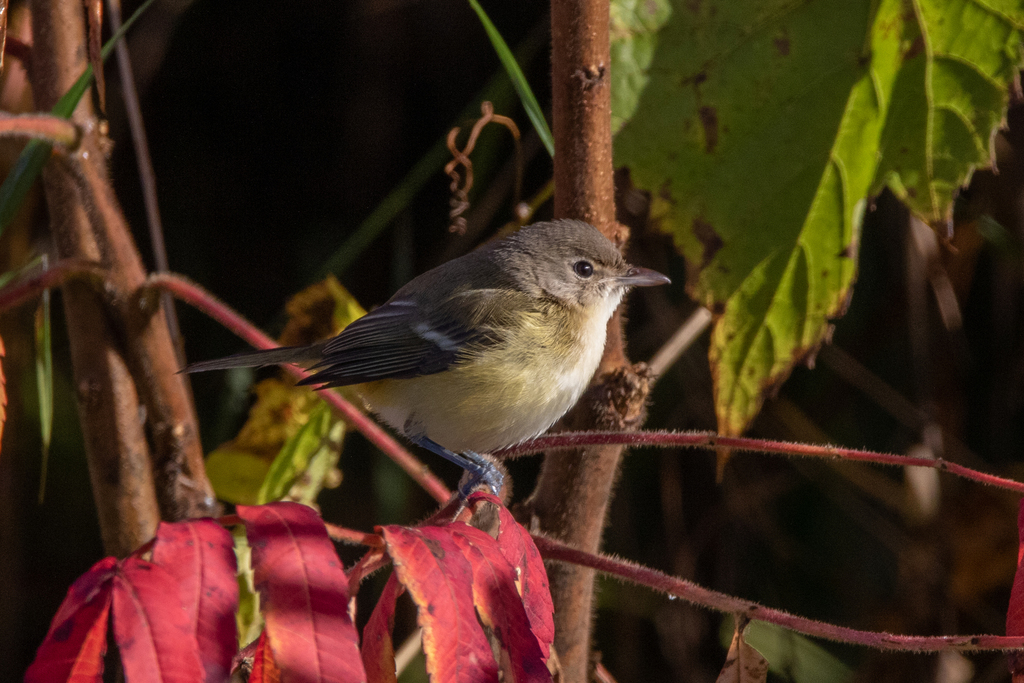
no rights reserved · CC0
Family: Vireonidae · Class: Aves · Order: Passeriformes
Conservation status: G5T2? S2
Vireo huttoni unitti (Catalina Hutton's Vireo) is a California animal in the Vireonidae family.
The Catalina Hutton's Vireo is a subspecies of Hutton's Vireo endemic to Santa Catalina Island off the coast of Southern California. This small passerine bird measures approximately 4.3 to 4.7 inches (11 to 12 cm) in length with a wingspan of 7 inches (18 cm). The subspecies displays typical vireo characteristics with olive-green to grayish upperparts, pale yellowish-white underparts, and distinctive white wing bars. A prominent white eye-ring and pale lores distinguish it from the similar Ruby-crowned Kinglet, though identification can be challenging due to their overlapping plumage patterns and behaviors. Historically, Hutton's Vireo occurred across a broad range from southwestern British Columbia to Guatemala, with eleven recognized subspecies. The Catalina subspecies (V. h. unitti) is restricted entirely to Santa Catalina Island, representing one of the most geographically limited populations within the species complex. Unlike mainland populations that inhabit mixed-evergreen forests from sea level to montane elevations, the Catalina Hutton's Vireo is confined to the island's limited habitat mosaic. On Santa Catalina Island, this subspecies primarily inhabits oak woodlands, chaparral, and mixed evergreen vegetation. The species shows a particular affinity for areas where live oaks predominate, consistent with mainland Hutton's Vireo habitat preferences. The island's Mediterranean climate and isolated geography have likely contributed to the evolutionary divergence of this population from mainland forms. Like other Hutton's Vireo populations, the Catalina subspecies is largely non-migratory and maintains year-round territories. During the breeding season, pairs construct cup-shaped nests suspended from horizontal branches, typically 4 to 30 feet above ground. The species feeds primarily on insects and spiders gleaned from foliage, occasionally supplementing its diet with small berries. Outside the breeding season, individuals often join mixed-species foraging flocks that may include Ruby-crowned Kinglets, providing mutual benefits for predator detection and foraging efficiency. The Catalina Hutton's Vireo is designated as a California Species of Special Concern by the California Department of Fish and Wildlife, reflecting conservation concerns about this island endemic population. The subspecies faces threats typical of island endemics, including habitat modification, introduced species impacts, and the inherent vulnerability associated with small, isolated populations. The Global/State Rank of G5T2? S2 indicates that while the species as a whole is secure globally, this particular subspecies is imperiled, with fewer than 20 occurrences and potential vulnerability to extirpation. The question mark in the ranking reflects some uncertainty about the exact conservation status, highlighting the need for continued monitoring and research. Conservation efforts focus on habitat protection and management on Santa Catalina Island, as the subspecies' entire global population depends on this single location. Climate change poses additional long-term concerns for this geographically restricted population, as sea level rise and altered precipitation patterns could affect the island's vegetation communities.
Classification
Class: Aves · Order: Passeriformes · Family: Vireonidae
Conservation status
G5T2? S2
Frequently asked questions
How is Vireo huttoni unitti classified?
Vireo huttoni unitti belongs to class Aves, order Passeriformes, family Vireonidae.
What family does Vireo huttoni unitti belong to?
Vireo huttoni unitti is in the Vireonidae family.
Is Vireo huttoni unitti protected or of conservation concern?
Vireo huttoni unitti carries the following status: G5T2? S2.
What is Vireo huttoni unitti?
The Catalina Hutton's Vireo is a subspecies of Hutton's Vireo endemic to Santa Catalina Island off the coast of Southern California.
Is Vireo huttoni unitti found in California?
Yes. Vireo huttoni unitti is recorded in California in The California Species Project's catalogue.
Related species
Other California species in the same genus, family, or bioregion.
Data from The California Species Project — 14,000+ California species with verified data from CNPS, CDFW, USFWS, and more.