Vireo olivaceus
Red-eyed Vireo
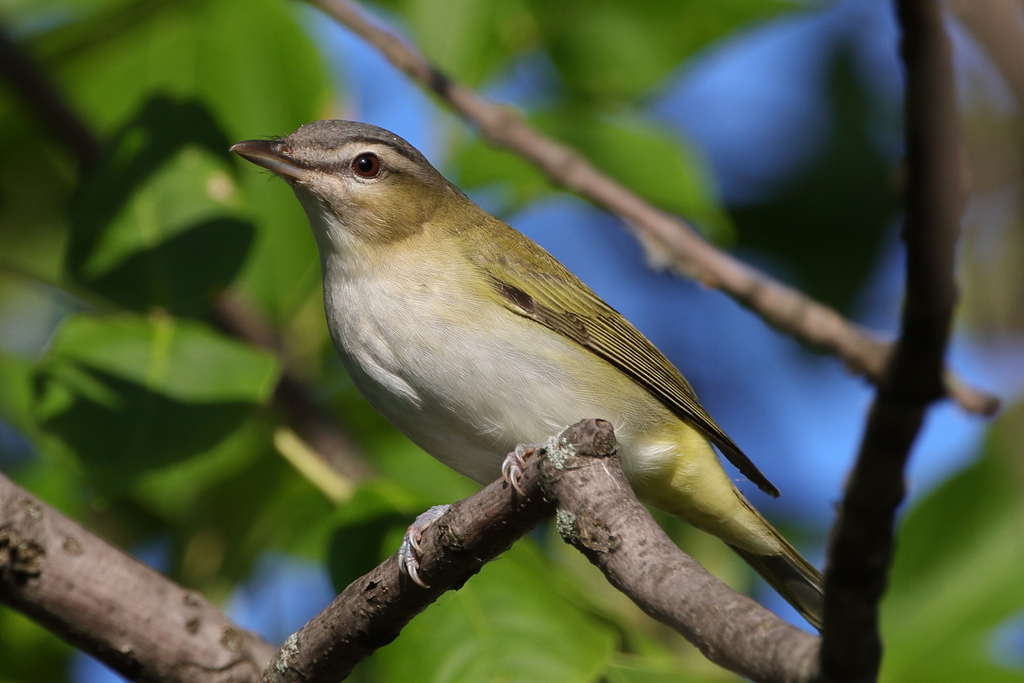
no rights reserved · CC0
Family: Vireonidae · Class: Aves · Order: Passeriformes
Vireo olivaceus (Red-eyed Vireo) is a California animal in the Vireonidae family.
The Red-eyed Vireo is a medium-sized songbird measuring 12-16 cm (4.7-6.3 inches) in length with a wingspan of 23-27 cm (9-10.5 inches). Adults weigh 12-26 grams. The species exhibits a distinctive appearance with olive-green upperparts and white underparts. A prominent white eyebrow stripe (supercilium) extends above a dark eye line, creating a striped facial pattern. The iris is typically red in adults, giving the species its common name, though juveniles may have brown eyes. The bill is straight and slightly hooked at the tip, adapted for gleaning insects from foliage. The Red-eyed Vireo breeds across most of temperate North America, from southeastern Canada south to the Gulf Coast states. In California, the species occurs primarily as a migrant and occasional breeder in the northern counties, including the Sierra Nevada foothills and Cascade Range. Historical breeding records exist from Shasta, Lassen, and Plumas counties, though current breeding status in the state remains limited. The species migrates to Central and South America for winter, traveling primarily through the Gulf Coast and across the Gulf of Mexico. Breeding habitat consists of mature deciduous and mixed forests with a well-developed canopy. The species prefers areas with oak, maple, aspen, and other broadleaf trees, typically at elevations below 2,000 meters (6,500 feet). Red-eyed Vireos forage primarily in the forest canopy, requiring dense foliage for nesting and insect foraging. During migration, they utilize a variety of wooded habitats including riparian corridors, parks, and residential areas with mature trees. Red-eyed Vireos are primarily insectivorous, feeding on caterpillars, aphids, beetles, moths, and other small arthropods gleaned from leaves and bark. They supplement their diet with small fruits during late summer and migration. The species is known for its persistent singing behavior, with males capable of delivering over 20,000 songs per day during breeding season. Nesting occurs from May through August, with females constructing a cup-shaped nest suspended from a horizontal fork in tree branches, typically 1-18 meters (3-60 feet) above ground. Clutch size ranges from 3-5 white eggs with brown spotting. Incubation lasts 11-14 days, and nestlings fledge after 10-12 days. The Red-eyed Vireo is not federally or state listed and maintains stable populations across much of its range. According to the North American Breeding Bird Survey, populations have remained relatively stable over the past several decades, though some regional declines have been noted in certain areas due to forest fragmentation and habitat loss. The species benefits from forest management practices that maintain mature canopy cover. Climate change may affect migration timing and breeding range boundaries, but current conservation status remains secure. In California, the species' limited breeding range and small population size warrant continued monitoring, though no specific conservation measures are currently implemented.
Classification
Class: Aves · Order: Passeriformes · Family: Vireonidae
Frequently asked questions
How is Vireo olivaceus classified?
Vireo olivaceus belongs to class Aves, order Passeriformes, family Vireonidae.
What family does Vireo olivaceus belong to?
Vireo olivaceus is in the Vireonidae family.
What is Vireo olivaceus?
The Red-eyed Vireo is a medium-sized songbird measuring 12-16 cm (4.7-6.3 inches) in length with a wingspan of 23-27 cm (9-10.5 inches).
Is Vireo olivaceus found in California?
Yes. Vireo olivaceus is recorded in California in The California Species Project's catalogue.
Related species
Other California species in the same genus, family, or bioregion.
Data from The California Species Project — 14,000+ California species with verified data from CNPS, CDFW, USFWS, and more.