Vireo philadelphicus
Philadelphia Vireo
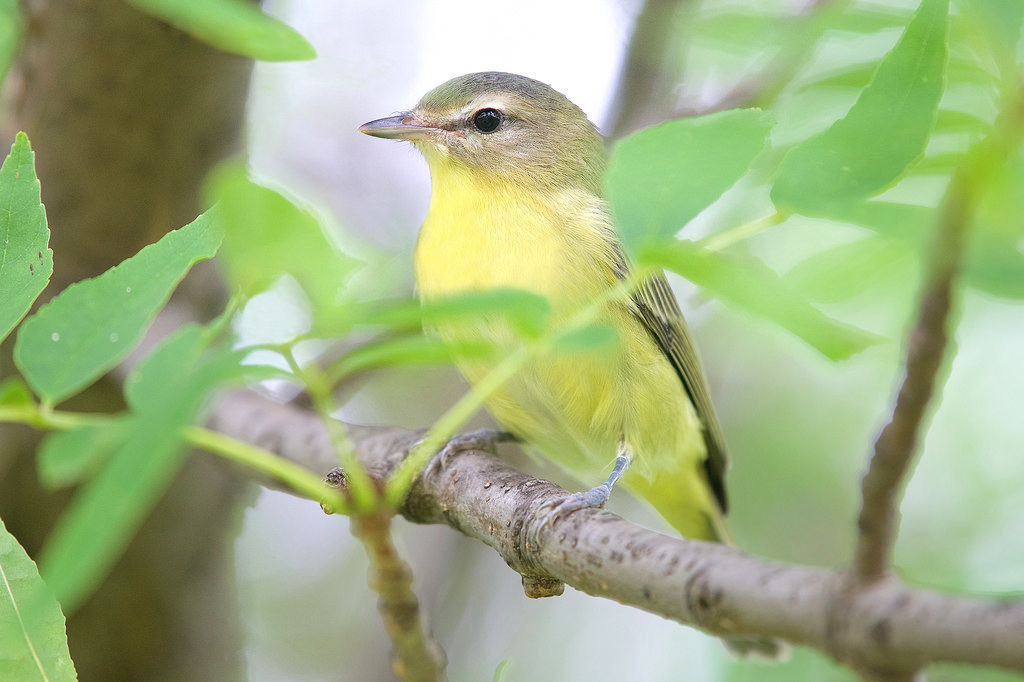
(c) Owen Strickland, some rights reserved (CC BY) · licence
Family: Vireonidae · Class: Aves · Order: Passeriformes
Vireo philadelphicus (Philadelphia Vireo) is a California animal in the Vireonidae family.
The Philadelphia Vireo is a small songbird measuring 11.5 to 13 cm (4.5 to 5.1 inches) in length with a wingspan of 20 to 22 cm (7.9 to 8.7 inches). Adults weigh 8 to 15 grams. The species displays subtle but distinctive plumage characteristics, with olive-green upperparts and pale yellow underparts that are brightest on the throat and breast. A prominent white eyebrow stripe contrasts with a dark line through the eye, while the crown appears slightly grayer than the back. The bill is relatively thick for a vireo, with a dark upper mandible and pale lower mandible. Philadelphia Vireos breed primarily in the boreal forests of Canada and the northern United States, with their range extending from British Columbia east to the Maritime Provinces and south into northern Minnesota, Wisconsin, Michigan, and northern New England. In California, the species occurs as an uncommon to rare migrant and vagrant, typically observed during fall migration from late August through October. Spring records are considerably rarer, occurring primarily in May. The species has been documented throughout California but appears most frequently along the coast and in montane areas during migration. During the breeding season, Philadelphia Vireos inhabit deciduous and mixed forests, particularly areas dominated by aspen, birch, and maple. They prefer forest edges, clearings, and second-growth woodlands with dense understory vegetation. In California, migrants are most often detected in riparian woodlands, oak groves, and mixed coniferous forests, typically at elevations from sea level to 2,400 meters (7,900 feet). Philadelphia Vireos are primarily insectivorous, gleaning caterpillars, aphids, moths, beetles, and other small arthropods from foliage. They supplement their diet with small fruits during migration and winter, particularly elderberries, sumac, and dogwood berries. The species builds a hanging cup-shaped nest suspended from a forked branch, typically 1.5 to 18 meters above ground. Females lay 3 to 5 white eggs marked with brown spots, which are incubated for 12 to 14 days. Breeding occurs from late May through July, with most pairs producing a single brood annually. The Philadelphia Vireo is not federally or state listed and is considered secure throughout most of its range. According to the North American Breeding Bird Survey, populations have remained relatively stable since the 1960s, though some regional declines have been noted. Partners in Flight estimates the global breeding population at approximately 10 million individuals. Primary threats include habitat loss from logging and forest fragmentation in breeding areas, as well as collisions with communication towers and buildings during migration. Climate change may affect the species through shifts in forest composition and timing of insect emergence. The species benefits from forest management practices that maintain structural diversity and edge habitats in boreal forests.
Classification
Class: Aves · Order: Passeriformes · Family: Vireonidae
Frequently asked questions
How is Vireo philadelphicus classified?
Vireo philadelphicus belongs to class Aves, order Passeriformes, family Vireonidae.
What family does Vireo philadelphicus belong to?
Vireo philadelphicus is in the Vireonidae family.
What is Vireo philadelphicus?
The Philadelphia Vireo is a small songbird measuring 11.5 to 13 cm (4.5 to 5.1 inches) in length with a wingspan of 20 to 22 cm (7.9 to 8.7 inches).
Is Vireo philadelphicus found in California?
Yes. Vireo philadelphicus is recorded in California in The California Species Project's catalogue.
Related species
Other California species in the same genus, family, or bioregion.
Data from The California Species Project — 14,000+ California species with verified data from CNPS, CDFW, USFWS, and more.