Vireo solitarius
Blue-headed Vireo
no rights reserved · CC0
Family: Vireonidae · Class: Aves · Order: Passeriformes
Vireo solitarius (Blue-headed Vireo) is a California animal in the Vireonidae family.
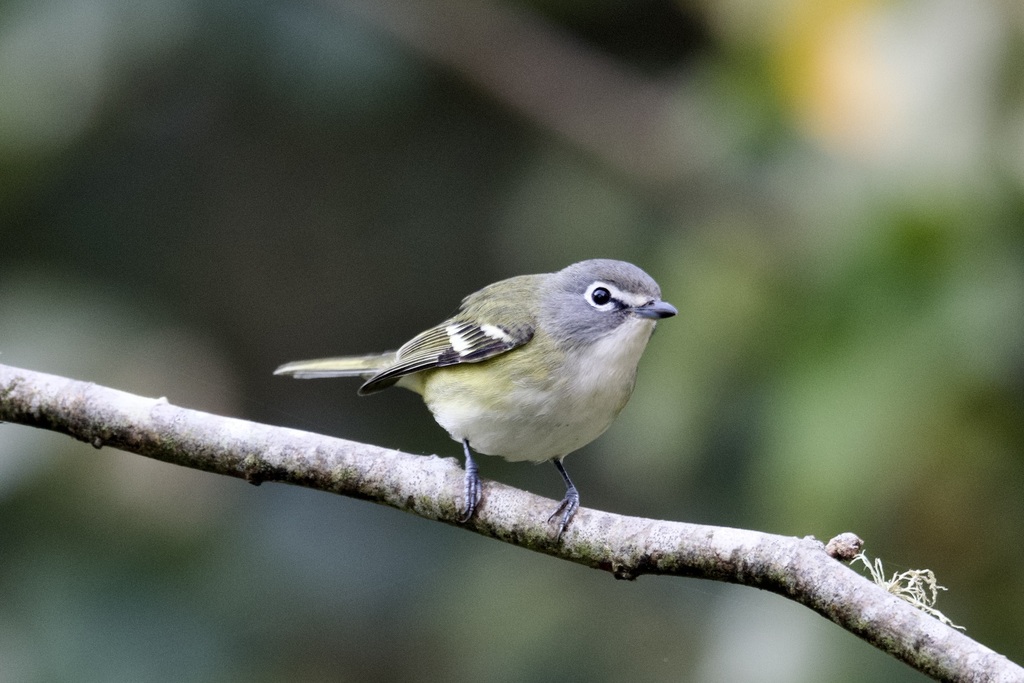
The Blue-headed Vireo is a medium-sized songbird measuring 12-14 cm (4.7-5.5 inches) in length with a wingspan of 20-24 cm (7.9-9.4 inches) and weighing 13-19 grams. The species displays distinct plumage characteristics with a blue-gray head contrasting sharply with white underparts. A prominent white eye-ring and white wing bars distinguish this species from other vireos. The back and wings are olive-green to grayish-green, while the throat and belly remain bright white. Males and females appear similar, though males may show slightly more vibrant coloration during breeding season. The Blue-headed Vireo breeds across the boreal and montane forests of North America, from southeastern Alaska and central Canada south through the western United States to central California. In California, breeding populations occur primarily in the Sierra Nevada mountains and the Cascade Range, with scattered populations in the Coast Ranges and higher elevations of southern California mountains. The species is migratory, wintering from the southeastern United States south through Mexico and Central America to northern Nicaragua. This vireo inhabits mature coniferous and mixed coniferous-deciduous forests, typically at elevations ranging from 1,200 to 3,000 meters (4,000 to 10,000 feet) in California. The species shows preference for forests with dense canopy cover and understory development, particularly those dominated by fir, pine, and spruce species. During migration, Blue-headed Vireos utilize a broader range of habitats including deciduous woodlands and forest edges. Blue-headed Vireos are primarily insectivorous, feeding on caterpillars, beetles, flies, aphids, and other small arthropods gleaned from foliage and bark surfaces. During migration and winter, they supplement their diet with small fruits and berries. The species employs a deliberate foraging strategy, moving slowly through the forest canopy while carefully examining leaves and branches. Breeding occurs from May through July, with females constructing cup-shaped nests suspended from horizontal branches 1-4 meters above ground. Clutch size typically ranges from 3-5 eggs, with an incubation period of 13-14 days. Both parents participate in feeding nestlings, which fledge after 13-15 days. The Blue-headed Vireo is not federally or state-listed and maintains stable populations across most of its range. According to the North American Breeding Bird Survey, continental populations have remained relatively stable over the past several decades, though some regional declines have been documented. Climate change poses potential long-term threats through shifts in suitable habitat distribution and alterations to insect prey availability. Forest management practices that maintain mature forest structure and canopy complexity benefit this species. The species' dependence on old-growth and mature forest characteristics makes it vulnerable to intensive logging and forest fragmentation, though current populations appear secure across most of the range.
Classification
Class: Aves · Order: Passeriformes · Family: Vireonidae
Frequently asked questions
How is Vireo solitarius classified?
Vireo solitarius belongs to class Aves, order Passeriformes, family Vireonidae.
What family does Vireo solitarius belong to?
Vireo solitarius is in the Vireonidae family.
What is Vireo solitarius?
The Blue-headed Vireo is a medium-sized songbird measuring 12-14 cm (4.7-5.5 inches) in length with a wingspan of 20-24 cm (7.9-9.4 inches) and weighing 13-19 grams.
Is Vireo solitarius found in California?
Yes. Vireo solitarius is recorded in California in The California Species Project's catalogue.
Related species
Other California species in the same genus, family, or bioregion.
Data from The California Species Project — 14,000+ California species with verified data from CNPS, CDFW, USFWS, and more.